 The Good Sign Company
Event-graphic transport comparison
Flat Sign Carry Sleeve vs Poster Storage Tube for Event Graphics
The graphic decides the carrier. Use a flat sleeve when a rigid board or a print that must remain flat fits the sleeve’s usable interior. Consider a poster tube only when the graphic maker permits rolled storage and the relaxed roll fits the tube. Measure the finished graphic and the full travel route before shopping for either.
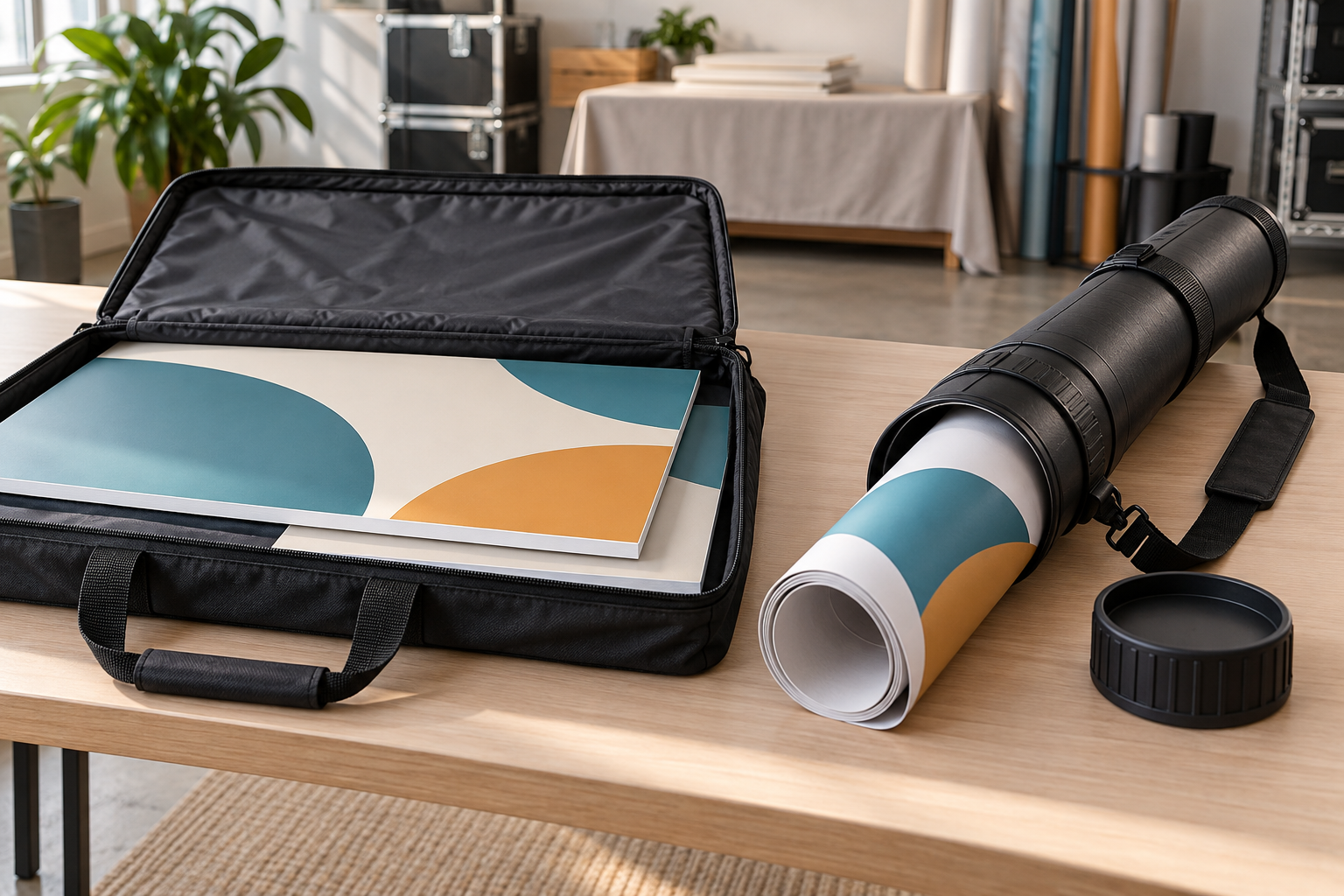
Compare the two carrier routes
Check usable internal dimensions, opening, closure, carry method, and the graphic maker’s storage instructions before buying.
The short decision
| Decision factor | Flat carry sleeve | Poster storage tube |
|---|---|---|
| Who it fits | Teams carrying rigid boards or graphics that must stay flat | Teams carrying flexible graphics approved for rolling |
| Fit measurement | Usable interior width, height, depth, and opening | Usable tube length and the relaxed roll diameter |
| Packing shape | Broad, flat footprint | Long, narrow cylinder |
| Setup work | Remove, inspect, and place the board | Unroll, allow the material to relax as directed, and install |
| Wrong choice when | The board exceeds the opening or packed depth | The graphic must not be rolled or the roll is too tight |
Start with the graphic, not the luggage
Write down the substrate or product name for every graphic in the kit. A rigid foam board, acrylic panel, mounted print, or framed sign needs a flat route unless its maker says otherwise. A flexible banner or compatible unmounted print may accept rolled storage, but that does not make every roll diameter appropriate.
If the material guidance is missing, keep the graphic in its existing approved storage form until the printer or manufacturer clarifies it. Do not force a rigid or crease-sensitive graphic into a tube simply because the tube takes less floor space.
Measure the packed object
For a sleeve, measure the board’s finished width, height, thickness, and any projecting hardware. Add the combined depth when several boards travel together, then compare those figures with the sleeve’s documented usable interior and opening—not just its exterior dimensions.
For a tube, first roll the approved graphic to the relaxed diameter allowed by its guidance. Measure that diameter and the roll’s full length, including any protective interleaf or end clearance. Compare both measurements with the tube’s usable interior. An adjustable tube still needs enough overlap and a secure closure in the selected position.
Compare transport and event setup
A flat sleeve spreads its footprint across a vehicle, cart, or storeroom wall. Check whether it can lie or stand in the planned orientation without other cases pressing on the sign faces. Handles may simplify a short carry, but stairs, narrow doors, and crowded loading paths still make a wide case awkward.
A tube is easier to place in some narrow vehicle or storage spaces, yet it adds an unrolling step. The team needs a clean area and enough setup time to let the graphic relax according to its instructions before it enters the stand or frame. Label either carrier with the event, destination, graphic count, and return location so the correct piece reaches the correct setup zone.
Choose a flat sign carry sleeve when
- The graphic is rigid, mounted, framed, or otherwise required to remain flat.
- Every board fits the documented interior, opening, and packed-depth limits.
- The vehicle and storeroom have a protected flat footprint for the complete sleeve.
- The setup team benefits from removing a board that is already in display-ready form.
Use the carry-sleeve ownership guide to decide whether repeat trips justify a dedicated carrier, then compare flat sign carry-sleeve categories by measured fit and handling.
Choose a poster storage tube when
- The printer or manufacturer permits the specific graphic to be stored rolled.
- The relaxed roll diameter and full length fit the tube’s usable interior.
- The team can manage the unrolling and installation sequence at the venue.
- A long cylindrical package works better than a broad flat case in transport and storage.
First decide whether recurring rolled-graphic trips justify a poster tube, then compare poster storage tubes by usable length, diameter, closure, and carry method.
Maintenance and ownership
After each event, empty the carrier and follow its maker’s cleaning and drying directions before repacking. Inspect seams, zipper paths, handles, caps, adjustment collars, and straps for visible problems. Keep dirt and loose hardware away from printed faces, and separate graphics when their documented care instructions require it.
Assign one role to count the graphics, match labels, record damage, and return each item to its designated storage position. The routine matters more than buying a carrier with unused pockets or features.
Skip both when
- The graphic’s storage guidance is unknown or conflicts with both routes.
- The finished piece includes hardware or a frame that needs a fitted rigid case or crate.
- Several mixed-format pieces and display parts need separated compartments in one kit; compare portable vendor sign cases instead.
- The trip exposes the package to handling conditions beyond the carrier’s documented purpose.
- The display is single-use and local printing near the venue produces a simpler approved workflow.
A practical packing worksheet
- List each graphic’s material, construction, finished size, hardware, and approved storage orientation.
- Mark each item “must stay flat” or “rolling permitted,” with the source of that instruction.
- Measure the sleeve interior and opening, or the tube’s usable length and diameter.
- Map the package through the vehicle, doors, stairs, cart, booth, and return storeroom.
- Write the setup and repacking order, including who checks the graphic before storage.
- Test the complete packed carrier on one ordinary trip before standardizing it for the team.
For the wider booth kit, return to small-business sign planning and document the message, sightline, fixture, transport owner, and storage handoff together.