 The Good Sign Company
Worth-it decision
Is a poster storage tube worth it for rolled booth graphics?
A poster storage tube is usually worth it when the graphic producer confirms the media may be rolled, the same graphics travel repeatedly, and a measured tube makes carrying and storage more consistent. Skip it for rigid boards, graphics that must stay flat, or disposable prints. Delay the purchase until the relaxed roll and usable tube interior are measured.
A tube organizes compatible rolled media; it does not automatically provide waterproof, crushproof, impact, or archival protection. Match the container to the exact graphic and handling route instead of treating every booth print as rollable.
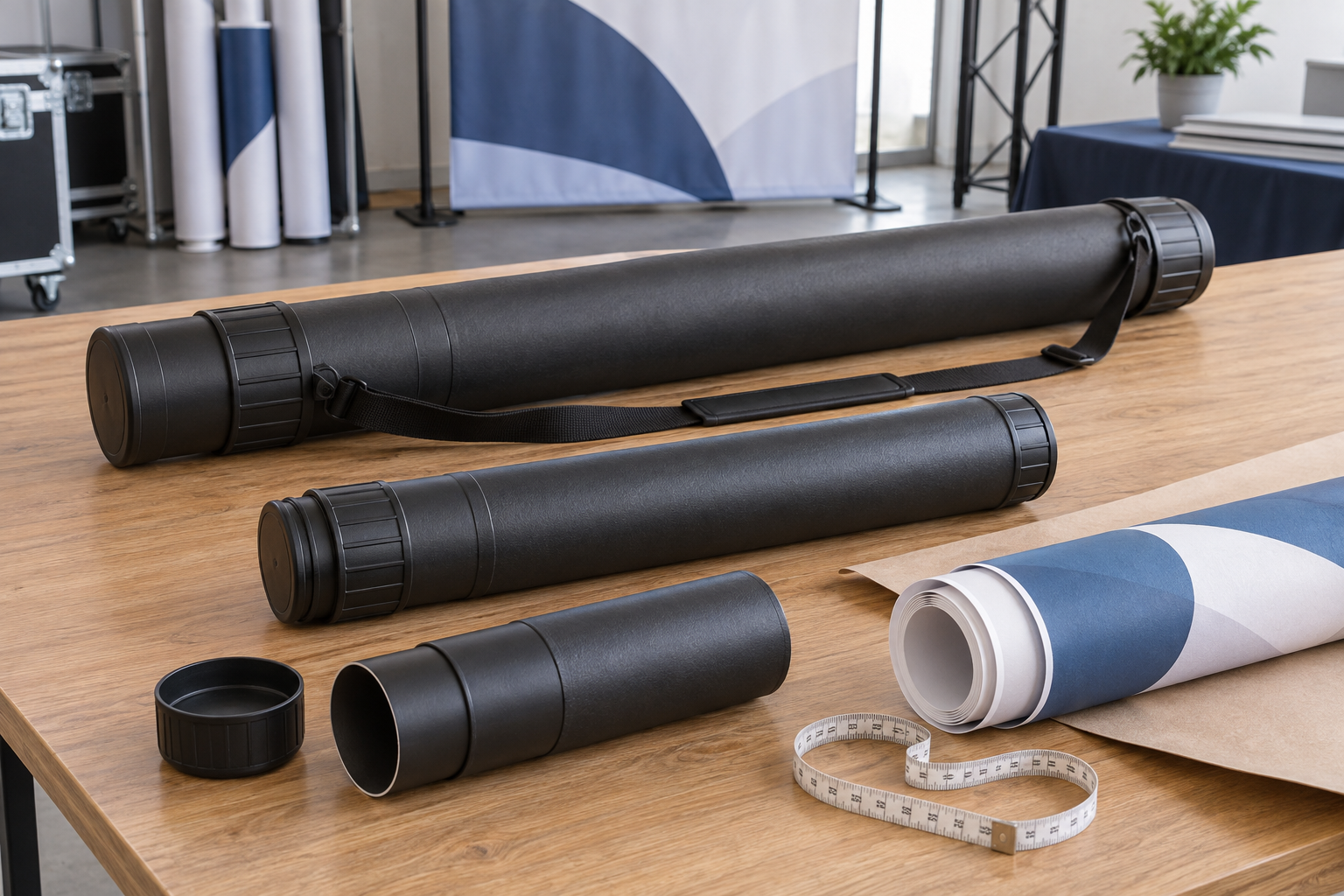
Evaluate the format after the roll passes the fit test
Confirm that the graphic may be rolled, then compare its relaxed roll length and diameter with the exact product's usable interior, opening, closure, carry method, and maker instructions.
Quick verdict: buy, skip, delay, or choose another carrier
- Buy: the same roll-compatible graphics travel often, their relaxed dimensions are known, and a fitted tube improves a repeatable load-in and storage workflow.
- Skip: the graphics are single-use, inexpensive to reprint, already travel safely in a supplied container, or must remain flat.
- Delay: the print provider's rolling guidance, roll direction, interior measurements, closure, or vehicle storage position is unknown.
- Choose an alternative: use a flat sleeve for rigid boards, a fitted case for mixed display parts, or the original packaging when its instructions support repeated use.
- Escalate: ask the printer or graphic producer when the media construction, laminate, mounted edges, or permitted roll direction is unclear.
First decide whether the graphic may be rolled
Inventory each item in the booth kit by material, finished width, and construction. A loose poster, fabric graphic, laminated print, mounted panel, and retractable-banner insert do not share one storage rule. Use the printer's or maker's current guidance for that specific graphic, including any required roll direction or minimum roll diameter.
Do not test an uncertain graphic by forcing it into a tight roll. If the guidance is missing, keep it flat and ask the producer. A tube cannot correct creases, edge damage, surface changes, or stress caused by an unsuitable rolling method.
Count actual trips before buying dedicated storage
Review the last event season and the next confirmed schedule. Count how often the same graphics leave storage, enter a vehicle, cross a venue, return, and get unpacked. A one-time print may not justify another container. A repeat graphic used across a predictable run of indoor events has a clearer case for a labeled, fitted carrier.
Include the person doing the work. Note who packs the graphics, who carries them, whether they travel with other booth parts, and where the empty tube sits during the event. A product that has no assigned storage position can become another loose item in an already crowded booth.
Measure the relaxed roll and usable interior
- Follow the producer's permitted roll direction without tightening the graphic to make it fit.
- Measure the relaxed roll from end to end, including any hems, rails, or permitted edge hardware.
- Measure the widest diameter of that relaxed roll.
- Check the candidate tube's usable interior length and diameter, opening size, cap intrusion, and telescoping overlap where applicable.
- Leave practical clearance for loading and removal; do not treat equal measurements as proof of fit.
Exterior dimensions and a nominal poster size do not establish usable capacity. If several graphics share one tube, measure the complete bundle in its approved rolled arrangement and check whether separators or individual wraps are called for by the makers.
Compare the full carrying and storage route
| Workflow question | A dedicated tube favors | Another route favors |
|---|---|---|
| Graphic format | Loose media explicitly approved for rolled storage | Rigid, mounted, fold-only, or must-stay-flat graphics |
| Trip frequency | The same graphics travel repeatedly | One-time or rarely reused prints |
| Load shape | One measured roll or a compatible rolled set | Mixed panels, stands, hardware, and supplies |
| Handling | A labeled tube has a defined vehicle and venue route | A flat sleeve or fitted case matches the route better |
| Storage | The closed tube has an assigned supported location | The existing original package already fits the storage plan |
| Replacement value | Repeat-use graphics warrant a dedicated workflow | Low-value disposable prints are simpler to replace |
Cost, setup, and maintenance tradeoffs
The cost is more than the tube. Count labels, any product-specific separators, staff time to roll and unload correctly, space in the vehicle, and indoor storage between events. A telescoping model may serve several lengths, but its adjustment and closure add steps that must be checked each trip. A fixed-length tube is simpler only when the graphic size is stable.
Keep the container clean according to its maker's instructions and inspect the opening, cap, strap, handle, and adjustment points before travel. Keep the graphics' care guidance with the event checklist. If the workflow regularly mixes rigid boards with rolled media, compare portable sign cases for vendor booth graphics instead of expecting one tube to carry the whole kit.
Red flags and who should skip
- No one can confirm that the graphic is suitable for rolled storage.
- The purchase depends on forcing a tighter roll than the producer recommends.
- The listing gives only exterior or nominal dimensions, not a usable interior that can be checked.
- Rails, hems, mounted edges, or other hardware obstruct the opening or closure.
- The team expects a basic tube to prove waterproof, crushproof, impact, or archival protection.
- The graphics travel once, change every event, or cost less to reprint than to maintain a dedicated carrier.
- The vehicle, venue, or storeroom has no supported place for the closed tube.
Run a no-purchase transport trial
- Confirm roll compatibility and prepare the graphic exactly as instructed.
- Record the relaxed length and diameter, then make a lightweight cardboard mockup of the candidate tube's exterior dimensions.
- Move the mockup through storage, vehicle loading, venue entry, booth setup, pack-down, and return storage.
- Note clearance problems, unattended-storage problems, and whether a flat or mixed-format carrier would reduce steps.
- Buy only when the fitted tube solves a repeated handling problem without creating a new storage problem.
Bottom line
A poster storage tube is worth considering for reusable booth graphics that are explicitly roll-compatible, measured in their relaxed roll, and transported often enough to benefit from a dedicated routine. It is a poor default for unknown media, rigid boards, mixed booth hardware, or one-off prints. Verify the graphic first, the usable interior second, and the complete route third.
Continue with the small-business sign planning pillar, use the poster storage tube category guide after the buy decision is clear, or compare portable cases for mixed booth graphics.