 The Good Sign Company
Rolled booth graphic storage guide
How to Choose poster storage tubes for rolled booth graphics
The best poster tube fits the graphic's permitted roll direction, relaxed roll diameter, and full width without forcing it. Confirm that the graphic producer allows rolled storage first. Then compare the tube's usable interior—not just its exterior label—with the measured roll, closure, carry method, and storage space.
This category guide is for recurring indoor vendors and event teams transporting compatible loose graphics. It does not assume every banner, laminated print, mounted panel, or retractable display may be rolled, and it does not rank named products or promise waterproof, crushproof, or archival protection.
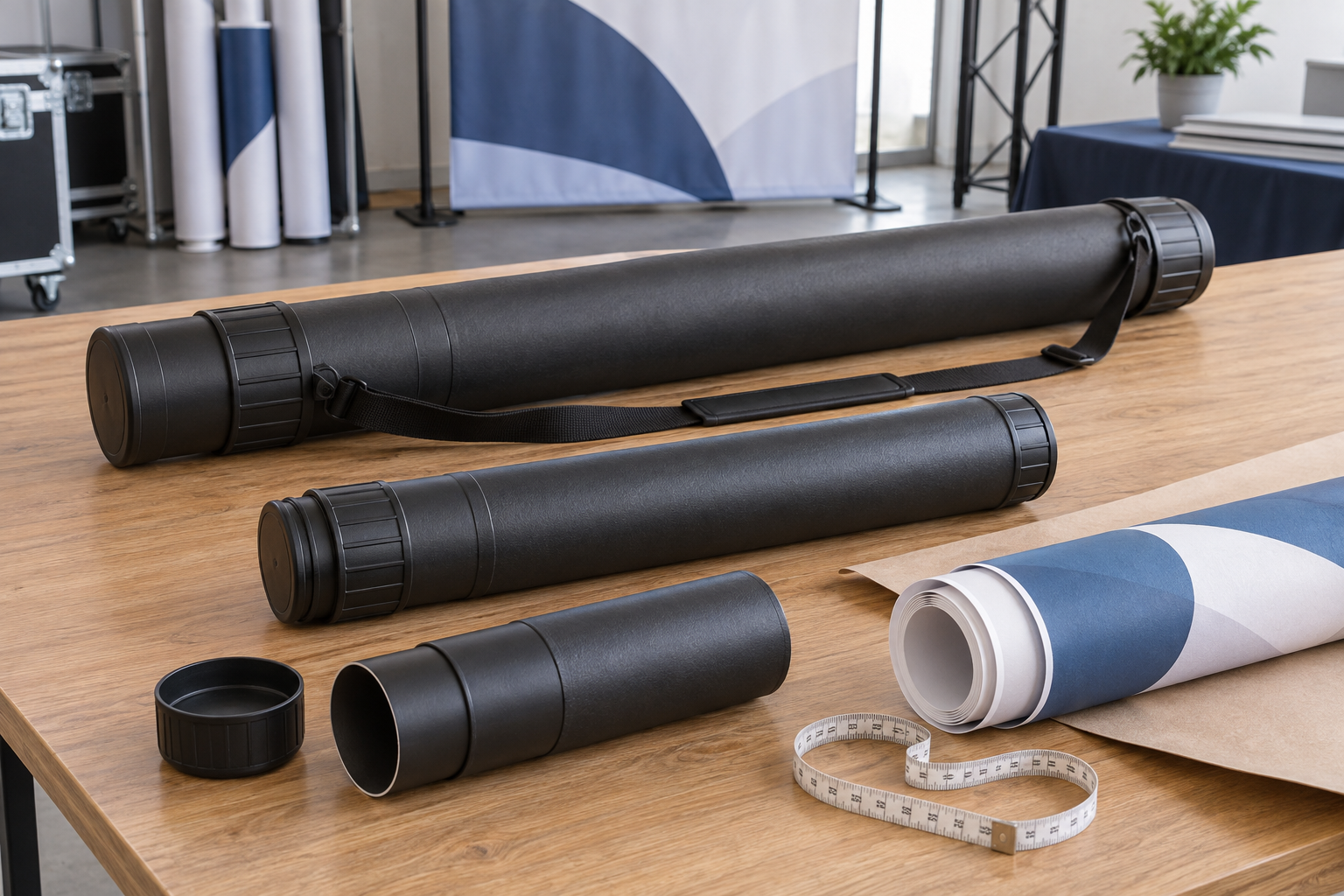
Compare tubes with the rolled graphic measurements in hand
Check current listings for usable interior length and diameter, opening size, cap or closure design, telescoping adjustment, strap or handle, and maker-provided use guidance. Confirm those details on the exact item before ordering.
Quick picks by transport workflow
| Tube format | Useful starting point | Main check |
|---|---|---|
| Fixed-length tube | One repeat graphic travels in the same rolled form. | Usable interior length and diameter exceed the measured roll without forcing it. |
| Telescoping tube | Several compatible graphics have different widths. | The adjustment locks as documented and still fits the longest roll. |
| Wide-diameter tube | The graphic producer calls for a larger minimum roll diameter. | The stated interior diameter—not exterior width—fits the relaxed roll. |
| Tube with shoulder strap | Staff carry the tube with other light event items. | Strap attachment, adjustment, packed length, and published use guidance fit the route. |
| Labeled multi-tube system | Different booth zones or campaigns travel separately. | Labels identify contents and setup order without obscuring closures. |
1. Confirm that rolled storage is allowed
Start with the graphic maker's current handling instructions. Some flexible graphics are designed to roll; other prints, laminates, mounted pieces, or assemblies may crease, curl, separate, or retain a shape when rolled. A storage tube cannot make an unsuitable graphic roll-safe.
Record the approved roll direction and any minimum diameter or core requirement. Keep attached rails, hooks, magnetic strips, or other hardware out of the roll unless the maker's instructions explicitly account for them. When guidance is missing, ask the producer before choosing a tube.
2. Measure the roll in its relaxed packed form
Roll the graphic only as directed and let it settle without squeezing it smaller. Measure the full width from edge to edge and the largest diameter across the roll. Add any approved tissue, sleeve, core, or end protection that will travel with it, then measure again.
Compare those numbers with the listing's usable interior dimensions. Exterior length, shipping dimensions, and broad labels such as “large” do not establish fit. Check the opening as well: a tube may have adequate space inside but a lip or neck that is narrower than the main body.
3. Choose fixed or telescoping length deliberately
A fixed tube has fewer setup decisions and can suit one stable graphic kit. A telescoping tube can cover several widths and reduce empty length, but it adds an adjustment point that staff must set consistently. Verify its documented minimum and maximum usable lengths and how the sections lock.
Do not treat a telescoping tube as unlimited. If the longest graphic sits against both ends, or the tube must be extended beyond its stated range, choose a longer verified size. Mark the normal setting only after the exact product and graphic have been tested together.
4. Inspect the closure and carry method
Compare threaded caps, friction-fit caps, tethered lids, and other closures by their documented operation. Rehearse opening and closing with the tube loaded; the graphic should not need to be pinched, twisted, or dragged across the rim. Check whether a cap reduces usable length.
A strap or handle can simplify a short indoor event route, but verify how it attaches and how the packed tube hangs. Walk the actual storage-to-vehicle-to-booth path and note doors, elevators, counters, and crowded setup areas. Product-specific instructions and published limits should control use.
5. Build a labeling and return routine
Label the outside with the graphic name, booth zone, approved roll direction, and setup order where useful. Keep labels clear of telescoping joints and caps. If multiple campaigns use similar tubes, add a contents checklist so the return trip does not depend on memory.
After each event, inspect the graphic and tube under good light, follow their makers' cleaning guidance, and allow compatible items to reach the condition required before storage. Store the tube as directed in a location where it will not become an improvised shelf support or be mistaken for a container for unrelated hardware.
A practical comparison framework
- Verify rollability: obtain the graphic maker's roll direction, minimum diameter, and handling guidance.
- Measure the packed roll: record full width and relaxed maximum diameter with every approved protective layer included.
- Check usable dimensions: compare interior length, interior diameter, opening, and any space taken by caps.
- Map the route: note the people carrying it, vehicle opening, doors, elevator, booth aisle, and final storage position.
- Test one tube: load, close, carry, open, and unpack the real graphic without forcing any step.
- Document the system: record the exact tube, adjustment, contents, roll direction, and storage owner before buying more.
Who should skip a poster storage tube
- The graphic must remain flat: use a measured flat sleeve, portfolio, or case that follows the maker's handling instructions.
- The display has a built-in cassette: use the display maker's transport method rather than removing or re-rolling the graphic without guidance.
- Rigid panels and hardware travel together: a divided portable sign case or separate containers may fit the mixed shapes better.
- The listing omits usable interior dimensions: do not infer fit from exterior measurements or photos.
- You need a documented protective property: choose only a product whose current manufacturer information explicitly supports that requirement.
- The rolled graphic is used once: a borrowed compatible container or producer-provided packaging may avoid another piece of event equipment.
Bottom line
Choose a poster storage tube in this order: graphic-maker approval for rolling, relaxed roll diameter and width, verified usable interior dimensions, opening and closure, then carrying and labeling workflow. If you are not yet sure a dedicated carrier earns its place, start with the poster storage tube worth-it decision. Test one complete setup before standardizing across an event kit. For the wider booth decision—message, sightline, setup roles, transport, and storage—use the small-business sign planning pillar.