 The Good Sign Company
Worth-it decision
Is a sign carry sleeve worth it for recurring flat event boards?
A dedicated carry sleeve is usually worth considering when the same compatible rigid boards make repeated indoor-event trips, their complete packed dimensions are known, and one fitted carrier simplifies a real loading and storage routine. Skip it for one-use boards, uncertain fit, or handling that calls for a rigid case. Delay the purchase until the boards and every layer traveling with them are measured.
A soft sleeve organizes and carries flat signs; it does not automatically provide waterproof, archival, crush, drop, or impact protection. The useful decision is whether a measured sleeve improves the actual route without promising protection its maker does not state.
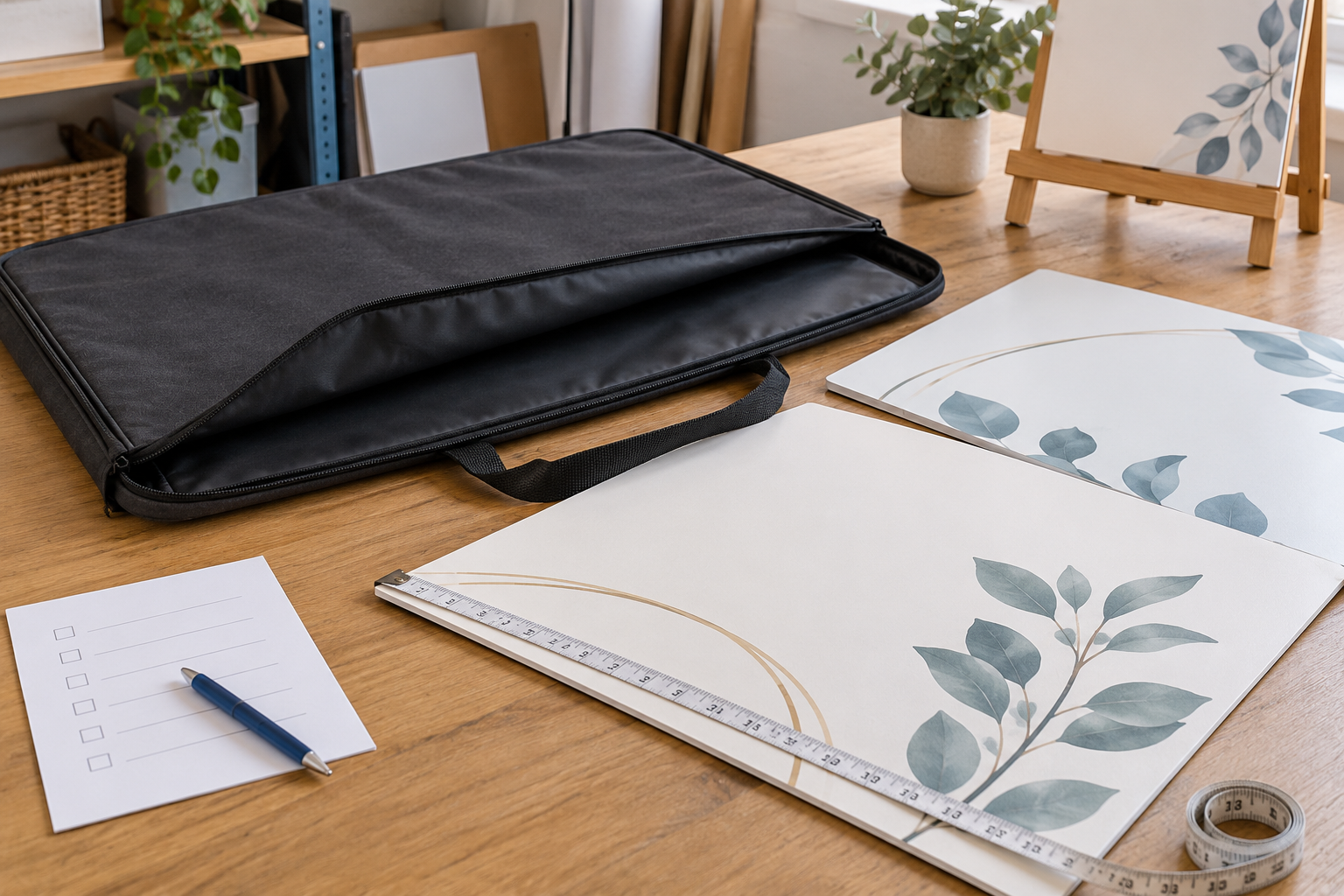
Evaluate the format after the fit and trip test
Compare the exact product's usable interior, opening, closure path, handles, complete packed dimensions, and current maker guidance with the whole board stack—not a nominal sign size.
Quick verdict: buy, skip, delay, or choose a case
- Buy: the same measured boards travel repeatedly, fit through the opening without flexing, and have a defined vehicle, venue, and storage route.
- Skip: the boards are disposable, travel once, already have suitable original packaging, or cost less to replace than to manage a dedicated carrier.
- Delay: the full stack thickness, corner clearance, sleeve interior, opening, closure, or carry orientation is unknown.
- Choose a rigid case: the route includes higher-risk handling, stacking, or equipment contact that a soft sleeve is not stated to address.
- Choose a poster tube: only when the graphic producer says the media may be rolled; rigid boards should remain flat.
Inventory the boards as a packed set
List each board by finished width, height, thickness, material, edge shape, and attached hardware. Then decide whether sheets, corner pieces, dividers, or other layers will travel in the same sleeve. Measure that complete arrangement. Two individually thin boards can create a much thicker pack, and raised details can change the usable clearance.
Do not bend a rigid board to clear a narrow zipper or force a sharp corner through the opening. If a board carries removable easel hardware or other accessories, pack those separately unless the sleeve maker explicitly describes a compatible compartment and use.
Count trips and handling steps
Review the last season and the next confirmed schedule. Count how often the same boards move from storage to a vehicle, through venue entry, onto a table or easel, through pack-down, and back into storage. Frequent repeat use strengthens the case for one labeled carrier. A single event or a constantly changing board size weakens it.
Name the person responsible for packing and return storage. A sleeve earns its place when it removes loose-board handling from a repeatable workflow. If no one owns the return check, it can become another empty bag separated from the signs it was meant to organize.
Measure fit in the order that loading happens
- Stack the exact boards and any approved flat separators in their travel order.
- Measure the widest width, tallest height, and thickest point, including corners and raised details.
- Compare those measurements with the product's stated usable interior—not only its exterior or nominal format.
- Check whether the opening and closure path clear the complete stack without bending, scraping, or catching.
- Confirm handle orientation, packed size, and product guidance for the intended carrying position.
Equal measurements do not prove practical fit. Allow loading and removal clearance, and return the product rather than forcing the boards when the real opening does not match the published information.
Compare the whole route, not just the bag
| Decision point | A soft sleeve favors | Another route favors |
|---|---|---|
| Sign format | Compatible rigid boards that stay flat | Roll-approved graphics or mixed hardware kits |
| Repeat use | The same board set travels often | One-use or frequently resized boards |
| Handling | Owner-controlled carrying and storage | Stacking or handling risks needing a specified rigid case |
| Fit | A measured stack clears the usable opening | Unknown dimensions, sharp projections, or forced loading |
| Storage | The loaded and empty sleeve each have an assigned place | Original packaging already supports the routine |
Run a no-purchase route trial
- Wrap the measured board set in a clean temporary layer appropriate for the board maker's handling guidance.
- Make a simple cardboard footprint matching the candidate sleeve's published exterior dimensions.
- Walk the route through shelving, doorways, vehicle loading, venue entry, setup, pack-down, and return storage.
- Record catches, crowded turns, unattended storage, and where the empty carrier will sit during the event.
- Buy only if the fitted sleeve removes a repeated problem without creating a new handling or storage problem.
Red flags and skip criteria
- The listing gives no usable interior or opening dimensions that can be checked.
- The fit depends on flexing, compressing, or scraping the signs.
- The boards have vulnerable raised elements or hardware with no compatible packing plan.
- The team expects an ordinary soft sleeve to establish weather, crush, drop, or impact protection.
- The boards will be checked with a carrier, stacked under equipment, or handled outside the controlled route without product-specific guidance.
- No one has assigned storage for the loaded sleeve or the empty sleeve at the venue.
Bottom line
A sign carry sleeve is worth considering for a stable set of measured flat boards that travels repeatedly through a predictable indoor-event workflow. It is not a substitute for verified fit, careful packing, or a rigid case when the handling route calls for one. Count trips, measure the whole stack, test the route, and then compare products.
Continue with the small-business sign planning pillar, use the flat-board carry-sleeve guide after the buy decision is clear, or decide whether a poster tube fits graphics approved for rolling.