 The Good Sign Company
Monthly notice decision
Is a wall-mounted acrylic sign pocket worth it for monthly notices?
A wall-mounted acrylic sign pocket is worth considering when one reachable indoor location uses the same paper size month after month and a reusable pocket makes each update simpler. Skip it when the notice size or location keeps changing, the loading edge will be blocked, or the wall and mounting method are unresolved.
Monthly changes alone do not make the purchase worthwhile. The pocket also needs a stable sightline, enough loading clearance, a readable face under the room lights, and one person or role responsible for replacing expired notices.
Disclosure: As an Amazon Associate, we may earn from qualifying purchases and approved partner referrals.
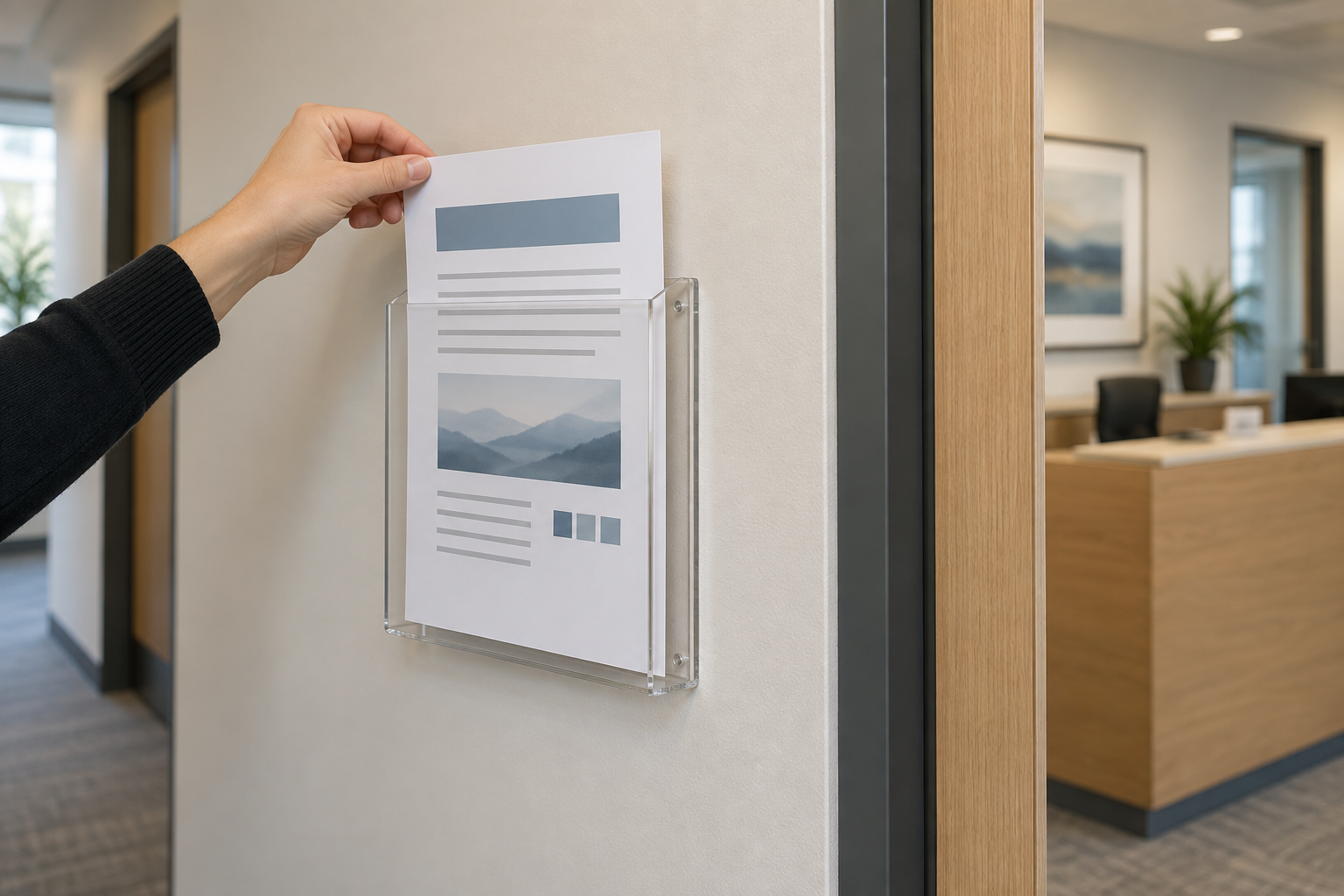
Compare pockets against a measured wall plan
For each current listing, verify the stated insert size and orientation, visible area, complete outside dimensions, loading direction, required edge clearance, mounting instructions, included parts, and cleaning guidance. A listing photo cannot establish fit on an unmeasured wall.
Quick verdict: buy, skip, delay, or choose another format
- Buy: the same finished paper size returns monthly, the wall position is stable, and the full replacement motion is easy to reach.
- Skip: changes are rare enough that an existing frame works, or the notice keeps moving between rooms.
- Delay: the final paper dimensions, visible margin, wall construction, mounting permission, lighting, or update owner is still unknown.
- Choose another format: use a tabletop holder when the message belongs at a counter, a snap frame when front access is the better workflow, or a portable display when the location changes.
The six-part worth-it test
| Check | The pocket earns its place when… | A different display is better when… |
|---|---|---|
| Repeat format | Every replacement uses one measured paper size and orientation. | Paper sizes vary or the template is not controlled. |
| Update cadence | The monthly schedule is real and likely to continue. | The notice changes only occasionally or unpredictably. |
| Loading access | The open edge and entire paper-removal path remain reachable. | Trim, shelving, another display, or furniture blocks the motion. |
| Wall location | The reader sees the notice at the right decision point. | The message belongs closer to a counter, doorway, product, or event route. |
| Readability | The finished notice stays legible through the face under normal room lighting. | Reflections or covered margins obscure important content. |
| Ownership | A named role keeps the source file and replaces the insert on schedule. | No one owns the update, so old information is likely to remain. |
Start with the paper, not the pocket
Print the actual monthly notice at its intended finished size. Measure the sheet rather than trusting a file name or familiar paper label. Then mark a conservative inner boundary around dates, calls to action, room numbers, and other essential information. The pocket edge may cover part of the sheet, and the product's stated visible area can differ from its insert size.
If the team produces a different page size each month, standardize the template before buying a fixed holder. A reusable pocket cannot fix an inconsistent content workflow.
Rehearse the full loading motion
Loading direction changes the space the display needs. A top-loading pocket requires clear wall space above it so the complete sheet can be lifted free. A side-loading pocket needs an unobstructed path to the relevant side. Tape a paper rectangle matching the complete outside dimensions to the wall, then rehearse removing and reinserting the full sheet without bending it around trim, shelving, neighboring signs, or furniture.
Also test reach. An opening that is technically clear may still be awkward if the pocket is mounted too high, above a deep cabinet, or behind equipment. Monthly handling should not require an improvised climbing or reaching routine.
Test the sightline and reflections at real times
Stand where the intended reader first needs the information. The headline should be understandable before the person passes the display or arrives at the decision point. Check the mockup from the approach path as well as directly in front of it.
Clear faces can reflect windows, ceiling fixtures, and bright screens. Test the proposed position during normal operating hours with the finished print behind a clear sleeve or sheet. Moving the display, changing the angle, or simplifying the print may help more than buying a larger holder. Do not assume “clear” means glare-free.
Mounting commitment belongs in the decision
Review the current manufacturer's mounting instructions and the known wall construction before choosing a pocket. Confirm the actual attachment points and whether listed components are included. Do not assume supplied hardware suits every wall, and do not assume an adhesive route will leave every paint or finish unchanged.
For leased or shared spaces, resolve placement, mounting, and later repair expectations with the responsible property stakeholder. This guide does not determine permission or compliance for a particular site.
Monthly upkeep is small but recurring
Keep the current print file, update date, product instructions, and cleaning directions together. The person changing the sheet should remove the old notice, check that the replacement sits flat, confirm that nothing important is hidden at the edges, and read it once from the normal approach.
Follow the maker's care guidance for the specific product. Acrylic surfaces can show dust, fingerprints, and scratches, but cleaning recommendations differ; avoid treating one general cleaner or cloth as suitable for every clear holder.
Choose the alternative by the failed test
- Front access is easier: consider whether a snap frame is worth it, especially when no loading edge has enough clearance.
- The message belongs on a counter: compare a table tent with an acrylic sign holder.
- The notice moves between locations: use a freestanding or portable holder sized around the real route.
- Several sheets rotate together: a wall rail or managed notice board may suit the group better than several isolated pockets.
- The print size varies: standardize the template first or use a format that can accept the actual range without hiding essential content.
Who should skip this purchase?
- Skip it when the wall is only a temporary test location.
- Skip it when nobody can name the monthly update owner and date.
- Skip it when the paper size changes and the team will not standardize it.
- Skip it when trim, fixtures, or furniture block the loading path.
- Skip it when reflections make the finished message unreadable from the real approach.
- Skip it for outdoor, emergency, accessibility, egress, or other regulated-sign duties unless the exact product and project have been reviewed for that use by the responsible parties.
Bottom line
A wall-mounted acrylic sign pocket can be a sensible monthly-notice system when one paper size, one wall position, and one update routine repeat. Its value disappears when the format, location, or owner remains unsettled. Mock up the complete footprint and loading path, test the final notice under real lighting, and confirm the product instructions before mounting anything.
Continue with the sign mounting supplies guide for the broader wall decision or compare snap frames and slide-in holders when access method is still the main question.