 The Good Sign Company
Changeable wall-notice comparison
Acrylic sign pocket vs snap frame for wall notices
Choose an acrylic sign pocket when a simple clear holder, an open loading edge, and an understated profile fit the wall. Choose a snap frame when front access and a defined border make repeated changes easier. The practical winner is the system whose complete footprint, opening motion, visible area, and mounting method work in the measured location.
This guide covers ordinary indoor office, studio, and shop notices. It does not establish requirements for emergency, accessibility, egress, lease, or other regulated signage.
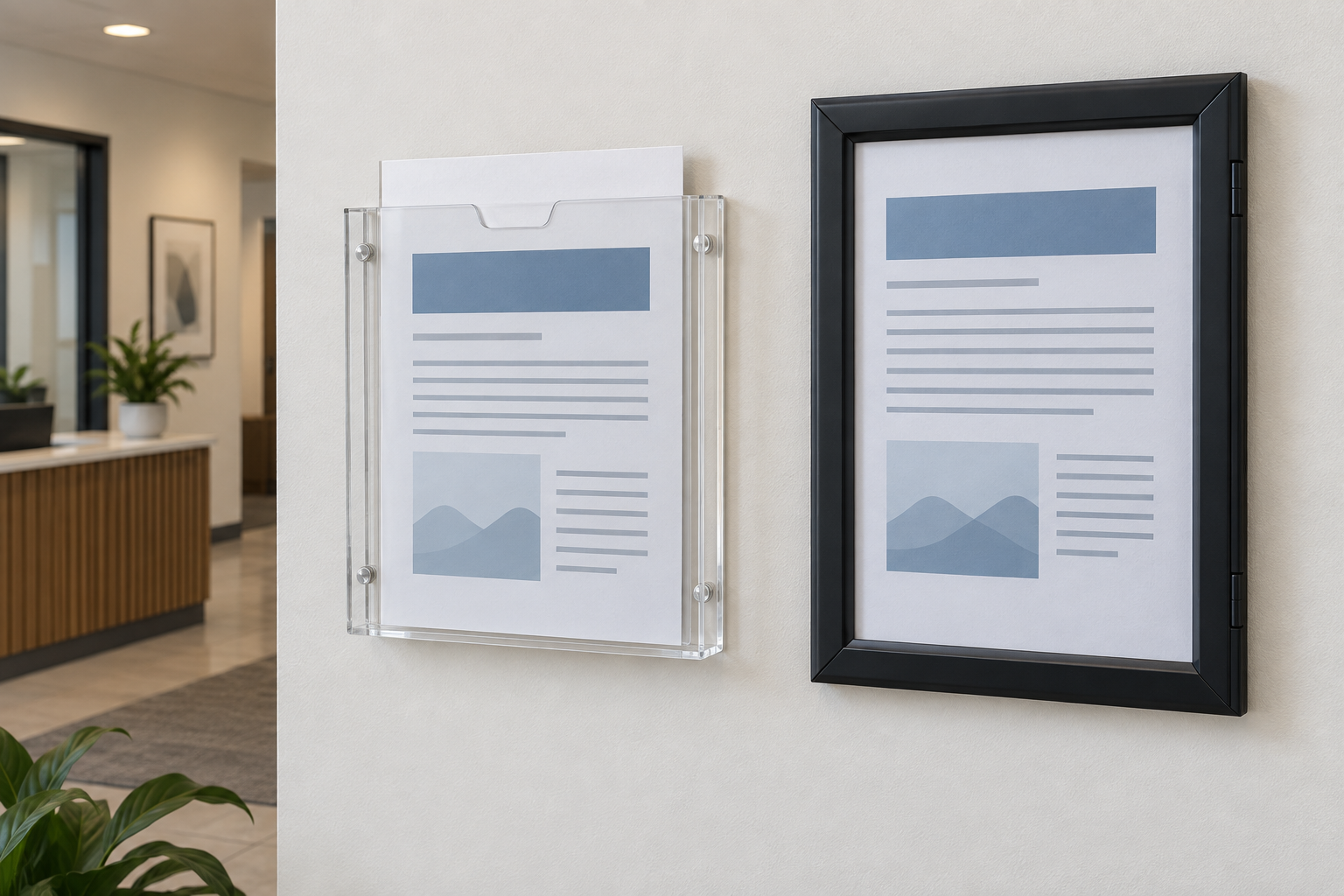
Compare both formats against one measured notice
For current listings, verify insert size, visible area, outside dimensions, orientation, loading or opening method, cover material, wall profile, included parts, mounting instructions, and care guidance. A nominal paper label does not prove that the holder fits the print or wall.
The short answer
- Acrylic pocket: best when one repeat paper size can travel through a permanently clear top or side opening and a minimal clear presentation suits the room.
- Snap frame: best when surrounding wall clearance is tight but the front and all opening edges remain reachable.
- Skip both: when the print size keeps changing, the wall or mounting permission is unresolved, reflections obscure the message, or updates belong at a counter or portable station.
Side-by-side decision table
| Decision | Acrylic sign pocket | Snap frame |
|---|---|---|
| Paper access | Sheet enters through an open top or side edge | Edges open from the front so the sheet can be lifted in or out |
| Clearance | Needs the full sheet-removal path beyond the loading edge | Needs hand access to every edge that must open |
| Presentation | Clear or low-border look, depending on construction | Visible perimeter frame defines the notice |
| Visible area | Pocket edges or hardware may cover margins | Frame lip normally covers part of the print edge |
| Face and glare | Clear surfaces can reflect room light | Cover finish and angle affect reflections and fine detail |
| Update fit | Works when edge-loading remains easy | Works when front access solves a cramped replacement path |
Who each option fits
Choose an acrylic pocket for a simple repeat-size notice
An acrylic pocket fits a stable indoor notice program where each replacement uses the same measured sheet and the loading edge will remain open. It can suit office schedules, studio instructions, or shop information when the holder should recede visually. The team still needs to check the stated insert dimensions, visible window, complete outside footprint, and exact mounting points.
Choose a snap frame for front-access updates
A snap frame fits a repeat-size print when lifting a sheet above or beside the holder would be awkward. It can also create a stronger visual border. That advantage depends on all required edges being reachable; nearby trim, furniture, another frame, or a corner can make the front-opening mechanism inconvenient.
Loading direction changes the setup
Mock up the complete holder footprint on the intended wall, then rehearse the entire paper change. For a top-loading pocket, lift a full-size sheet above the opening and remove it without bending around trim or a ceiling feature. For a side-loading pocket, trace the sheet's full horizontal path. For a snap frame, open each working edge and confirm that fingers can reach it comfortably.
Do not judge clearance from the empty holder alone. The sheet itself often travels farther than expected, and a high or deep location can turn a technically open path into an awkward routine.
Compare the visible area, not just the insert label
Measure the finished print. Keep dates, room names, contact details, calls to action, and other essential information inside a conservative safe margin. Pocket lips, mounting details, or a snap-frame border can hide part of the sheet even when the insert technically fits.
Also compare the complete outside dimensions. Two products designed for the same paper can occupy different wall areas and create different spacing beside doors, switches, trim, or neighboring notices.
Mounting and wall commitment
Both formats are wall systems, not merely paper sleeves. Review the current manufacturer's mounting instructions, attachment points, included parts, product weight, and orientation. Identify the wall construction before selecting fasteners, and do not assume supplied hardware suits every substrate.
For leased or shared spaces, resolve placement, attachment, removal, and later repair expectations with the responsible property stakeholder. Neither format guarantees permission, easy removal, or compatibility with an unknown wall.
Maintenance and change ownership
Clear faces and covers can collect dust and fingerprints and can reflect windows or ceiling lights. Test a full-size notice from the real approach during operating hours. Follow the specific product's cleaning guidance; do not assume one cleaner or cloth suits every acrylic sheet, cover, coating, or frame finish.
Name the role responsible for the source file, replacement date, old-notice removal, and final readability check. A more convenient opening cannot prevent stale information when nobody owns the update.
When to skip each format
Skip the acrylic pocket when
- The top or side loading path is blocked now or likely to be blocked later.
- The sheet changes size or orientation often enough that one fixed pocket will not work.
- The clear, low-border presentation makes the notice too easy to overlook for the intended setting.
Skip the snap frame when
- Furniture, corners, trim, or adjacent frames prevent comfortable access to its opening edges.
- The frame border covers essential print content or visually competes with the notice.
- The update cadence is too low to justify a dedicated front-opening system.
Skip both when
- The message belongs at a counter, doorway, product display, or portable station instead of this wall.
- The wall, mounting method, or permission remains unknown.
- The display duty is outdoor, safety-critical, accessibility-related, or otherwise regulated and the exact project has not been reviewed by responsible parties.
- A maintained notice board, wall rail, or digital channel better fits mixed sizes and frequent changes.
A practical buying checklist
- Measured paper width, height, thickness, and orientation
- Stated insert size, visible area, and full outside dimensions
- Top-, side-, or front-opening change path
- Hand clearance and comfortable reach
- Cover material or face finish under real room lighting
- Wall construction, attachment points, included parts, and current mounting instructions
- Cleaning guidance and replacement-part availability where documented
- Update owner, source-file location, and replacement schedule
Next steps
If the open-pocket route looks promising, use the acrylic wall-pocket worth-it test. If front access is the stronger fit, continue with the snap-frame worth-it test and the snap-frame buying guide. If the wall or attachment plan remains unresolved, return to the sign mounting supplies pillar.