 The Good Sign Company
Changeable notice decision
Is a snap frame worth it for frequently changed notices?
A snap frame is more likely worth it when the same indoor wall position holds one standard print size and a reachable front-opening frame makes scheduled changes noticeably easier. It is usually unnecessary when notices change only a few times a year, the wall cannot accept the documented mounting method, or a simple sleeve, conventional frame, magnetic hanger, or tabletop holder already serves the reader at the right place.
Disclosure: As an Amazon Associate, we may earn from qualifying purchases and approved partner referrals.
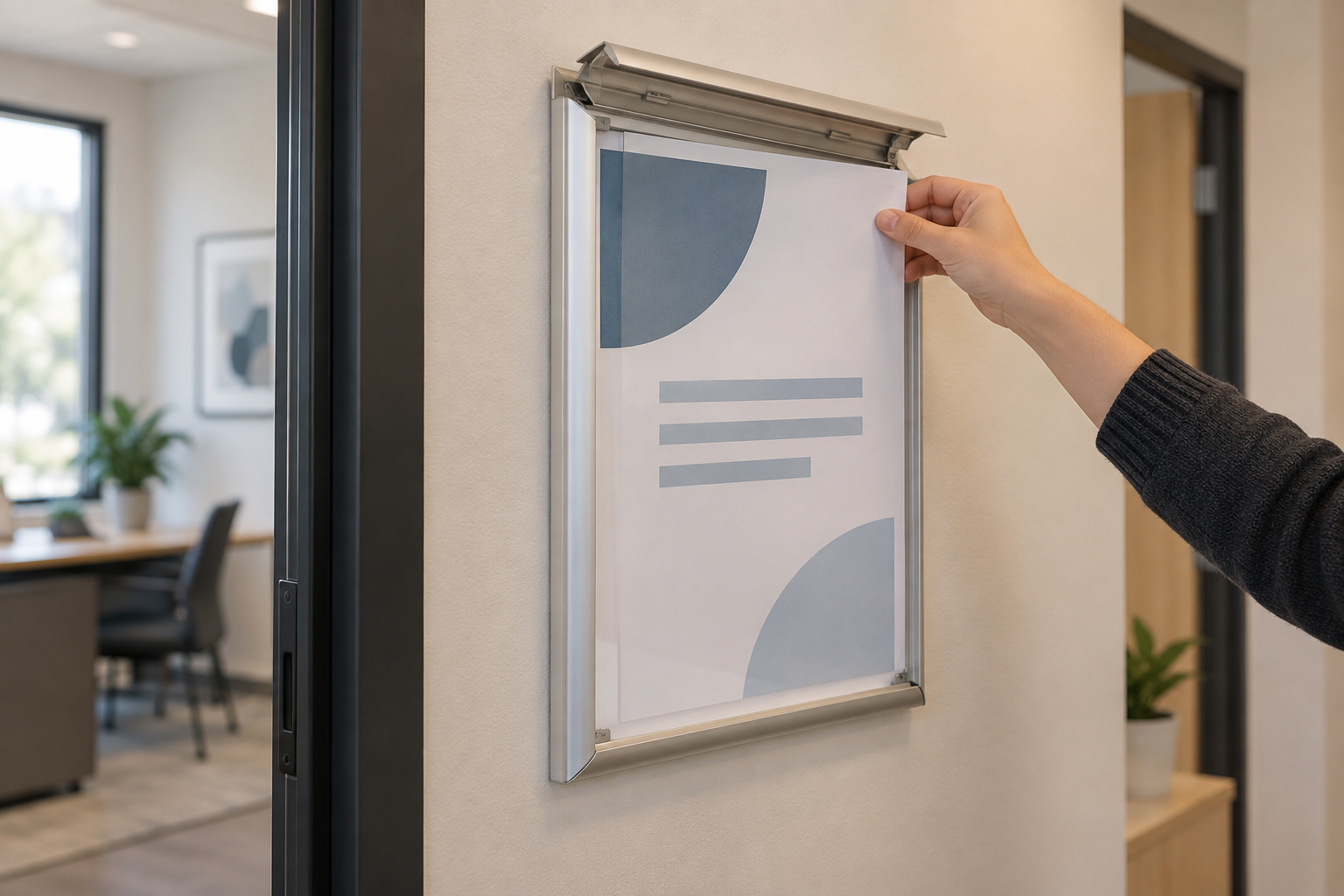
Check current snap-frame details against the wall and print
Compare the stated insert size, visible area, complete outer dimensions, cover finish, edge-opening method, orientation, included parts, and mounting instructions. Treat the product listing as a starting point—not proof that a frame fits an unmeasured print or unknown wall.
Quick verdict
- More likely worth it: one reachable indoor display changes on a real schedule, every replacement uses the same measured format, and front access removes an awkward recurring task.
- Less likely worth it: the message changes rarely, the print size varies, or a frame must come off the wall only occasionally.
- Delay the purchase: the visible area, outer dimensions, opening clearance, cover reflections, wall construction, or mounting instructions are still unknown.
- Choose another format: the notice must travel, move between rooms, accept several paper sizes, or avoid a committed wall installation.
The six-question worth-it test
| Question | A snap frame earns its place when… | A simpler display is usually enough when… |
|---|---|---|
| How often does the notice change? | Changes are frequent and scheduled enough that access time repeats throughout the year. | The print stays up for months and removing a conventional frame is a rare task. |
| Does one print size repeat? | The team controls a standard finished size and can keep essential content inside the measured visible area. | Paper sizes vary or replacements arrive without a consistent template. |
| Is front access actually easier? | All opening edges are reachable without moving furniture or taking the frame down. | A corner, adjacent frame, trim, or counter blocks the opening motion. |
| Is the wall location settled? | The notice has a stable sightline and the known wall suits the current mounting instructions. | The display needs to move or the installation and later repair implications are unresolved. |
| Does the cover work in the room? | A sample remains readable from the real approach under normal lighting. | Reflections obscure the message and a different cover does not solve the viewing-angle problem. |
| Who owns the update? | One person or role keeps the source file, replacement print, change schedule, and cleaning instructions. | No one is responsible, so expired notices are likely to remain regardless of hardware. |
Start with the update cadence, not the frame
List the notices that occupied the proposed wall position during the last several months. Record how often each changed, whether the finished paper size stayed consistent, and what made the old update process inconvenient. This separates a recurring workflow from a vague hope that a special frame will make communication easier.
A weekly class schedule, rotating exhibition notice, or regularly revised office announcement can create a clear case. One annual certificate or a poster that changes with the seasons may not. There is no universal change-count threshold: the useful question is whether front loading removes enough repeated handling in this exact location to justify buying and mounting another system.
Measure four rectangles before ordering
- The finished print: record its physical width and height rather than relying only on a file name or familiar paper label.
- The stated insert area: confirm the product is designed for that finished print size and orientation.
- The visible area: frame lips can cover the perimeter, so keep dates, logos, QR codes, and other essential information inside a conservative inner margin.
- The complete outer frame: tape this footprint on the wall and check trim, switches, doors, neighboring frames, and the clearance needed to open every edge.
If the replacement notices do not share one size, standardize the print template first or choose a display that tolerates the variation. For detailed product-selection criteria, continue with the snap-frame guide for frequently changed posters.
Run one paper-and-light mock-up
Tape a paper rectangle matching the complete outer frame to the proposed position using a temporary method suitable for the wall finish. Approach from the doorway, counter, or corridor where the notice must first be read. Check whether the headline lands near a comfortable sightline and whether people or furniture routinely obscure it.
Then place a clear sheet or an existing framed print in the same area to expose reflection problems. “Anti-glare” is not a promise of readability from every angle; cover texture can also soften fine detail. If reflections are the only reason to replace an otherwise useful frame, compare compatible anti-glare replacement covers before buying a complete new system.
Compare the real alternatives
- Conventional frame: sensible when changes are rare and the existing frame already fits the print, wall, and room.
- Clear wall sleeve or slide-in holder: useful for lightweight notices when side or top loading is accessible and the visible edge treatment is acceptable.
- Magnetic poster hanger: keeps most of the paper exposed and may suit lightweight indoor prints where fast changes matter more than a full cover. Use the poster frame versus magnetic hanger comparison to choose by edge coverage and update routine.
- Wall display rail: can suit several lightweight sheets that rotate together; compare wall rails for changing displays by accepted media and mounting instructions.
- Tabletop holder: makes more sense when the reader needs the notice at a counter and the message or location changes often.
Installation and upkeep can change the answer
Front-loading does not remove the initial wall decision. Before drilling, review the current manufacturer instructions, frame orientation, mounting points, included hardware, and the known wall construction. Do not assume supplied fasteners suit every wall. If the location is leased or the wall finish is uncertain, resolve permission and repair expectations with the responsible party rather than relying on a general buying guide.
Keep the manufacturer's cover and frame-cleaning instructions with the print template. A practical update routine includes clean hands, a flat replacement print, a quick check that every edge is fully closed, and a view from the normal reading position. Do not make a general indoor snap frame responsible for outdoor, emergency, accessibility, egress, or other regulated-sign duties.
Who should skip a snap frame?
- Skip it when no one can name the update schedule or the problem front access will solve.
- Skip it when print sizes vary and the team is unwilling to standardize them.
- Skip it when any edge would be blocked or uncomfortable to reach in the proposed location.
- Skip it when the notice travels between rooms or events; choose a portable holder around that workflow.
- Skip it when the wall, mounting plan, reflections, or later removal implications remain unresolved.
The bottom line
A snap frame is worth considering when one standard-size indoor notice changes often, the wall position is stable, and every front-opening edge is easy to reach. It does not create a useful update process by itself. Confirm the print, visible area, complete footprint, cover, wall, instructions, and update owner first, then use the sign mounting supplies guide to plan the wider installation.