 The Good Sign Company
Changeable Poster Frame Guide
Best snap frames for frequently changed posters
The best snap frame matches the poster's exact finished size and lets the person updating it reach every front-opening edge. Compare insert dimensions, visible area, cover finish, frame profile, orientation, and mounting instructions before choosing a frame. Skip this category when the print changes rarely or a tool-free freestanding holder better fits the location.
This guide is for indoor posters and notices in offices, studios, community rooms, reception areas, and small-business interiors. It does not establish a safe installation or make a frame suitable for outdoor, regulated, or emergency signage.
Disclosure: As an Amazon Associate, we may earn from qualifying purchases and approved partner referrals.
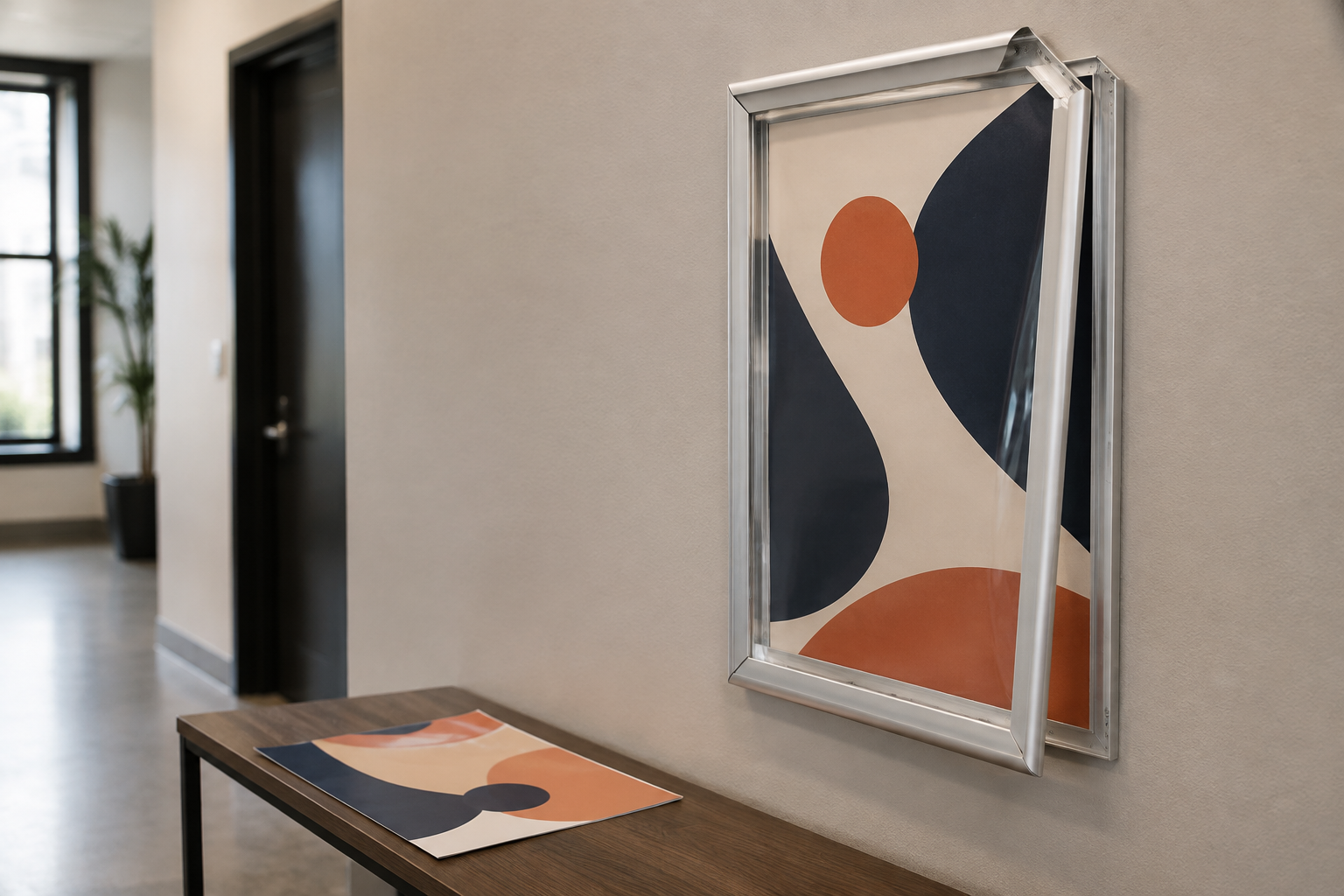
Category starting point
Compare snap frames by the insert—not the nominal label alone
Bring the poster's measured width and height to the listing. Check the stated insert size, visible area, orientation, cover finish, opening method, frame depth, included parts, and current mounting instructions.
Best snap-frame formats by poster job
These are fit-based categories, not named winners or hands-on rankings.
- Standard-size front-opening frames: best for a repeat print format. Use one when each replacement is produced to the same documented insert dimensions. Confirm how much of the print the frame edge covers.
- Low-glare-cover frames: best for a known reflection problem. A matte or textured cover may reduce mirror-like reflections but can soften fine print. Evaluate a sample from the real viewing position rather than assuming “anti-glare” solves every light angle.
- Narrow-profile frames: best when wall space is visually tight. Compare the outer dimensions as well as the insert size; the border still affects spacing between neighboring frames, trim, and doors.
- Larger-profile frames: best when the border should read clearly at a distance. Check the remaining visible poster area and whether all edges are comfortable to reach during changes.
Seven checks before buying
- Measure the finished poster. Do not rely only on a file size or a familiar paper name. Record the physical width and height of the print you will insert.
- Separate insert size from visible area. The frame lip can hide content near the edges. Keep logos, dates, QR codes, and essential copy inside a conservative inner margin.
- Map the outer frame. Tape the complete outside dimensions on the wall and check nearby trim, switches, doors, furniture, and other frames.
- Check the update motion. Make sure each edge can open without colliding with a corner or neighboring object, and that the updater can reach it without leaning over a counter.
- Review the cover. Confirm whether the cover is included, how it loads, which face goes outward, and what cleaning method the manufacturer specifies.
- Read the mounting instructions. Identify orientation, hole pattern, included hardware, required fasteners, known wall construction, and any installation limits before drilling.
- Test one complete change. Insert a real poster, close every edge, view it under normal lighting, then remove it and note whether the routine is practical.
When a snap frame earns its wall space
- The poster changes often enough that rear-loading a conventional frame is cumbersome.
- Replacement prints use one repeatable size and keep important content clear of the covered edges.
- The frame is indoors, reachable, and positioned where its cover remains readable under actual room lights.
- The known wall and mounting plan match the current product instructions.
If reflections are the main problem and the existing frame otherwise works, compare anti-glare replacement covers before replacing the whole system.
Who should skip a snap frame
- Skip it when the poster changes rarely and a conventional frame already fits.
- Skip it when the print is an unusual size unless the documented insert and visible-area measurements match.
- Skip wall mounting when the display must move between counters, events, or rooms; use a measured freestanding holder instead.
- Skip any frame whose edges cannot open fully in the proposed location.
- Skip general indoor products for outdoor, egress, accessibility, electrical, or other code-sensitive sign duties; confirm those needs with the responsible authority or qualified provider.
Snap frame, magnetic hanger, or wall rail?
A snap frame surrounds and covers a repeat-size print. A magnetic poster hanger leaves most edges exposed and can be quicker for lightweight decor prints. A wall rail manages several changing sheets along one run. Compare poster frames and magnetic hangers, or use the wall-rail guide when several notices rotate together.
The practical bottom line
A snap frame is worthwhile when one indoor poster size changes repeatedly and front access is genuinely easier in the chosen location. If the ownership threshold is still unclear, use the snap-frame worth-it test before comparing products. Measure the poster, visible area, complete frame, edge-opening clearance, and wall before ordering. Continue with the sign mounting supplies guide to plan the surrounding installation.