 The Good Sign Company
Changeable wall-notice comparison
Snap frame vs slide-in sign holder: which is easier to update?
Choose a snap frame when you need front access and cannot reserve open space beside or above the display. Choose a slide-in holder when a simple pocket suits the presentation and its loading edge will remain easy to reach. Either format can become frustrating when the listed insert size, visible area, loading clearance, mounting method, or cover construction does not match the real wall.
This comparison is for ordinary indoor paper notices in offices, studios, and shops. It does not establish requirements for emergency, accessibility, code, lease, or regulated signage. For a broader product screen, see the guide to snap frames for frequently changed posters.
Disclosure: As an Amazon Associate, we may earn from qualifying purchases and approved partner referrals.
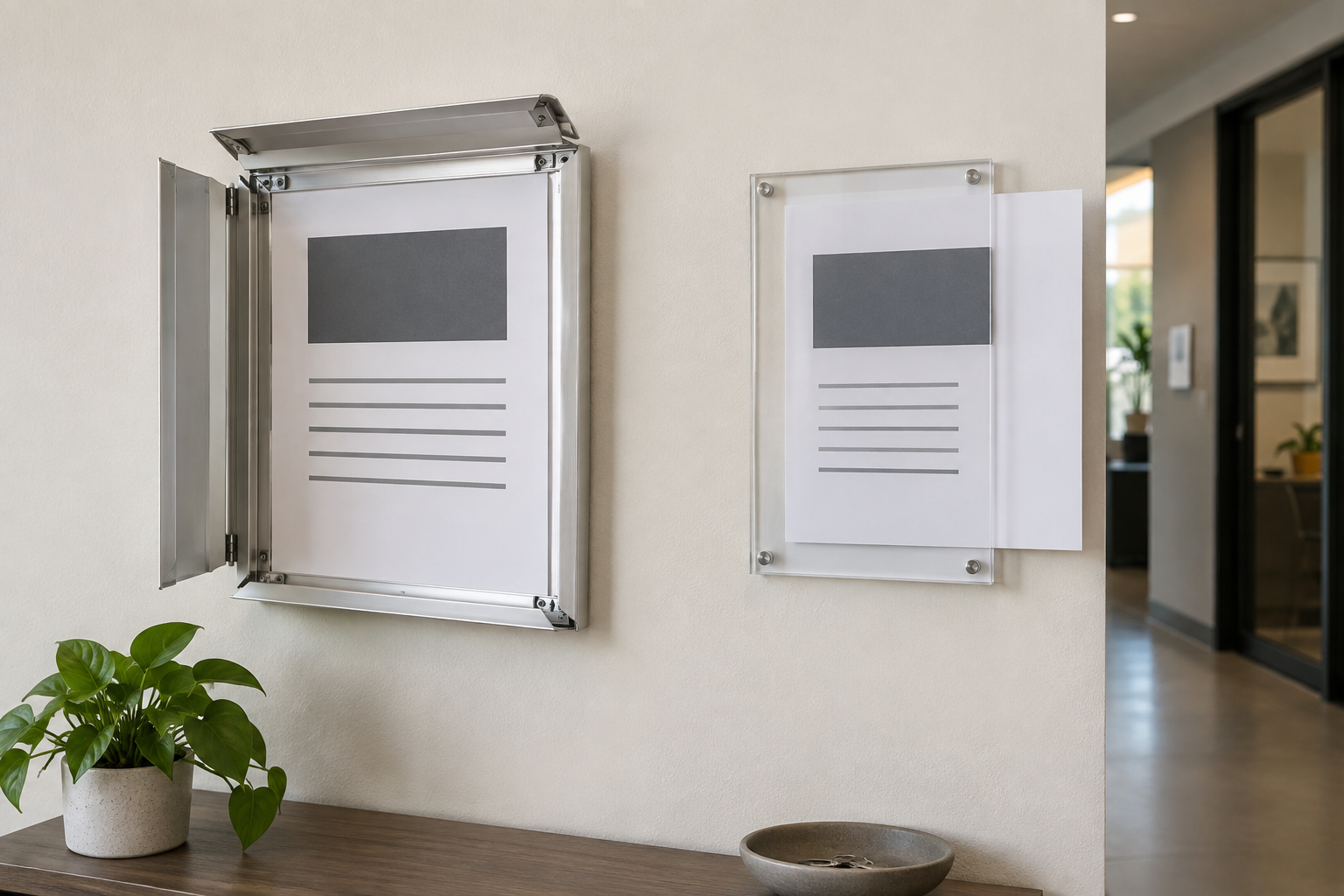
Compare the opening method before the finish
For each current listing, verify the exact insert size and thickness, visible opening, loading edge, overall depth, cover material, orientation, mounting instructions, and included hardware. Product construction varies, so use the current listing and maker instructions rather than the category name alone.
Quick decision
- Choose a snap frame: furniture, corners, or neighboring displays limit side access and the notice must change from the front.
- Choose a slide-in holder: its open edge stays reachable, the insert can move through that full path, and a low-key pocket suits the room.
- Choose neither: the paper size is still changing, glare blocks the message, the wall is unsuitable, or a tabletop or magnetic display better fits the update routine.
- Delay the order: you have not tested the longest notice at full size or identified who will replace it.
Front access versus edge clearance
A snap frame usually holds the print behind a cover while hinged or flexible rails open from the front. That can make updates practical in a narrow corridor or between neighboring wall elements. Opening still takes working room in front of the frame, and the rails must remain reachable around the full perimeter. Confirm the actual mechanism because products described as snap frames do not all open in exactly the same way.
A slide-in holder accepts the print through a top or side edge. The profile can look visually simple, but the sheet needs a clear path equal to the distance required to remove and insert it. A side-loading holder placed tight against a corner or another frame may be impossible to update without taking it down. Trace that path on the wall before ordering.
Visible area and print preparation
Both formats can hide part of the paper. Snap-frame rails overlap the print perimeter, while a slide-in pocket can cover edges with seams, bends, caps, or mounting points. Compare the listed insert size with the listed visible opening; those measurements answer different questions.
Print the longest normal notice at full size and mark a quiet margin around important words, dates, arrows, and codes. Put the mockup at the intended height and read it from the actual approach. If shrinking type is the only way to fit the message, simplify the message or choose a larger format instead of relying on a familiar paper-size label.
Update speed depends on the whole routine
Front opening is not automatically faster. A snap frame may require opening several rails, managing a separate cover, aligning the sheet, and closing the edges in sequence. A slide-in holder may take one movement, but only if the paper stays flat, the opening is accessible, and there is enough room to withdraw the sheet.
Rehearse the update with a paper template. Include the steps to reach the display, set down the new notice, remove the old sheet, align the replacement, wipe fingerprints if needed, and store or recycle the old notice. The better holder is the one that reduces friction in your actual routine.
Depth, glare, and wall context
Check overall projection rather than assuming either category is flatter. Frame rails, covers, pocket bends, spacers, and mounting hardware all contribute to depth. In a narrow indoor passage, compare that complete projection with doors, carts, furniture, and normal movement through the space.
Clear covers and pockets can reflect windows and overhead lights. Tape a clear sleeve over the paper mockup and view it at different times and from each normal approach. Repositioning or changing the angle of the display may help more than editing the artwork. Follow the product maker's cleaning directions rather than assuming every clear cover tolerates the same cleaner.
Mounting and orientation checks
- Known wall: identify the wall material and condition before selecting hardware.
- Maker instructions: confirm mounting points, orientation, included parts, and installation sequence for the exact item.
- Loading path: reserve front working space for a snap frame or full edge clearance for a slide-in holder.
- Print fit: verify insert dimensions, thickness range if stated, visible area, and portrait or landscape use.
- Nearby conflicts: check trim, corners, switches, furniture, doors, and adjacent displays.
- Update owner: make sure the person changing notices can reach and operate the holder comfortably.
When to skip both
- The notice changes size or orientation often enough that one fixed holder will not accommodate the workflow.
- The wall cannot be used, or its mounting requirements have not been confirmed by the responsible owner.
- The message needs to move between locations; consider a tabletop display instead of a wall-mounted sign.
- The wall is a verified magnet-responsive surface and frequent changes make a magnetic poster frame a more natural candidate.
- The notice is code-, emergency-, accessibility-, or lease-sensitive; requirements must come from the responsible authority or qualified professional.
- The listing omits the dimensions, access method, mounting guidance, or cover details needed to confirm fit.
Bottom line
A snap frame is usually the more practical choice when front access solves a tight-wall problem. A slide-in holder can be the simpler choice when its loading edge stays clear and the insert follows a short, unobstructed path. Mock up the notice and the full update movement, then verify visible area, depth, glare, mounting, orientation, and current product instructions before buying.
Continue with the sign mounting and display pillar, use the snap-frame worth-it test, or compare a poster frame with a magnetic poster hanger if a fixed wall holder is not yet the clear choice.