 The Good Sign Company
Format comparison
Engraved desk plate vs changeable insert nameplate
Choose an engraved desk plate when the name and role are settled and a finished, permanent face matters. Choose a changeable insert nameplate when people, titles, schedules, or desk assignments may change. The insert holder usually makes revisions simpler; engraving avoids a paper-update routine. Neither is automatically more readable—face size, type, contrast, angle, and reflections decide that.
This comparison is about format and upkeep. If you are still deciding whether personalization belongs on the desk, start with the custom desk name sign worth-it guide. For the wider reception layout, use the small-business sign planning pillar.
Disclosure: As an Amazon Associate, we may earn from qualifying purchases and approved partner referrals.
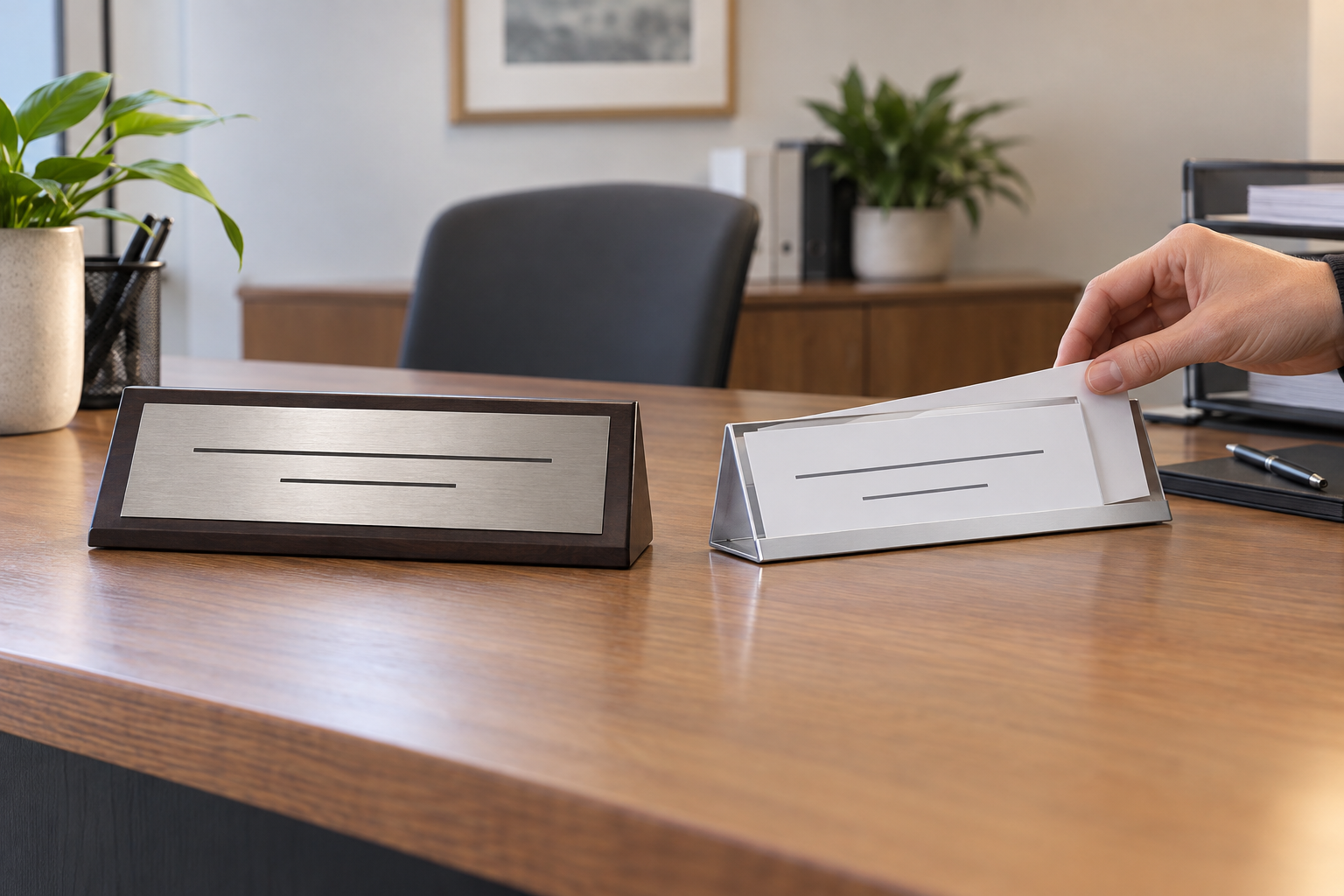
Compare both formats after measuring the desk
Check the visible face, complete base width and depth, viewing angle, finish, insert size and loading clearance, personalization instructions, and current correction or return terms. Confirm what is included on the live listing.
Quick comparison
| Decision | Engraved desk plate | Changeable insert nameplate |
|---|---|---|
| Best fit | Stable name, title, or room identity | Rotating staff, roles, messages, or desks |
| How copy changes | A new face, replacement, or vendor-supported revision may be needed | Print and load a new insert that matches the holder |
| Visual consistency | The finished face stays consistent after approval | Depends on a maintained print template and correct paper loading |
| Main mistake | Engraving unsettled wording | Buying before confirming visible insert size and access |
| Ongoing task | Keep the fixed face current and clean | Own the template, printing, trimming, loading, and old-insert removal |
1. Start with the life of the wording
Write the exact first and second lines, then ask what could make either line wrong. A preferred name may be stable while a title changes. A department may stay fixed while the person at the desk rotates. Engraving is easier to justify when every important line is expected to outlast the placement.
A changeable insert is not only for daily updates. It can be sensible when one revision during the holder's useful life would otherwise require replacing a personalized face. But flexibility has a cost in staff time: someone must retain the template, use the correct insert dimensions, approve the new copy, print it, trim it, and remove outdated versions.
2. Measure the visible face and full base separately
Product names rarely tell you how much text will remain visible. Record the actual opening width and height, not only the outside frame size. For an insert holder, allow for any edge captured by rails or a clear cover. For engraving, confirm the available line count, character guidance, capitalization, and proof process shown by the current seller.
Then measure the complete base. A long face may require a deep wedge or stand that competes with keyboards, payment terminals, paperwork, or visitor handoff space. Fold a paper or cardboard mockup to the listed outside dimensions and leave it on the working desk for a day before choosing.
3. Test readability with the real longest line
Print the longest realistic name or title at the proposed visible width. View it from the position where a visitor first needs the information, including a seated position if that is common. If the second line becomes tiny, shorten the wording instead of assuming a different material will solve it.
Finish and angle can change reflections. Test the mockup during normal working hours and from more than one approach direction. Product photography cannot predict a specific window, task light, or overhead fixture. Compare current face finishes and holder angles only after the message fits at readable type size.
4. Compare correction risk with update effort
With engraving, proofing happens before the fixed face is made. Check spelling, preferred name, credentials, punctuation, capitalization, line breaks, and title ownership. Review the seller's current proof, correction, cancellation, and return terms without assuming personalized goods follow the same policy as standard products.
With inserts, the physical holder is reusable, but an incorrect print can still reach the desk. Keep one controlled template with the exact visible area marked. Assign one person to approve revisions and remove obsolete inserts. That prevents mismatched fonts, clipped names, double-loaded paper, and stale titles.
5. Let placement decide the base and face
- Visitor-facing desk: prioritize the approach sightline, simple wording, and a base that leaves transaction or handoff space clear.
- Shared or rotating desk: an insert system makes a change visible only if updates happen before the new assignment begins.
- Home office: engraving can suit a stable personal or studio identity; a reusable holder is safer while a title or business name develops.
- Gift: confirm the recipient's exact preferred wording and likely display location before ordering permanent personalization.
- Wall or door: stop and compare wall-mounted formats; a tabletop base may solve the wrong placement problem.
When to choose neither
Skip a desk nameplate when the viewer already has the information, the desk position changes too often, the face would sit behind equipment, or no one owns updates. Use a door sign when the identity must be known before entry. Use a general counter sign when the real message is “Check in here,” “Pickup,” or another action rather than a person's identity.
For a changeable reception message, compare desk sign holders by insert access, glare, and footprint. If a replaceable nameplate will mount on a cabinet or divider instead, the magnetic vs adhesive nameplate-holder comparison addresses the substrate and relocation decision.
A no-cost mockup test
- Write the final copy for today and one realistic future update.
- Print both at the proposed visible face size.
- Fold a cardboard base to the listed complete depth and angle.
- Test the sign from the visitor approach, seated position, and staff side.
- Simulate an insert change, including printing, trimming, loading, and storing the template.
- Choose permanent engraving only if its lower update flexibility matches the expected life of the wording.
Bottom line
An engraved desk plate is the stronger match for settled wording and a permanent finished face. A changeable insert nameplate is the stronger match when reassignment or revision is plausible and someone will maintain the print workflow. Measure the visible area and full base, test the longest real line from the approach point, and choose the update burden your office can support.
Continue with the custom desk sign decision guide, the reception holder guide, or the small-business sign planning pillar.