 The Good Sign Company
Worth-it decision
Is a custom desk name sign worth it?
A custom desk name sign is worth it when the displayed name or role is unlikely to change, the desk has a clear viewing position, and personalization adds meaning that a replaceable paper insert cannot. Stay changeable when a job title, room assignment, brand, or recipient preference is still moving.
This is a personalize-or-simplify decision, not a ranking of sign makers. For a broader custom-project brief, start with the custom signs and light-box guide.
Disclosure: this page includes an approved partner link. We may earn from qualifying referrals.
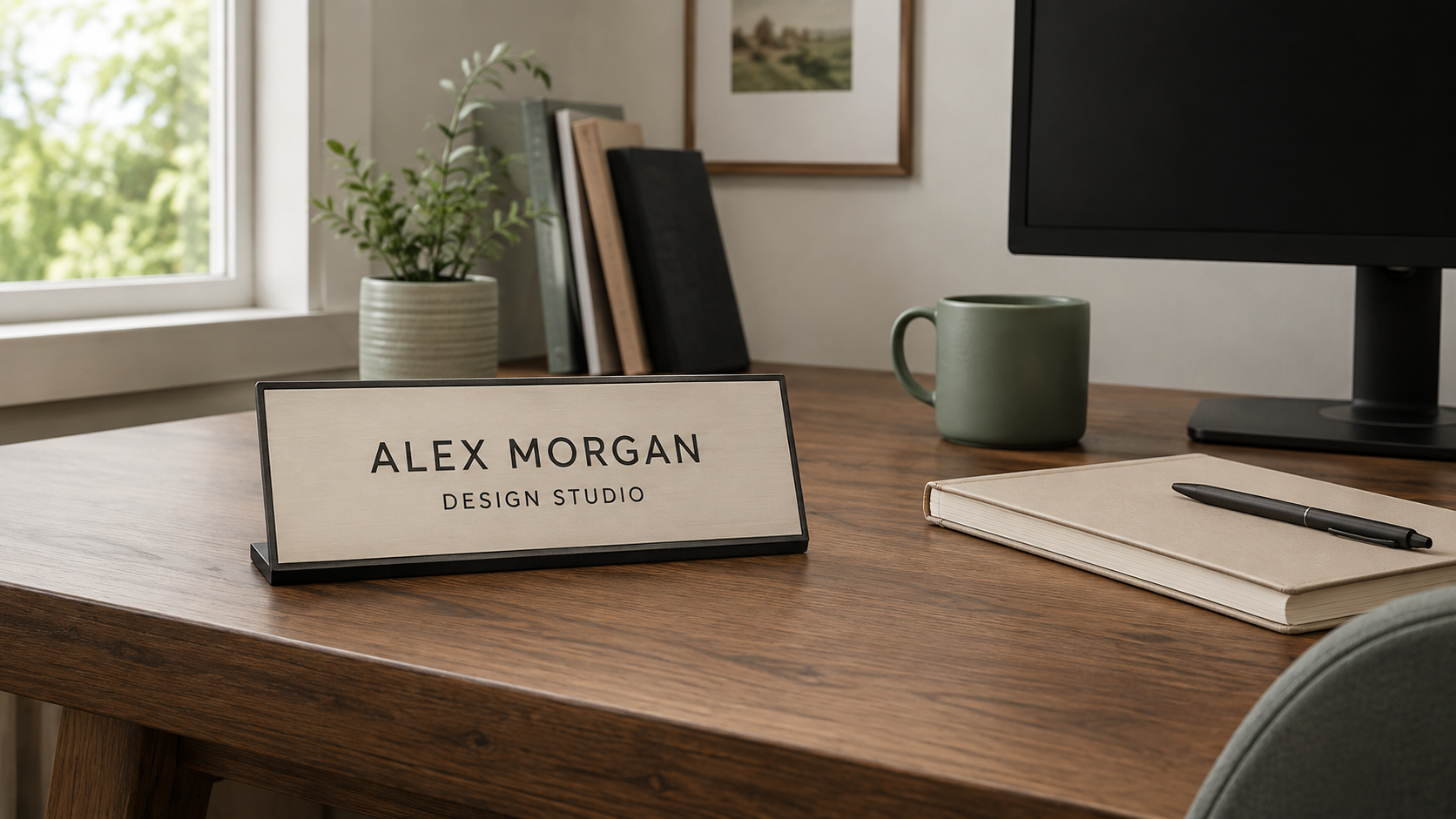
Prepare the wording and desk measurements before requesting custom work
Write the exact name and second line, measure the usable desk area, photograph the normal viewing angle, and decide whether the sign must face a visitor, a camera, or the desk user. Ask how proofs, corrections, dimensions, base style, and finish are handled before approving production.
Quick verdict: customize, test, or skip
- Customize: the name and role are settled, the sign has a defined audience, and a measured base fits without displacing everyday work.
- Mock it up first: print the final wording at the intended width, fold a paper base to the proposed depth, and view it from the actual chair, doorway, and camera.
- Use a changeable insert: staff assignments, titles, services, branding, or desk locations may change.
- Skip: the sign has no clear viewer, duplicates information already visible on a door or screen, or would live behind a monitor or desk clutter.
Start with how long the wording should remain true
Personalization has the most value when the message is specific and durable: a person’s preferred name, a stable studio name, or a short identifier used in the same place for years. A rapidly changing title creates avoidable correction risk. So does a business name or visual identity that has not been finalized.
Write every character exactly as it should appear, including punctuation, capitalization, credentials, and line breaks. Ask the recipient or responsible owner to confirm it. A proof is a decision checkpoint, not a substitute for settled wording. Review the maker’s correction and return terms because personalized products may be treated differently from standard goods.
Measure the footprint, not just the face
A desk sign can look compact from the front while its base occupies useful keyboard, notebook, payment, or product space. Measure the complete width and base depth. Place a paper rectangle of that size on the desk for several workdays and leave normal objects around it.
Check three sightlines: the seated user, a visitor standing or sitting across the desk, and a camera if the sign will appear in video calls. The ideal face angle differs between those positions. If the sign must serve all three, test whether one placement keeps the text visible without forcing it into the main work zone.
Custom sign vs changeable nameplate
- Custom desk sign: best when the wording is stable and the name, material, or visual treatment is part of the room or brand; changes can require replacement or rework.
- Changeable insert holder: best for rotating staff, temporary roles, shared desks, and printed updates; the hardware may look more utilitarian.
- Dry-erase nameplate: useful for frequent short updates, provided the writing area, marker, cleaning routine, and finish suit the setting.
- No physical sign: sensible when the viewer already knows whose desk it is or when a digital profile supplies the needed identity.
If the remaining choice is a permanent face or a reusable holder, compare an engraved desk plate with a changeable-insert nameplate. For broader reusable formats, compare desk sign holders for reception counters. For a wall rather than a tabletop, use the small-business reception wall sign guide.
Readability matters more than decorative detail
Test the longest real line at the expected viewing distance. A name may remain readable while a smaller title disappears. Simplifying the second line can improve the result more than making the entire sign larger. Avoid treating a detailed logo as automatically legible at tabletop scale.
Material and finish affect contrast and reflections, but product photos cannot predict the light in your room. Place the paper mockup where window light, task lamps, or overhead lights hit it. If glare obscures the text, change the angle or placement and ask the maker about available finish choices without assuming a particular material is offered.
A five-part brief prevents avoidable revisions
- Exact copy: final name, role, punctuation, capitalization, and line breaks.
- Audience: visitor, customer, camera, desk user, or gift recipient.
- Space: maximum face width, maximum base depth, and nearby objects.
- View: a photo from the normal eye level plus the intended reading distance.
- Approval: who checks spelling, layout, proof, and any correction terms before production.
For gifts, confirm the recipient’s preferred name and whether a role or business label is likely to last. A simpler first-name sign can sometimes age better than a highly specific job title.
Who should wait or choose another format?
- Wait when a job title, business name, logo, or shared-desk assignment is under review.
- Choose a printed insert when the sign must transfer among people or locations.
- Choose a wall sign when the message needs to be seen before someone reaches the desk.
- Choose a camera-background guide when on-screen readability—not tabletop identification—is the main job.
- Skip personalization when the recipient has not approved the wording or display style.
Bottom line
A custom desk name sign earns its place when its wording is stable, its audience is clear, and a measured mockup works from the real sightline without crowding the desk. If any of those conditions remain uncertain, a replaceable insert is the safer first step. Settle the copy, run the footprint test, review the proof carefully, and only then commit to personalization.
Next, compare changeable desk sign holders, plan a home-office sign, or review the custom sign project pillar.