 The Good Sign Company
Counter sign format comparison
Self-standing acrylic block vs insert sign holder: fixed or changeable?
Choose a self-standing acrylic block when the finished message will stay in place and the thick, polished presentation is part of the display. Choose an insert holder when staff need to replace a paper message without replacing the whole sign. Message lifespan is the first filter; visible area, full footprint, loading clearance, reflections, and cleaning routine decide the fit.
This guide covers compact indoor counter and tabletop displays. It does not rank named products or establish impact resistance, scratch resistance, food-service suitability, accessibility, or safe placement in a public route.
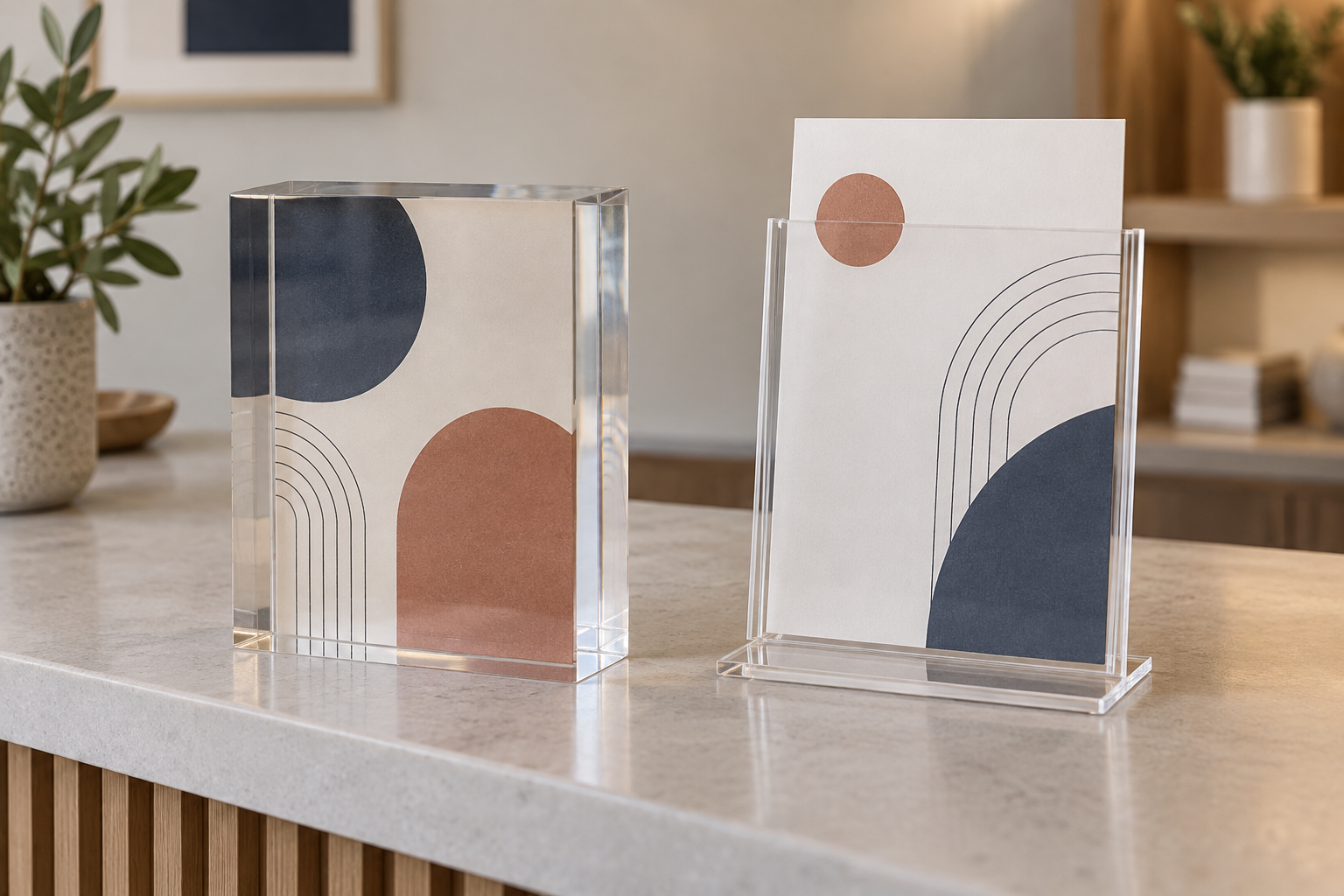
Compare construction before appearance
Check the current listing for the print or insert method, visible area, complete outside dimensions, base depth, orientation, loading direction, included parts, and care instructions. “Acrylic block” can describe a permanently printed piece or an opening photo frame, so verify the exact construction.
Quick comparison
| Decision | Self-standing acrylic block | Replaceable-insert holder |
|---|---|---|
| Best fit | Stable photo, logo, short instruction, or display message | Prices, schedules, promotions, menus, or notices that change |
| Message workflow | Often fixed, maker-produced, or opened less frequently | Print, load, align, and replace on site |
| Counter geometry | Thick body creates its own base | Folded, bonded, or separate base adds depth beyond the face |
| Presentation | Clear edge and visual depth are prominent | Paper message and practical loading access are prominent |
| Skip when | The message is still being tested or changes often | The exposed paper look conflicts with a long-lived finished display |
Who a self-standing acrylic block fits
A block fits a reception name, stable QR prompt, photo, gift display, or short branded message that has already passed copy and placement review. Its thickness supports the face without a rear leg, and its clear edges can be part of the intended look. That does not prove that every block is solid or permanently printed: magnetic sandwich blocks, slide-in blocks, and direct-print pieces require different update steps.
Before ordering, finish the artwork and confirm whether the seller prints it, expects a separate insert, or supplies two opening panels. Record the final visible area, border, full width and depth, orientation, and access method. For a fuller product-format review, use the acrylic block guide.
Who a replaceable-insert holder fits
An insert holder fits a counter whose information changes on a predictable schedule. Staff can print a new card locally, keep approved spares, and replace one sheet while reusing the holder. Top-loading, side-loading, L-shaped, T-shaped, and double-sided holders have different clearance and sightline needs, so “replaceable” alone is not enough to choose one.
Use the final paper size and orientation when checking listings. Measure the complete base, not only the face, and leave room for the paper to enter and exit. If cabinets or equipment limit that path, compare top-loading and side-loading holders before buying.
Setup test before ordering
- Finish the longest routine message. Print it at the intended size and check the type hierarchy without relying on a product mockup.
- Mark the complete footprint. Include the block thickness or holder base and keep payment, pickup, merchandise, and staff work areas clear.
- Test the normal approach. View the paper mockup from where the reader first needs the message, not only from directly in front.
- Recreate the room light. Check windows and overhead fixtures at normal operating times; changing the angle or position may help more than changing formats.
- Rehearse an update. For a holder, remove and replace a full-size sheet. For an opening block, follow the documented access method without improvising.
- Match a current listing. Confirm outside dimensions, visible area, construction, loading method, included components, intended use, and care guidance.
Message changes and production tradeoffs
A fixed printed block moves more of the production work before purchase: the wording, artwork, crop, and proof should be settled before the finished piece is made. That can suit an evergreen desk message, but it makes a poor prototype. Start with paper in a holder when the team is still testing language, scan behavior, or placement.
An insert holder moves production into the operating routine. Someone must own the source file, print the correct version, remove the old sheet, align the new one, and discard outdated copies. If consistency across locations matters, name the file owner, paper specification, approval step, and replacement date rather than assuming every counter will update itself.
Glare, depth, and counter space
Both formats can reflect windows and ceiling lights. A block adds a deeper clear edge and may show reflections through several surfaces; a holder places a clear face in front of paper and may expose a rear face as well. Neither format is universally lower-glare. Test a full-size mockup at the real viewing angle, then inspect the completed product again after installation.
Depth works differently too. The block occupies roughly its full material thickness along the counter. An angled or T-shaped holder may extend beyond the sign face at the base. Compare listed outside dimensions with a traced rectangle on the counter, including any paper-loading movement.
Cleaning and maintenance
- Follow the maker’s care instructions. Do not assume one cleaner suits every acrylic, printed surface, coating, adhesive, or paper insert.
- Remove loose grit carefully. Use only the tools and method allowed for the exact product; this guide makes no scratch-resistance claim.
- Handle inserts with clean, dry hands. Replace curled, stained, or outdated sheets and keep approved spares flat.
- Check alignment after cleaning. Re-center opening block panels and holder inserts according to their documented construction.
- Assign an owner. Decide who cleans the sign, checks the message, and approves the next version.
Who should skip both
- The message must be read from farther away than a compact counter face allows.
- The sign would obstruct payment equipment, merchandise, service work, or an active customer path.
- The planned print, thickness, orientation, or loading clearance falls outside the documented product dimensions.
- The location is outdoors, overhead, unstable, or otherwise outside the product’s stated use.
- The message needs handwriting during use; compare a purpose-made printed insert and dry-erase counter sign instead.
- The display needs two approach directions; first compare a single-sided and double-sided counter sign.
Bottom line
A self-standing acrylic block fits a stable message whose finished depth and clear edges matter. A replaceable-insert holder fits a maintained message system where local paper updates matter more. Choose only after measuring the complete object, testing the normal sightline and light, and assigning the print, cleaning, and update routine.
Continue with the small-business sign planning pillar, or use the reception counter sign-holder guide when the message, paper size, and viewing direction are already settled.