 The Good Sign Company
Indoor room-status comparison
Room-availability slider sign vs dry-erase door sign
Choose a slider when the room needs a small, repeatable set of states such as “available” and “in use.” Choose a dry-erase sign when staff regularly need names, times, destinations, or exceptions. The better format is the one the team can update, read, and reset consistently—not the one that appears more flexible in a product photo.
This comparison covers ordinary indoor workflow planning. It does not determine privacy, accessibility, property, mounting, emergency, security, or code requirements. Confirm the exact sign, surface, placement, and project rules with the responsible stakeholders.
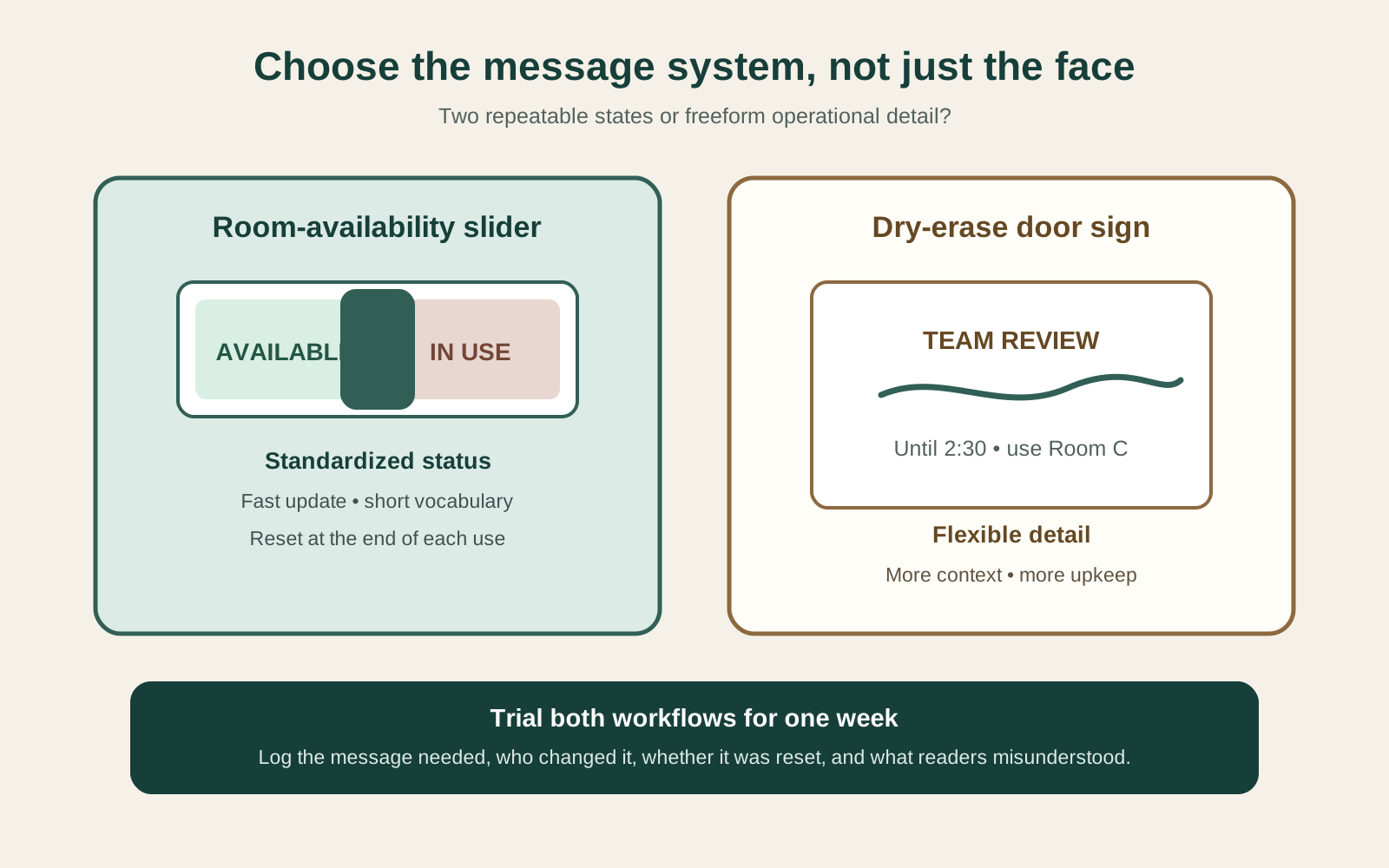
Quick decision
- Choose a slider when everyone uses the same two or three short states and the person entering or leaving the room can move the indicator.
- Choose dry erase when the message needs a name, end time, temporary room role, or short exception that cannot fit a fixed state vocabulary.
- Pause both options when no one owns the update, the sign is hidden from an important approach, the mounting surface is unsettled, or the team has not agreed what may be displayed.
Compare the operating workflows
| Decision | Availability slider | Dry-erase door sign |
|---|---|---|
| Message range | A limited set of predefined states | Short freeform names, times, notes, or exceptions |
| Update action | Move the indicator to the correct state | Erase, rewrite, and return the compatible marker |
| Consistency | Wording and layout remain fixed | Handwriting, wording, and spacing can vary |
| Reset risk | A stale state remains after the room changes | Old detail remains, or the face is cleared incompletely |
| Supply dependency | Current labels and an operable mechanism | Compatible marker and documented cleaning supplies |
| Best evidence | A short status list and observed state changes | A log of the actual details staff need to display |
Who a room-availability slider fits
A slider fits a shared room where the operational question is deliberately narrow: may someone enter, or is the room currently unavailable? Its main benefit is constraint. Staff do not need to compose a message, find writing space, or interpret different handwriting.
That constraint is also the weakness. If the team routinely needs “available at 2:30,” “session in progress,” or “use Room C,” a two-state slider cannot carry the exception. Do not add more states until staff can define when each begins, who selects it, and what clears it.
Who a dry-erase door sign fits
A writable sign fits a studio, consultation room, treatment room, or shared workplace where the useful detail changes from one use to the next. It can carry a short name, time, room role, or alternate destination without producing a new insert.
Flexibility creates editorial and maintenance work. The organization must decide what information is appropriate to display, keep the message short enough to read, follow the exact maker’s marker and cleaning instructions, and assign someone to clear stale details. This page does not decide what information is appropriate for a particular workplace.
One-week message log
Run this original planning exercise before choosing a format. It is not a product test. For each room-status change over five operating days, record:
- Date and time of the change: ______
- Exact message a person approaching the room needed: ______
- Could a predefined state express it? yes / no
- Who changed the sign: ______
- Was the state or note reset on time? yes / no
- Did anyone ask for information the sign did not show? ______
- Was any proposed detail inappropriate to display? ______
If nearly every entry reduces to the same two states, investigate a slider. If exceptions, names, and end times recur, investigate a writable face—but only with a defined content and cleaning routine.
Worked example: test the message before the hardware
Hypothetical example, not a measured workplace: a three-room studio logs 24 status changes in one week. Nineteen require only “available” or “in use.” Five require a short exception such as “class ends 3:00” or “use Studio B.” The operations lead should not declare dry erase the winner from those five exceptions alone. The team can compare a standard slider plus an existing scheduling channel against a writable sign that must be updated and cleared 24 times.
The deciding output is a workflow, not a percentage: what must be visible at the door, what belongs elsewhere, who changes it, and how missed resets are corrected. If the exception details are not necessary at the door, the simpler slider may still fit. If they repeatedly prevent confusion, the writable option may earn its upkeep.
Setup and maintenance issues
For either format, measure the complete available area, record all approach directions, check the sign with the door open and closed, and make a full-size paper mockup. Confirm the exact item’s overall and visible dimensions, operating clearance, mounting instructions, compatible surfaces, and care directions from current primary documentation. Do not assume a magnetic-looking door attracts a magnet or that an adhesive will remove without affecting a finish.
For a slider, include the state vocabulary and reset trigger in the room procedure, and periodically confirm that the indicator moves and the labels remain legible. For dry erase, store the maker-compatible marker and cleaning supplies with a named owner, define acceptable message content, and inspect whether writing remains readable from the real approach. Follow the maker’s instructions rather than general category advice.
When to skip a slider
- The room regularly needs a name, time, alternate destination, or other short exception at the door.
- The available labels do not match the team’s agreed vocabulary.
- No one reliably changes the state when entering and leaving.
- The operating control cannot be reached or used comfortably in the proposed position.
When to skip a dry-erase sign
- The message is always one of two short states and freeform space would add unnecessary work.
- No one owns the marker, cleaning routine, content rules, or end-of-use reset.
- Normal handwriting does not fit the visible area at a readable size.
- The organization has not decided what information may be displayed at the room.
Next steps
Start with the broader conference-room availability sign guide to map approach directions, vocabulary, mounting limits, and the update owner. Use the dry-erase door nameplate worth-it test when the writable format remains the candidate, and the small-business sign planning guide to assign site inputs, approvals, and handoffs.
Evidence boundary and editorial QA
This page makes no product-specific claim about dimensions, materials, marker compatibility, cleaning, mounting, surface suitability, durability, privacy, accessibility, or performance. Those facts must come from current primary instructions for the exact item and project. The comparison table, one-week log, hypothetical example, and skip tests are original planning tools from The Good Sign Company editorial desk.
AI-assisted tools helped prepare and reconcile this page. The editorial desk inspected the local hero as an illustration, checked overlap and internal links, and remains responsible for hypothetical labels and unsupported-claim removal; see our About and editorial process.
Bottom line
A slider is a disciplined choice for a few repeatable states. A dry-erase sign earns its extra flexibility only when necessary details recur and someone maintains the message. Log one week of real needs, trial both faces at full size, and reject any format whose current instructions, placement, or update owner cannot be verified.