 The Good Sign Company
Worth-it decision
Is a dry-erase door nameplate worth it for a shared room?
A dry-erase door nameplate is worth it when a short room name, staff name, or availability note changes at least weekly and one person will keep the writing legible and current. Use a printed insert when changes are occasional or a polished type style matters. Choose a fixed sign when the message is stable. Before buying, test the wording at actual size and confirm the marker, cleaning, mounting, and surface instructions for the exact product.
This guide addresses whether the erasable format earns its place. For the broader choice among fixed plaques, sliders, and insert holders, start with the office door sign guide.
Disclosure: As an Amazon Associate, we may earn from qualifying purchases and approved partner referrals.
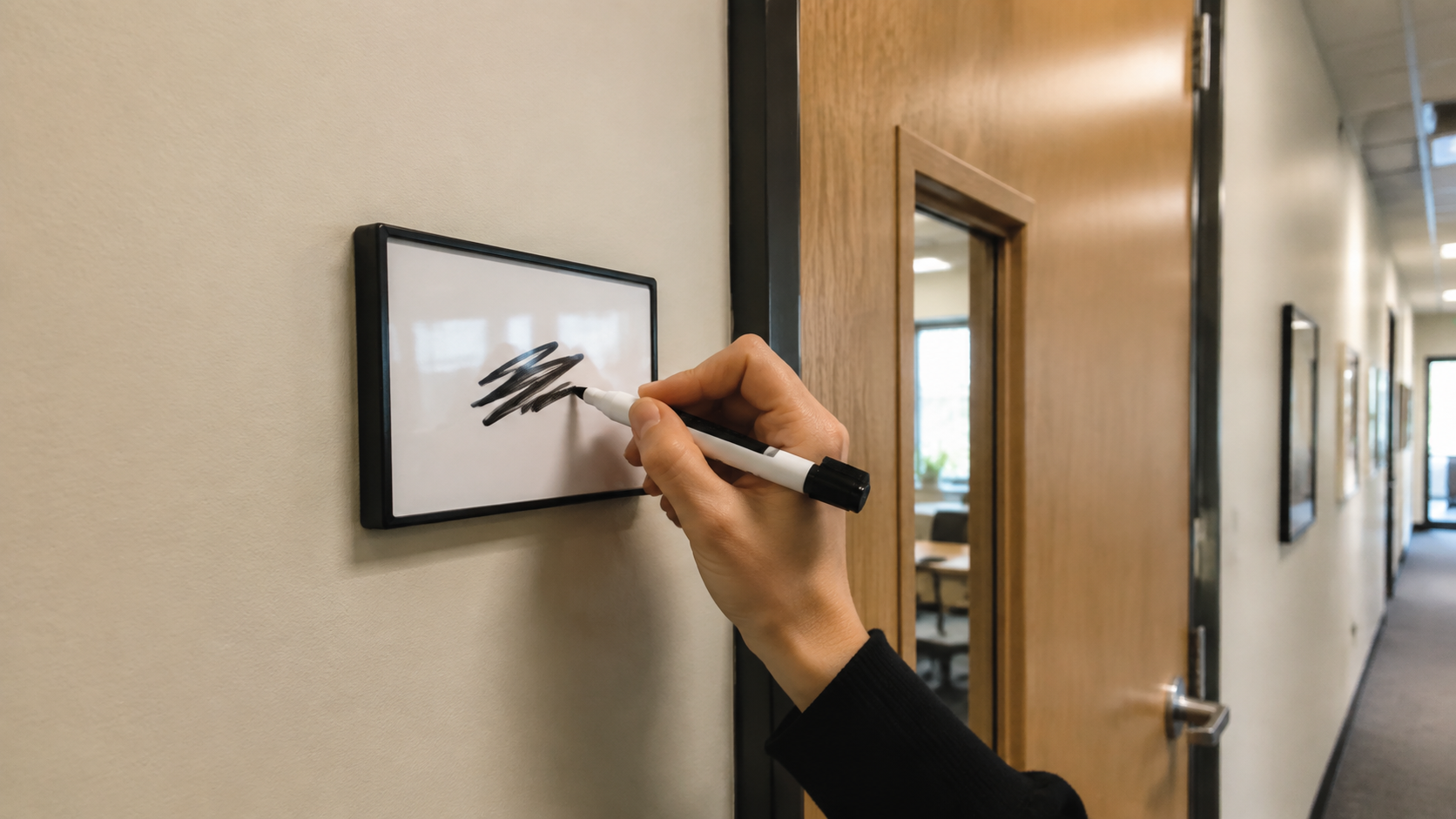
Compare nameplates after testing the message
Check the visible writing area, complete dimensions, compatible markers, cleaning directions, mounting method, surface exclusions, orientation, and included parts. Do not assume every marker erases cleanly or every adhesive suits every door finish.
Quick verdict: buy, trial, or skip
- Buy: names or short statuses change weekly or more often, the approved mounting surface suits the listed method, and someone owns updates and cleaning.
- Trial first: tape a paper rectangle at the planned location, write the longest typical message at normal size, and check it from the real approach for a week.
- Use a printed insert: changes happen monthly or seasonally, consistent typography matters, or different staff members have uneven handwriting.
- Skip: the message is permanent, the surface or placement is unresolved, glare obscures the face, or nobody will remove stale information.
The update-frequency test
The erasable face solves one problem: frequent, small changes without printing another card. Count the real updates from the last eight weeks. A rotating staff name, room booking note, or short class label may justify it. A room name that changed once last year probably does not.
Also count the work around each update. Someone must find the compatible marker, erase the old message according to the maker's directions, rewrite it clearly, and return the marker. If that routine is more annoying than printing a new insert, the writable face is not the simpler system.
Make sure the message fits the writable area
- Write the longest likely name or status on paper without squeezing the letters.
- Cut the paper to the product's listed visible writing area, not its outside frame size.
- Place it where the sign may be mounted and view it from the corridor approach.
- Check it with the door open and closed; a door-mounted sign can move out of view.
- Shorten the message or choose a larger format if normal handwriting becomes cramped.
A dry-erase face is better for “Studio A,” “Jordan,” or “In Session” than for instructions, schedules, or several names. Use a larger dry-erase schedule sign when the information needs rows, dates, or multiple fields.
Dry-erase face vs printed insert vs fixed plaque
- Dry-erase nameplate: fastest for brief, frequent handwritten changes; depends on compatible markers, readable handwriting, cleaning, and glare control.
- Printed insert holder: better for occasional changes, consistent branding, longer names, or a shared template; requires access to the file and printer.
- Fixed plaque: best for a stable room function where no update mechanism is needed; poor fit when assignments are still moving.
- Status slider: useful for a tiny set of repeated states such as available or occupied, provided staff will keep it current.
Glare, markers, and cleaning can change the answer
Glossy writable faces can reflect windows and ceiling lights. Hold the paper mockup behind a clear sleeve or glossy sheet, then check the normal approach at different times of day. If reflections cover the writing, a matte printed insert or a different angle may be easier to read.
Follow the product maker's current marker and cleaning instructions. “Dry erase” does not establish compatibility with every marker or cleaner, and this guide does not promise stain-free use. Keep the approved marker with the update supplies rather than asking everyone to use whatever is nearby.
Mounting and shared-room limits
Confirm whether the exact nameplate mounts with screws, adhesive, magnets, hooks, or a holder, then compare that method with the actual door or adjacent wall. A metal-looking surface is not necessarily magnetic. Adhesive removal can affect some finishes. Door movement can also hide, loosen, or repeatedly jolt a sign, so an approved adjacent-wall position may work better.
This is product-selection guidance, not accessibility, lease, landlord, fire, or code advice. Room-identification signs and their placement can be subject to building-specific requirements. Ask the property contact and relevant qualified professional before replacing required identification or mounting anything in a controlled location.
Who should choose another format?
- Choose a printed insert when names change occasionally and the office needs consistent type and logo placement.
- Choose a fixed plaque when the room function is settled for the foreseeable future.
- Choose a larger board when the message includes a schedule, instructions, or several names.
- Use a digital or booking system when information changes too rapidly for staff to keep a physical sign accurate.
- Delay the purchase when mounting permission, surface compatibility, or required room-identification rules are unresolved.
Bottom line
A dry-erase door nameplate is worth it for a genuinely frequent, short update on a confirmed indoor surface—with a compatible marker, readable writing area, manageable glare, and an owner for upkeep. It is not automatically the flexible choice if the sign remains stale or messy. Run the paper trial first, then compare the current product instructions with the real door and cleaning routine.
Next, compare office door sign formats, review the small-business sign planning pillar, or choose a larger reusable format with the dry-erase schedule guide.