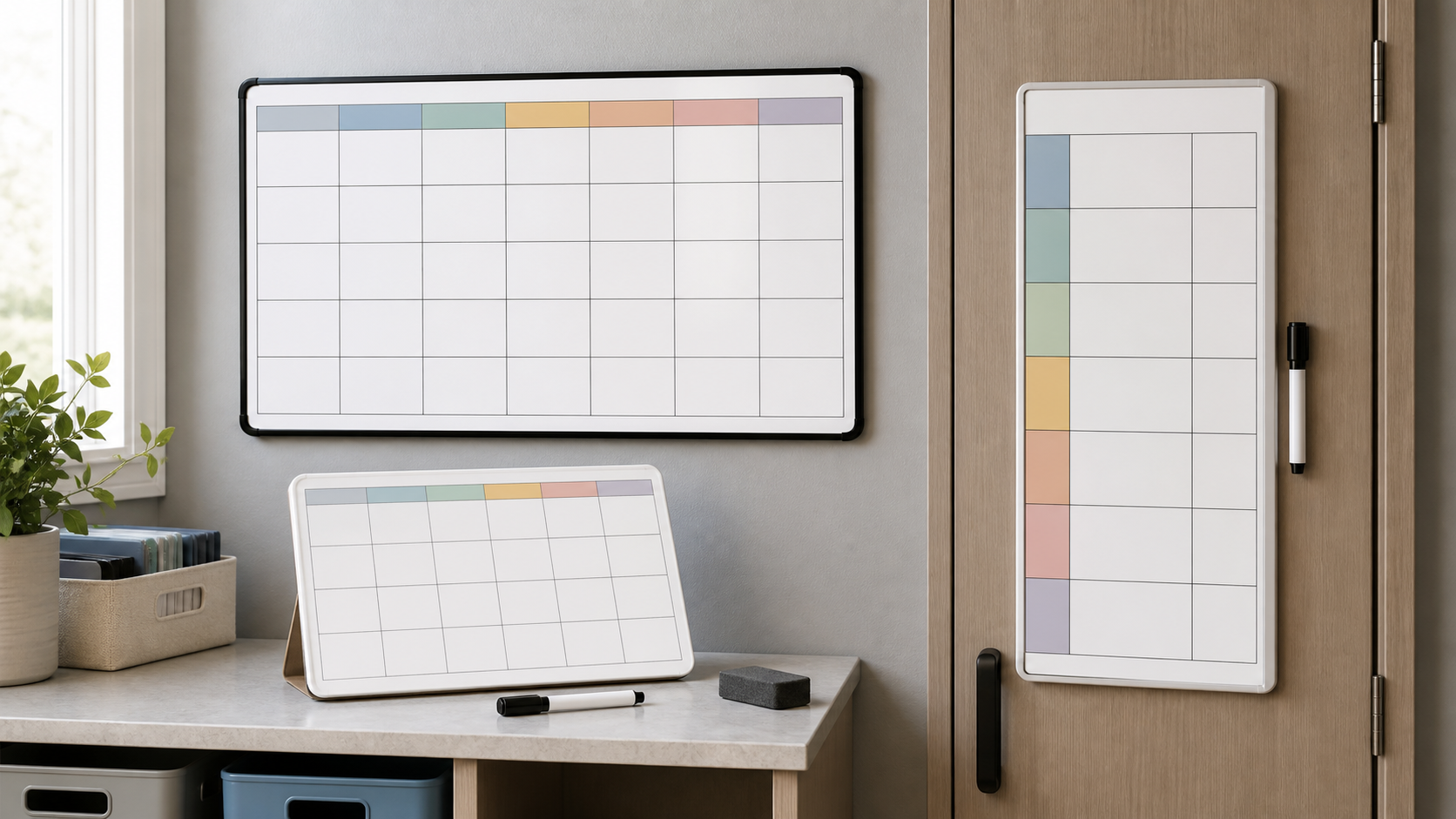
Wall-mounted weekly grid: good fit for a shared schedule
A fixed grid gives several people one reference point. Verify cell size, writing height, mounting instructions, wall fit, and whether glare hides entries from the main approach.
 The Good Sign Company
Independent publisher disclosure: We may earn compensation from DaNite Sign Company referrals.
Talk to DaNiteReusable Schedule Sign Guide
The best dry-erase schedule is not necessarily the largest board. It gives each update enough writing room, stays readable from the decision point, fits the available wall or counter, and makes erasing, rewriting, and marker storage easy enough that people will actually maintain it.
Best overall starting route
Write the longest realistic entry on a paper mockup before shopping. Compare the usable writing area—not only the outside dimensions—plus grid spacing, mounting method, marker storage, supplied care guidance, and the distance from which the schedule must be read.
This is a product-category comparison and buying framework, not hands-on testing or a ranking of current named products. Compare candidates in this order:
A fixed grid gives several people one reference point. Verify cell size, writing height, mounting instructions, wall fit, and whether glare hides entries from the main approach.
A tabletop format can move with the workflow and avoids wall mounting. Count the full base footprint, check the viewing angle and stability, and leave enough counter space for normal tasks.
A vertical panel can use a door or cabinet area that will not fit a wide weekly board. Confirm that the surface is appropriate, hardware clears movement, and the narrow cells still fit real entries.
List the information that must appear every time: a date or day, time, name, location, status, and any brief note. If a cell cannot fit a normal entry without abbreviations nobody understands, the layout is too dense. A larger blank board with a simple hand-drawn structure may be more useful than a preprinted grid with tiny cells.
Test a paper version in the proposed location for several update cycles. This shows whether people can reach the top row, whether a door blocks the view, whether window light creates reflections, and whether the update process interrupts counter or desk work.
Surface-cleaning results depend on the board, marker, time between erasing, and care method. Treat seller claims as product-specific evidence and follow the supplied instructions rather than assuming a board will always erase perfectly.
Choose the simplest format that gives normal entries enough space. Mock up the smallest cell, test the viewing position, decide who updates the schedule, and make marker storage part of the setup. For most shared weekly schedules, a wall grid is the clearest starting point; use a tabletop board when portability matters or a slim panel when the available surface is narrow. Continue with the small-business sign planning pillar for visibility and placement, or compare dry-erase schedule board categories.