 The Good Sign Company
Recurring-event storage decision
Is a sign storage rack worth it for recurring events?
A dedicated rack is more likely worth it when several rigid signs return to the same indoor storage room, are reused often, and are awkward to retrieve from a horizontal stack. It is usually unnecessary for one or two boards, rolled graphics, or signs that must stay in fitted travel cases. Inventory the actual boards and the available storage footprint before comparing racks.
Disclosure: As an Amazon Associate, we may earn from qualifying purchases and approved partner referrals.
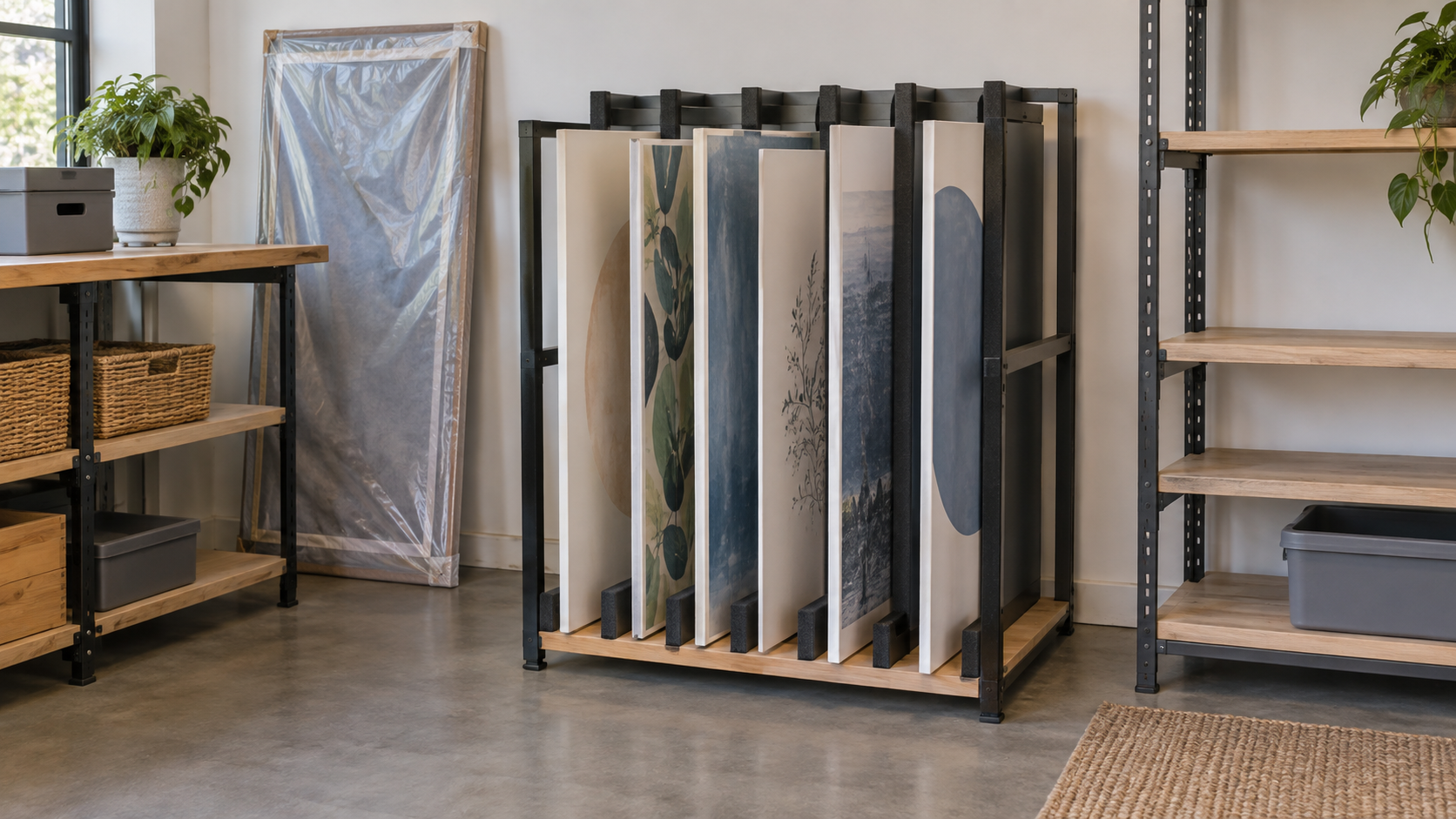
Compare a rack with your measured board inventory
Record every board's complete height, width, thickness, and current handling guidance. Compare those measurements with the rack's documented usable slot width, base depth, overall dimensions, capacity, and assembly instructions. A generic photo or stated item count does not establish fit.
Quick verdict
- More likely worth it: you have several compatible rigid boards, frequent reuse, a permanent indoor storage zone, and a need to remove one sign without shifting the rest.
- Less likely worth it: the inventory is small, changes shape often, or already stores safely on accessible flat shelves.
- Wrong job: transport, shipping, climate control, or protection promised only by a purpose-specific case or the sign maker's instructions.
- Do not shop yet: if you have not measured the largest board, thickest edge or frame, slot clearance, rack footprint, and retrieval path.
The six-question worth-it test
| Question | A rack has a case when… | Use a simpler option when… |
|---|---|---|
| How many boards? | Several rigid signs need separate, repeatable positions. | One or two boards fit an accessible shelf or individual sleeve. |
| How often are they reused? | Teams retrieve and return individual signs throughout the event calendar. | The set comes out rarely and can stay packed together. |
| Are the formats compatible? | Measured panels and frames fit documented slot dimensions and clearances. | Rolled, folded, lighted, projecting, or irregular pieces need different storage. |
| Is access the problem? | One board must come out without unstacking or moving the others. | A labeled flat shelf already gives direct access. |
| Is space committed? | The complete rack footprint fits a dry indoor location without taking needed work space. | The rack would obstruct doors, equipment, shelving, or the normal route. |
| Who owns the system? | One person maintains labels, slot assignments, inspection, and returns. | No one will restore signs to assigned positions after an event. |
Inventory the signs before the furniture
List each rigid panel, frame, base, and projecting attachment. Measure the complete item rather than the printed face. A frame, folded support, fastener, or edge trim can determine whether a slot works. Record which pieces may touch and which require a sleeve, separator, or different storage method under their current instructions.
Sort the inventory into rigid flat boards, rolled graphics, fabric pieces, stands, and hardware. A vertical board rack should not become a catch-all for incompatible shapes. For a kit that travels as mixed components, use the portable sign case guide to map compartments and the transport route.
Measure usable slots and the retrieval path
Compare the thickest stored edge with the rack's documented usable slot opening, not the center-to-center spacing visible in a photo. Check the tallest and widest board against any top rail, side frame, wall, or adjacent shelving. Leave enough access to lift or slide a board according to its handling guidance.
Then map the route from rack to packing table and vehicle. The storage location should let the assigned person identify and retrieve the right board without dragging faces across one another or temporarily leaning other panels in a walkway. This is an operating check, not a claim that any rack prevents damage.
Count the complete footprint
Mark the rack's published outside dimensions on the floor with removable tape and add the access area needed to load its deepest slot. Open nearby doors and drawers and walk the normal room route. Include base projections, feet, wall clearance, and any anchoring or assembly requirements in the plan.
Follow the current rack manufacturer's assembly, placement, capacity, and maintenance instructions. Confirm that the intended sign materials and finishes may be stored in the chosen orientation and indoor conditions; when those details are unclear, ask the sign maker or product manufacturer rather than treating the rack category as universal.
Compare three simpler alternatives
- Flat shelf with separators: sensible for a small inventory when shelf dimensions support the boards and each one remains individually reachable.
- Individual sleeves: useful for separating compatible printed panels while keeping identification visible; verify complete fit and closure rather than assuming protection.
- Travel cases or bags: better when the same grouped kit stays packed between events. Compare event-sign storage bags by measured interior dimensions and packing order.
Run a two-event pilot
- Photograph and measure the current inventory and storage area.
- Assign every compatible board a numbered mock slot using temporary dividers on an existing shelf or floor-marked zone.
- Retrieve, inspect, pack, return, and refile the signs for two real events.
- Record search time, boards that do not fit the grouping, blocked access, and unused footprint.
- Buy a rack only if separate vertical access solves a repeated problem and current specifications fit the measured inventory.
Who should skip it?
- Skip a dedicated rack for one or two boards that already have an appropriate, accessible home.
- Skip it when most graphics roll, fold, stay attached to stands, or require fitted cases.
- Do not use slot count as capacity; verify usable dimensions and current manufacturer guidance.
- Skip a location that interferes with normal doors, equipment, work areas, or circulation.
- Do not assume vertical storage suits every face, frame, material, attachment, or environmental condition.
- Delay the purchase when no one owns inspection, labeling, retrieval, and return.
The bottom line
A sign storage rack can be worth its floor space when a recurring event program has several compatible rigid boards and individual access is the real bottleneck. Measure the whole inventory, test the retrieval workflow through two events, and compare the rack's documented slot and footprint dimensions with the room. Use shelves, sleeves, bags, or fitted cases when the inventory or job points elsewhere.