 The Good Sign Company
Indoor office directory comparison
Fixed-panel vs changeable-insert office directory
Choose a fixed panel when the approved destination list is genuinely stable and a future change can trigger a controlled remake. Choose changeable inserts when names or assignments change often enough to justify a maintained row system. The deciding evidence is the directory’s change history and update ownership, not which finish looks more permanent.
This comparison covers ordinary indoor directory planning. It does not determine accessibility, code, landlord, mounting, structural, or installation requirements. Verify the actual system, wall, property conditions, and project requirements with the responsible stakeholders and provider.
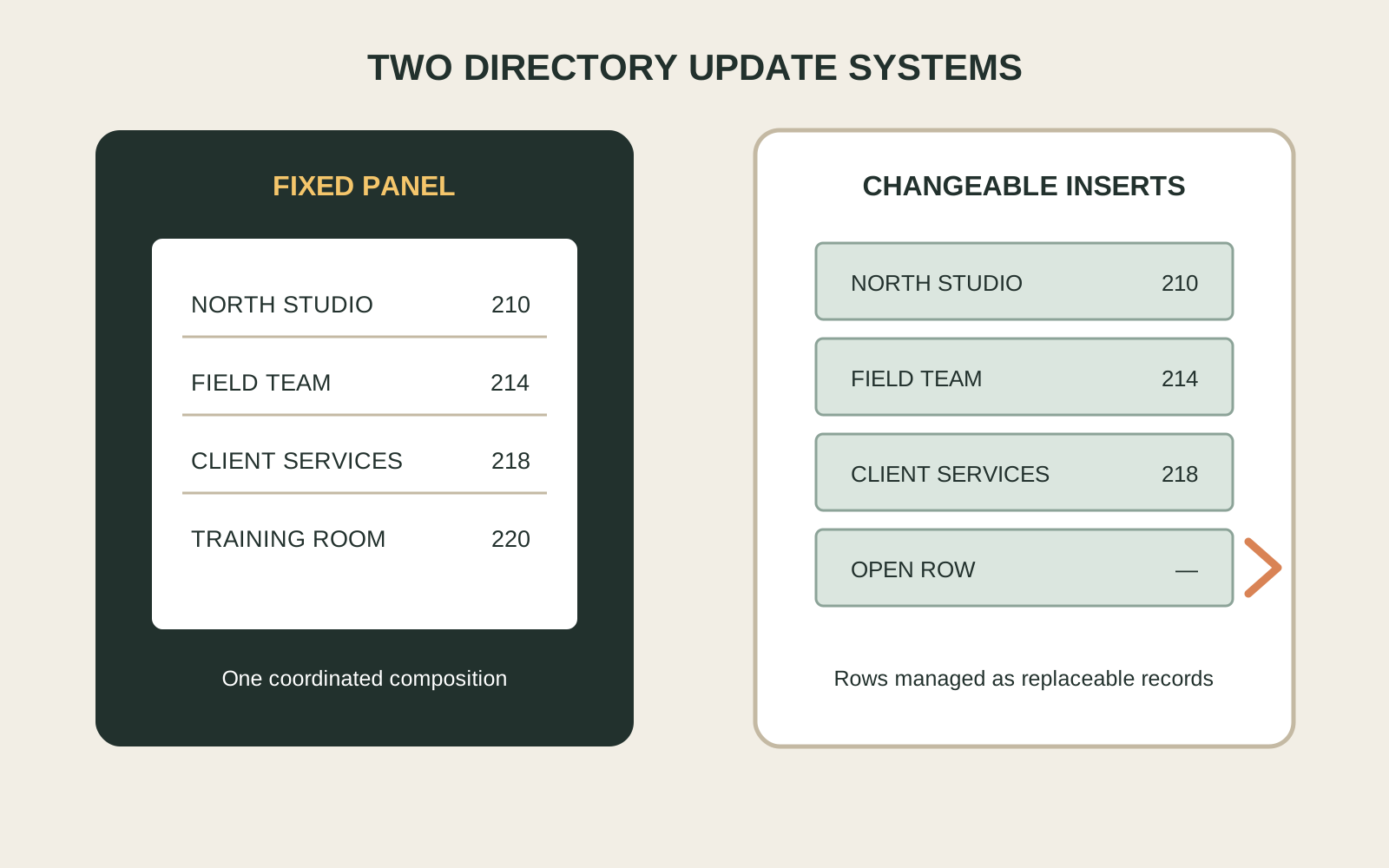
Quick decision
- Choose fixed-panel when the public names, room assignments, and destination count have stayed stable through a meaningful review period, and the organization accepts remaking the relevant panel when they change.
- Choose changeable inserts when tenant, team, or room assignments change on a recurring basis and one named owner can control templates, replacement parts, approvals, and installation of each update.
- Pause either route when the source list, naming authority, wall facts, viewing position, update owner, or approval path is unsettled.
Compare the operating models
| Decision | Fixed panel | Changeable inserts |
|---|---|---|
| Content model | One coordinated composition | Individual rows or modules managed as records |
| Best fit | Stable names and destinations | Recurring, controlled changes |
| Update event | Revise and reproduce the affected fixed component | Produce, approve, and load a matching replacement insert |
| Capacity question | Will the complete future list still fit the composition? | Are enough compatible rows and replacement parts planned? |
| Governance risk | An outdated panel may remain because a remake was not started | Rows may drift in wording or appearance without a controlled template |
| Maintenance record | Archive approved artwork and production details | Archive template, insert specifications, spare inventory, and change log |
Who a fixed-panel directory fits
A fixed panel fits an office where public-facing names and destinations rarely change, one approval cycle can cover the whole composition, and the team has a defined process for correcting the panel later. Its main operational advantage is coherence: spacing, alignment, and hierarchy are approved together.
Do not call the list stable from intuition. Review dated move, rename, and correction records. A directory that changed four times last year is not operationally stable just because the wall currently looks settled. Ask a provider how the proposed fixed construction is revised, what records must be retained, and which portion would need replacement; do not assume the answer from the category name.
Who a changeable-insert directory fits
A changeable system fits a shared suite, department floor, or multi-tenant workplace where destinations change predictably and facilities can own a controlled update process. Replaceability is useful only when the organization maintains the correct template, compatible insert route, spare capacity, approval record, and person authorized to load changes.
Before selecting a system, ask for current documentation covering visible area, insert dimensions, loading method, artwork requirements, replacement parts, mounting, and care. Print the longest approved real names at full size. A nominal row count is not enough if long names cannot be handled consistently in the available visible area.
Change-cadence worksheet
Use the last 12–24 months if those records exist. This is an original planning exercise, not a performance formula or product test.
- Current listed destinations: ______
- Names added, removed, renamed, or reassigned in the review period: ______
- Corrections caused by source-list or proofing errors: ______
- Longest approved public-facing name: ______
- Known upcoming moves or vacancies: ______
- Person who approves public names: ______
- Person who orders or produces updates: ______
- Person who installs the change and logs the date: ______
- Acceptable process when a replacement is delayed: ______
Worked example: count the update events
Hypothetical example, not a measured project: a 12-destination shared office recorded two tenant replacements, one suite reassignment, and one naming correction in 18 months. The team should not conclude automatically that four events make inserts cheaper or better. It should price and document both workflows: which fixed component each event would have changed, and which insert, approval, inventory, and staff steps each event would have required.
The useful output is a comparable update brief. If nobody can own the insert template and change log, a modular system can become inconsistent. If a fixed remake has no budget owner or trigger, the fixed directory can remain outdated. Governance can eliminate either option before finish or price is discussed.
Setup and maintenance issues
Both routes need an approved source list, actual-size copy trial, measured viewing position, wall and site information, proofing authority, installation scope, cleaning instructions, and an update record. Ask the selected provider for project-specific instructions and identify any assumptions before production.
For a fixed panel, retain final artwork, typography rules, production references, and the contact who initiates a correction. For changeable inserts, retain the exact template, supported media or replacement route, row assignment list, spare-part inventory, loading instructions, and a dated change log. Follow only the maker’s documented care and loading method for the selected system.
When to skip a fixed panel
- The destination list is still changing or an upcoming move is already known.
- The organization cannot identify what a correction or name change would require.
- Long names have not been tested at actual size.
- A temporary directory would avoid locking unsettled information into production.
When to skip changeable inserts
- No one owns templates, approvals, spare parts, or the update log.
- The current supplier cannot document compatible replacement inserts or parts.
- The proposed visible area does not handle the longest real names consistently.
- The list is stable enough that modular capacity and update procedures add work without solving a recurring problem.
Next steps
Start with the broader interior office directory planning guide to inventory destinations and test the viewing position. Use the small-business sign planning guide to assign stakeholders, approvals, site inputs, and provider handoffs. If individual room identifiers are the remaining decision, compare an engraved nameplate with a changeable-insert nameplate separately rather than treating a coordinated directory as a collection of unrelated door signs.
Evidence boundary and editorial QA
This page makes no product-specific material, capacity, installation, durability, or performance claim. Those details must come from the current primary documentation for the exact system being considered. The comparison table, change-cadence worksheet, hypothetical exercise, and governance tests are original planning tools from The Good Sign Company editorial desk. The hero was inspected as an illustration and is labeled accordingly; no hands-on test or project observation is claimed.
AI-assisted tools helped prepare and reconcile this page. The editorial desk remains responsible for overlap review, claim boundaries, hypothetical labels, and unsupported-claim removal; see our About and editorial process.
Bottom line
A fixed panel favors a stable, coordinated composition; changeable inserts favor recurring updates with disciplined ownership. Audit real changes, test the longest names at full size, document both update workflows, and reject any system whose current instructions or replacement route cannot be verified.