 The Good Sign Company
Counter insert format comparison
Clear menu sleeve vs rigid acrylic sign holder: which fits your counter?
Choose a clear menu sleeve when the printed insert needs a flexible enclosure that staff can carry, file, or place into a separate support. Choose a rigid acrylic holder when the display needs to stand on its own in one measured counter position. The deciding factors are support, complete footprint, loading access, handling, storage, reflections, and who updates the sheet.
This guide covers replaceable printed messages used indoors on counters and vendor tables. It does not establish food-contact suitability, liquid protection, scratch resistance, sanitization, accessibility, or safe placement in a customer route.
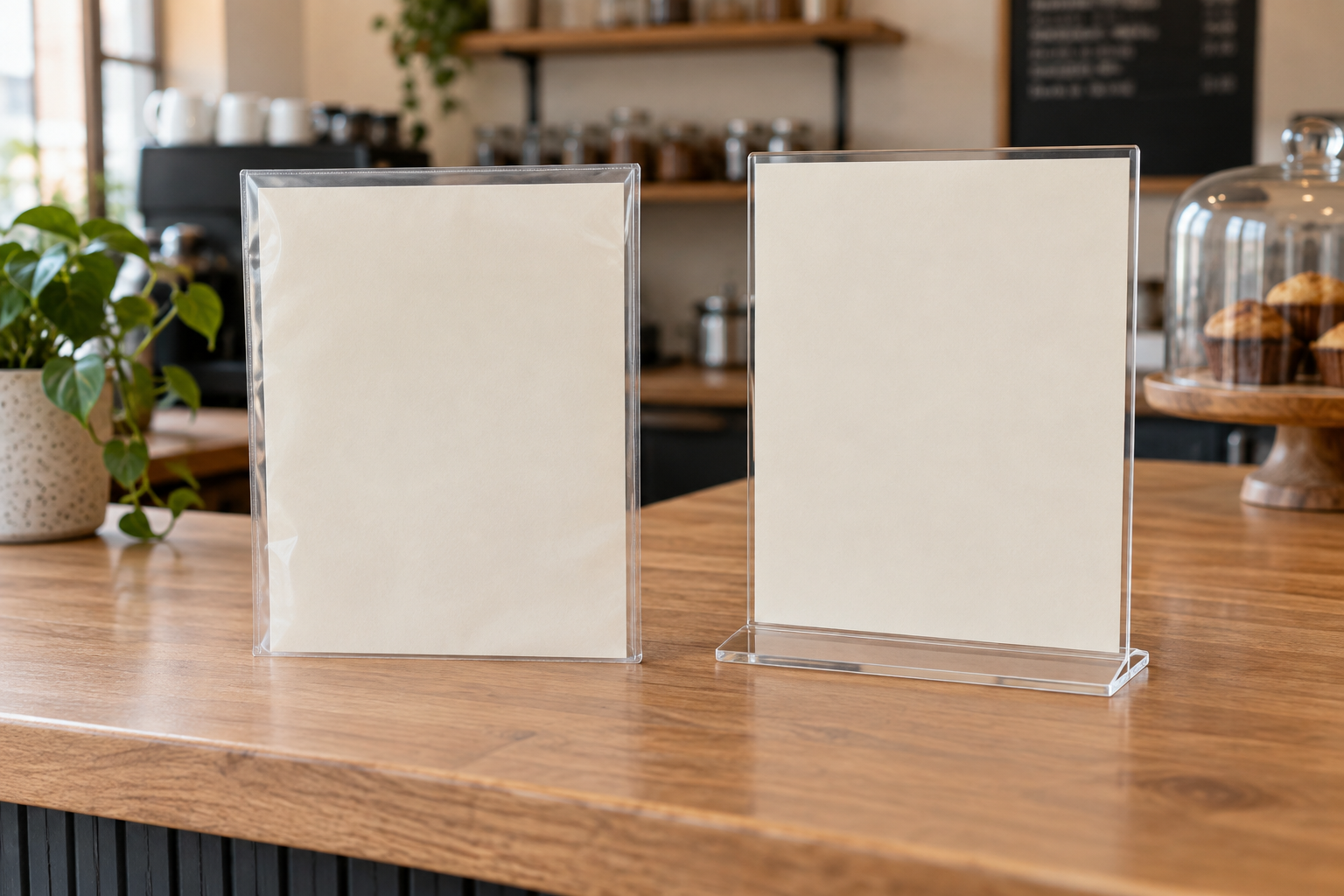
Compare the complete display, not just the paper size
Check current listings for exact insert and visible dimensions, loading edge, orientation, outside dimensions, base depth or required support, cleaning instructions, and stated use. A sleeve photographed upright may rely on a separate stand that is not included.
Quick comparison
| Decision | Clear menu sleeve | Rigid acrylic sign holder |
|---|---|---|
| Display support | May lie flat, be handed over, or need a separate stand | Uses an integrated bend, base, or body to stand |
| Counter footprint | Depends on how the sleeve is supported or presented | Defined by the full base and face geometry |
| Handling | Easier to carry, file, and move with the paper enclosed | Better suited to a set display position |
| Insert updates | Loading edge and closure determine the routine | Top, side, or rear access determines clearance |
| Skip when | The message must stand without another support | The piece must be stored flat or handed to readers |
When a clear menu sleeve fits
A flexible sleeve fits a printed menu, price list, service list, schedule, or instruction sheet that moves between storage and use. It can make sense when staff hand the sheet to a reader, place it on a counter, or load it into a compatible separate stand. The sleeve is only one part of the display plan: determine what keeps it upright, where it rests, and whether that support is included.
Measure the finished paper rather than relying on a familiar size label. Check the opening edge, sealed edges, visible area, orientation, closure if present, and the maker's care guidance. For a product-category screen after those details are known, use the clear menu sleeve guide.
When a rigid acrylic holder fits
A rigid holder fits a message that should remain upright in a repeatable counter position. L-shaped holders usually emphasize one face; T-shaped and other double-sided profiles can address two approaches. The exact construction matters more than the material name because base depth, face angle, loading path, and visible area vary.
Trace the complete listed footprint on the counter, then rehearse removing a full-size insert without moving equipment or merchandise. If the counter has side or overhead obstructions, compare top-loading and side-loading acrylic holders before choosing a product.
Run this counter test before buying
- Print the real message. Use the intended type size, line count, margins, and orientation rather than a blank sheet.
- Map the normal approach. Mark where a customer first needs the message and whether they view it from one direction or two.
- Define the support. For a sleeve, name the stand, clip, easel, or flat-reading use. For a rigid holder, mark the complete base.
- Rehearse an update. Remove and replace the insert using the product's documented opening without improvising a new bend or loading path.
- Check representative light. View the mockup during normal operating hours and move it if reflections obscure the message.
- Match a current listing. Confirm dimensions, loading edge, included pieces, stated use, and care instructions before ordering.
Paper support and reading position
A sleeve follows the paper more closely. If it is held, laid down, or placed in a narrow support, the reader or stand determines the final angle. A rigid holder supplies its own face and base geometry, which makes the reading position more predictable but consumes a defined area on the counter.
Neither route fixes a crowded message. Start with one primary task, then use short supporting information only when the reader needs it at that point. For a counter that alternates between printed consistency and handwritten changes, compare a printed insert with a dry-erase counter sign.
Loading, storage, and update ownership
Sleeves can store flat, but staff still need a method for keeping current and retired inserts separate. Rigid holders require more storage volume and may need individual spacing to avoid contact during transport. Do not assume either material tolerates bending, stacking, or a particular cleaner; follow the exact maker's instructions.
Assign one person or role to own the source file, print specification, approval, replacement schedule, and disposal of old versions. A low-cost display becomes unreliable when several outdated inserts remain available or nobody knows which file is current.
Glare and cleaning
Both choices put a clear surface over or in front of paper, so either can reflect windows and overhead lights. Sleeve wrinkles, multiple layers, holder angle, paper finish, and room lighting can all change the result. Test at the actual viewing position; no clear format is universally lower-glare.
- Follow the product maker's cleaning and handling instructions.
- Remove the paper first when the documented design allows it.
- Replace inserts that are curled, stained, outdated, or cut to the wrong size.
- Check the message and alignment after every update.
- Keep the display clear of active payment, pickup, and staff work areas.
Who should skip both
- The message must be read from farther away than the tested paper size supports.
- The available counter has no clear footprint or places the display in an active work path.
- The listed insert size, visible area, loading access, or orientation does not match the finished print.
- The intended use is outdoors or outside the product's documented conditions.
- The display requires a custom fixed message rather than a replaceable paper workflow.
- The counter needs two reading directions; compare single-sided and double-sided counter signs first.
Bottom line
A clear menu sleeve is the more flexible document system; a rigid acrylic holder is the more defined freestanding display. Choose the sleeve when handling and flat storage matter and a support plan already exists. Choose the rigid holder when a stable counter position, face angle, and integrated base matter more.
Continue with the small-business sign planning pillar, or compare desk sign holders for reception counters once the message size, update routine, and approach direction are settled.