 The Good Sign Company
Printed Insert Storage Guide
How to Choose storage envelopes for reusable printed sign inserts
A useful storage envelope keeps one measured set of inactive paper or cardstock inserts together, identifiable, and easy to retrieve. Choose the envelope only after recording the largest finished insert, the complete stack thickness, the update cycle, the shelf or drawer, and who removes obsolete versions.
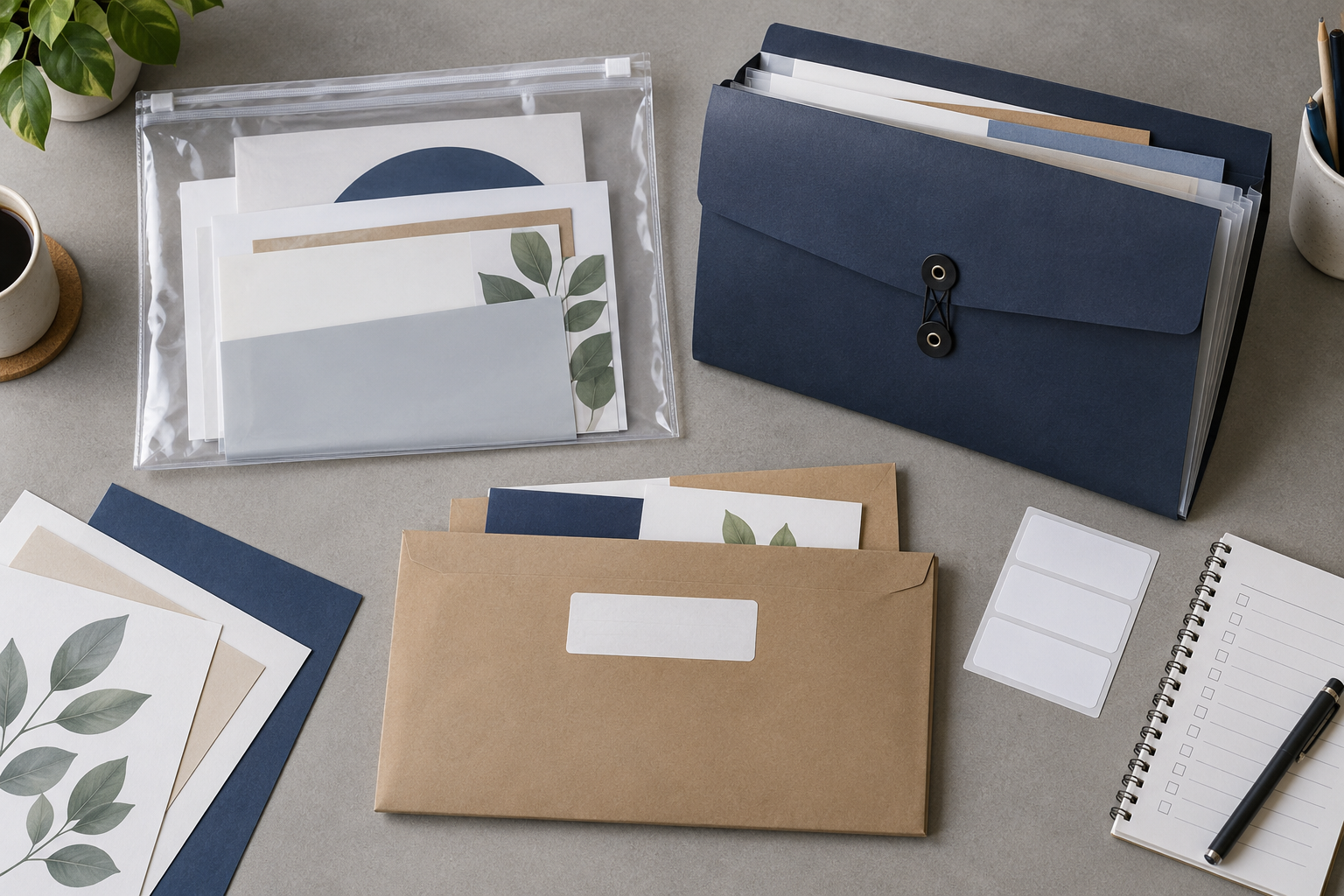
Format comparison
Measure the finished insert set before comparing envelopes.
Check current listings for usable inner dimensions, expansion, closure, material and care guidance, label area, and the complete exterior footprint. A familiar paper-size label does not confirm fit for trimmed, laminated, tabbed, or stacked inserts.
The short answer
- Choose a clear zip document envelope when quick visual identification matters and the closure and usable dimensions fit the finished stack.
- Choose an expanding document wallet when one location has several coordinated insert groups and the stated expansion fits the complete stack.
- Choose a slim project envelope when each message set is thin, stable, clearly labeled, and stored flat.
- Skip all three when the insert maker requires a different storage orientation or when the pieces are damp, curled, dirty, oversize, or still in active use.
Three envelope formats worth comparing
| Format | Best starting condition | Verify before buying | Main tradeoff |
|---|---|---|---|
| Clear zip document envelope | One thin set that staff must identify quickly | Usable interior, zipper path, seam clearance, label method | Visibility can expose clutter and does not prove protective performance |
| Expanding document wallet | Several related inserts stored as one controlled set | Base and side expansion, closure reach, full exterior footprint | Extra capacity can encourage overfilling or mixed versions |
| Slim project envelope | A small, stable set with a clear project or location label | Finished insert fit, closure, label adhesion, shelf orientation | Limited stack depth and less visual inventory |
These are shopping categories, not tested winners. Product construction and dimensions vary, so confirm the current listing and maker guidance before ordering.
Inventory the inserts first
Lay out one complete active set and one inactive set. Record the finished width and height of the largest insert, the thickest finished edge, tabs or labels that project beyond the sheet, and the relaxed stack thickness. Include laminated pieces only when their maker permits the proposed flat-storage method.
Do not size an envelope from the nominal printer paper alone. Trimming, sealed margins, corner rounding, tabs, and mixed orientations can change the needed interior. Leave only the working clearance required to load and retrieve the set without forcing a closure.
Match capacity to one retrieval job
Define what staff should retrieve in one trip: every weekday insert for one counter, one event's directional set, or one seasonal message family. That retrieval job is a better grouping rule than putting every sheet of the same paper size together.
A large wallet may hold more, but excess capacity can mix current and retired versions. If two people cannot identify the correct set from the closed envelope, improve the label and grouping before buying more storage.
Build a label and version routine
- Location: name the exact counter, holder, room, or event kit.
- Visible size and orientation: record the finished dimensions and portrait or landscape format.
- Message set: describe the group in plain language, such as weekday pickup instructions.
- Owner: identify the role that updates, retrieves, and retires inserts.
- Review date: set a date to check whether the wording and destination are still current.
- Status: separate current, scheduled, and retired pieces rather than relying on memory.
A blank label area is useful only when the team maintains it. Test the planned label or removable index on the exact envelope material and follow the makers' application and removal guidance.
Plan the shelf, drawer, and handoff
Measure the full closed envelope, including the closure, expansion, label tab, and any projecting edge. Confirm that it lies or stands in the orientation allowed by the insert and envelope makers, and that staff can remove one set without bending neighboring material.
Keep inactive-insert storage separate from the display holder and from transport storage for rigid boards or rolled graphics. For finished flat event boards, use the flat sign carry-sleeve guide; for graphics approved to be rolled, use the poster storage-tube guide.
What these envelopes do not establish
An envelope listing does not automatically establish archival suitability, moisture resistance, bend protection, impact protection, chemical compatibility, or safe storage for every print process. Use only claims and care directions published for the exact product and insert material. For valuable, irreplaceable, regulated, or long-term records, follow the record owner's storage requirements rather than this category guide.
Who should skip a storage envelope?
- A team that recreates inexpensive inserts on demand and has no reason to retain old versions.
- An insert set whose current storage instructions exclude the proposed material or orientation.
- Rigid boards, framed signs, thick acrylic pieces, rolled graphics, or assembled display hardware.
- Damp, contaminated, curled, damaged, or still-in-use inserts.
- A workflow with no owner for removing expired or duplicated messages.
- Any set that needs verified archival, moisture, impact, or other protective performance not documented for the product.
Final buying checklist
- Largest finished insert and complete stack measured
- Tabs, sealed edges, and mixed orientations included
- Usable inner dimensions and expansion verified
- Closure path tested against the full stack
- Closed exterior footprint fits the shelf or drawer
- Location, size, message set, owner, and review date fit on the label
- Current, scheduled, and retired versions have separate rules
- Material and care guidance checked for both envelope and inserts
- No undocumented protection claim is required
The best envelope is the one that fits a measured insert set and makes the correct version easy to retrieve. Capacity without a label, owner, and retirement rule is only another place for outdated signs to accumulate.