 The Good Sign Company
Two-sided counter display buying guide
Best countertop sign holders for double-sided inserts
The best double-sided countertop holder matches the finished insert exactly, keeps both faces readable from the real approach paths, and leaves enough working counter space around its full base. Choose the message and print a full-size mockup first. Then compare portrait or landscape orientation, visible area, loading method, glare, and how staff will keep both sides current.
This guide starts after you have established a real need for two viewing faces. If that choice is still open, first compare single- and double-sided counter signs or use the double-sided worth-it test.
Disclosure: As an Amazon Associate, we may earn from qualifying purchases and approved partner referrals.
Compare formats only after measuring the insert and counter
Check stated insert dimensions, visible area, orientation, outside dimensions, base depth, loading edge, and current care instructions. A category label does not establish that a particular sheet, card thickness, or cleaner will fit.
Best holder format by message job
These are fit-based categories, not named winners or hands-on rankings.
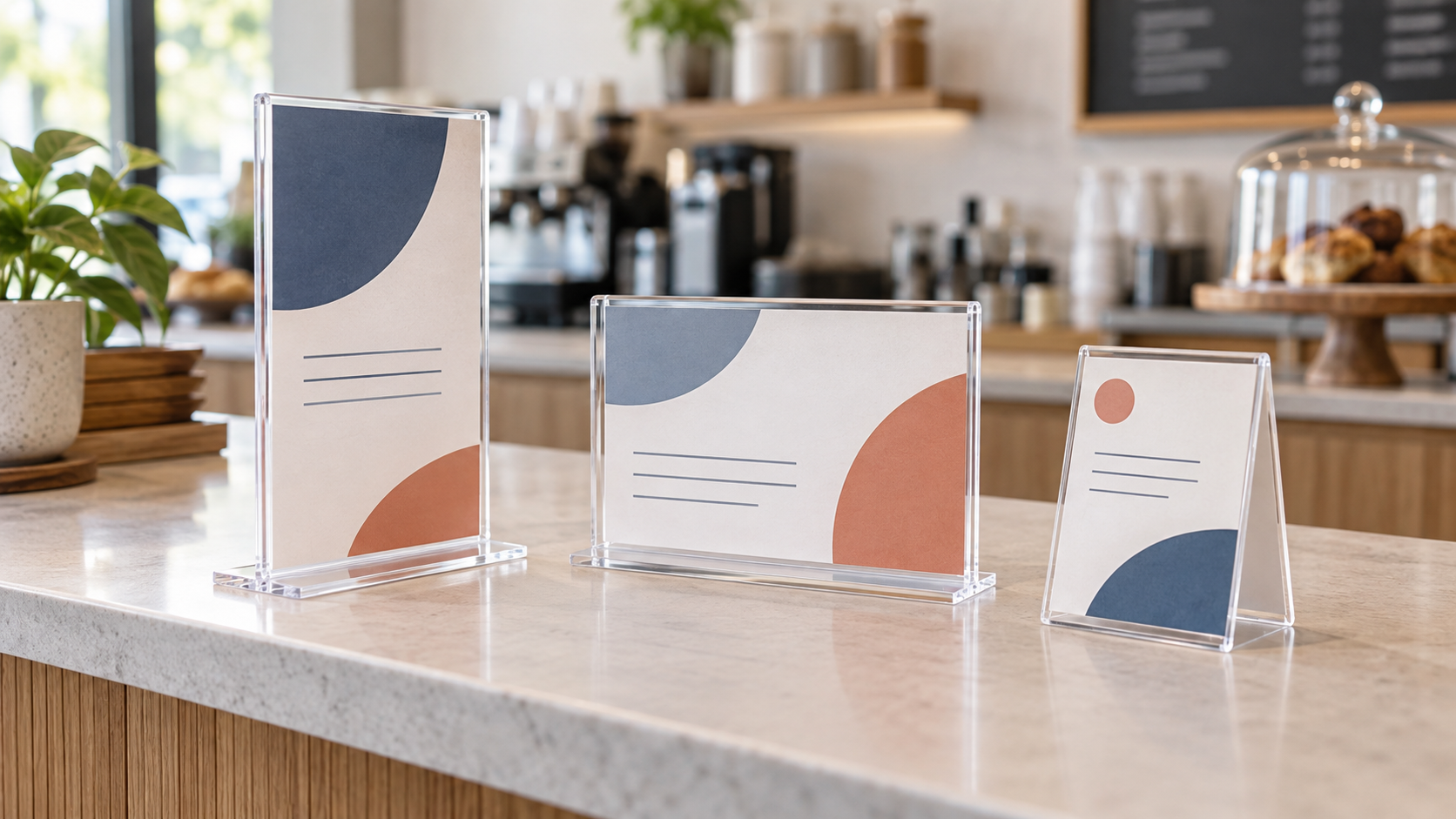
- Portrait T-base holder: best for a narrow counter patch and vertically stacked message. It creates height without using as much width as a landscape sheet. Check that the complete base still clears equipment and handoff space.
- Landscape T-base holder: best for short directions, hours, or a wide menu excerpt. It can keep lines comfortably short, but the wider face is easier to block with displays or payment equipment.
- Clear tent holder: best for close reading from opposite seated or standing positions. The angled faces can suit tables and compact counters. Verify how the insert loads and whether a fold, seam, or lower edge hides part of the design.
- Framed two-sided holder: best when edge definition helps the insert separate from the background. A frame may improve visual contrast but adds outside dimensions and can reduce visible area. Confirm both measurements.
Measure insert size and visible area separately
“Letter size,” “A4,” or another nominal label is not enough. A border, bend, lip, or slot may cover part of the paper, and the holder may expect two sheets, one back-to-back assembly, or one folded insert. Measure the final printed piece and keep important copy inside the documented visible area.
- Print both faces at intended size.
- Trim or fold them exactly as displayed.
- Mark the holder's stated covered edges on the mockup.
- Check the longest line and smallest essential copy from both approaches.
- Verify loading clearance before ordering multiples.
Map the two viewing directions
Draw the counter, queue, doorway, pickup point, seating, equipment, and merchandise. Place a folded-paper stand where the holder might go, then walk both routes during the normal setup. A second face is useful only if it appears before the reader needs to act and is not hidden by the counter operation.
The two faces can repeat one message or carry different messages. Repeating is easier to maintain. If they differ, assign each face a reader and task—for example, arrival instructions toward the entrance and pickup instructions toward the exit—and give both the same update trigger.
Compare the full base and loading method
A narrow front view can disguise a deep support. Trace the complete outside footprint on paper and place it among the card reader, register, bell, display trays, handoff zone, and visitor writing space. Pass a bag or folder across the counter and open nearby drawers before deciding that it fits.
Top-loading holders need vertical clearance. Side-loading holders need open space beside the face. Bottom-loading or framed designs may require lifting or disassembly. Choose the route staff can use without moving unrelated counter equipment, and verify the current product instructions.
Test glare and readability on both faces
Two transparent faces create two reflection checks. View the mockup from each approach under the lighting used during operating hours. Bright windows, ceiling fixtures, pale inserts, and a busy background can reduce useful contrast. Repositioning the holder, changing the face angle, simplifying the design, or using a matte insert may work better than adding more copy.
This practical sightline test does not establish accessibility, lease, venue, or code compliance. Use the applicable authority or qualified professional for requirements governing the actual location.
Plan updates, cleaning, and storage
- Keep front and back in one master file so a revision does not leave one face outdated.
- Label the intended direction on the reverse of each insert before loading.
- Store a spare print flat and keep the loading edge accessible.
- Follow the holder maker's cleaning instructions; do not assume every clear plastic or finish accepts the same cleaner.
- Inspect feet, edges, joints, and the base during routine counter cleaning.
When to skip a double-sided holder
- Skip it when people approach from one useful direction; one angled face is simpler to maintain.
- Skip it when the base removes space needed for payment, writing, service, or product handoff.
- Skip clear faces when testing cannot control reflections or background clutter.
- Skip a fixed insert size while wording, brand layout, or paper format is still changing.
- Skip different messages on each side when no one owns the update routine.
- Move the message earlier in the route when readers need it before reaching the counter.
Bottom line
Choose a portrait T-base for a vertical message in limited width, a landscape T-base for a short wide layout, a tent holder for close two-way reading, or a framed holder when edge definition is worth the added size. In every case, verify the actual insert and visible dimensions, trace the complete base, test both approaches and both glare angles, and rehearse the update path before buying more than one.
Continue with the small-business sign planning pillar, compare broader reception desk holder formats, or plan a constrained checkout setup with the retail counter sign guide.