 The Good Sign Company
Worth-it decision
Is a double-sided counter sign worth it?
A double-sided counter sign is worth it when people genuinely approach from two directions and each face has one useful, maintained job. Skip the second face when nearly everyone arrives from one side, the back points toward staff or clutter, or duplicate upkeep will be ignored. Delay the purchase until you observe the counter during normal use and measure the space left after everyday equipment is in place.
This is a two-way visibility decision, not a promise that a second face will improve sales or engagement. If you first need to choose the orientation, compare a single-sided counter sign with a double-sided counter sign. If you are still choosing the whole checkout display, start with the retail counter sign guide.
Disclosure: As an Amazon Associate, we may earn from qualifying purchases and approved partner referrals.
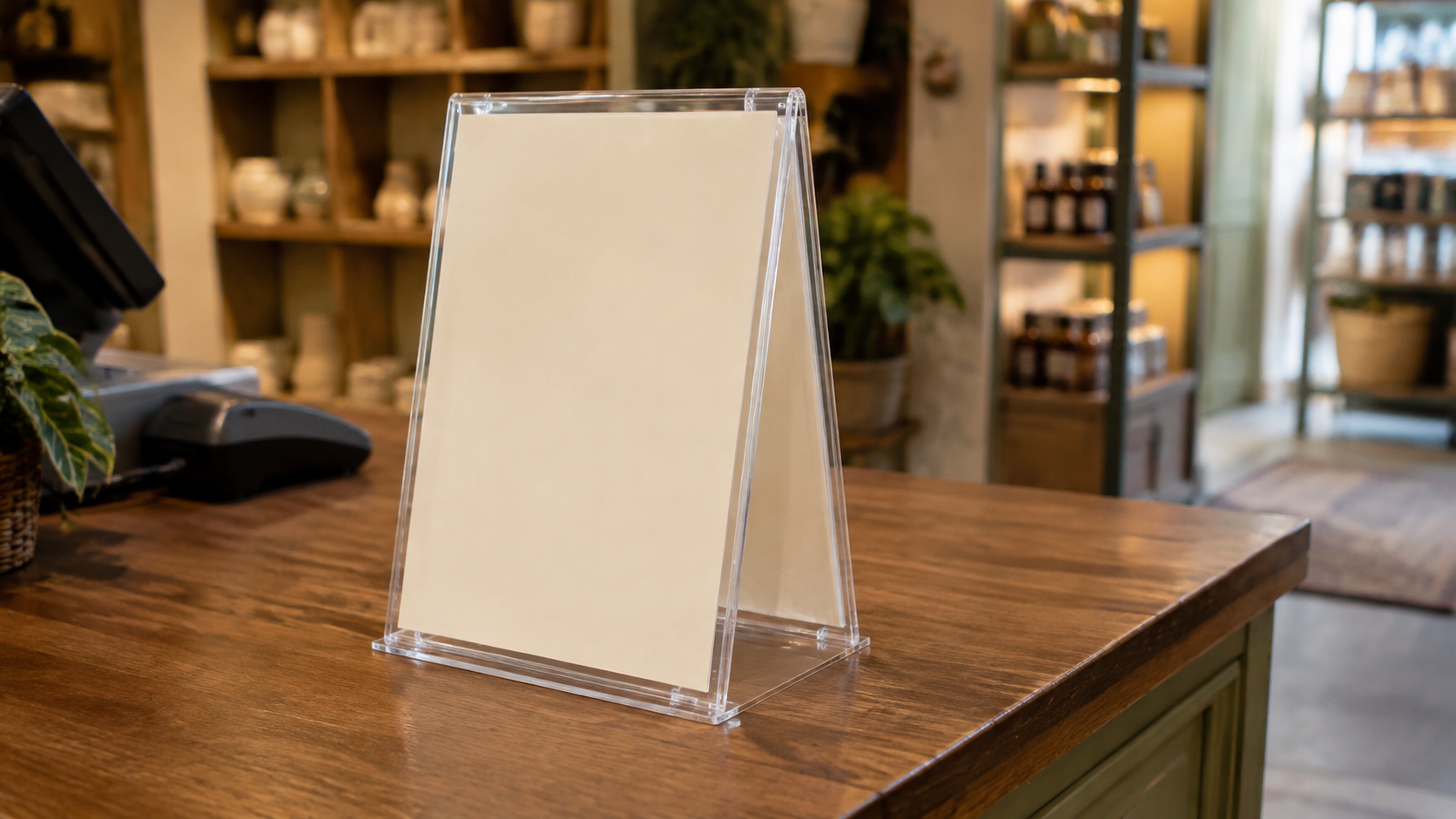
Compare holders after mapping both sightlines
Check the exact insert size, visible area, base dimensions, loading method, orientation, and maker instructions. Confirm whether one sheet or two inserts are needed; product photos alone do not settle that workflow.
Quick verdict: buy, skip, delay, or simplify
- Buy: customers or visitors approach from two meaningful directions, both faces remain readable, and someone owns every message update.
- Skip: traffic is one-directional, the reverse face has no distinct audience, or the added base depth crowds payment, pickup, or work space.
- Delay: the counter layout, final insert size, main message, or traffic pattern is still changing.
- Simplify: use one angled face when it can be seen from the full approach zone, or use two separate signs when the audiences need different locations.
The two-direction test
Stand where each intended reader first enters the counter area. Do this during the real setup, not at an empty table. Note what blocks the view: a payment terminal, display basket, monitor, menu, flowers, merchandise, or another customer. A second printed face has no value if the holder itself is hidden.
- Mark approach A and approach B on a quick sketch of the counter.
- Write the single action or fact each person needs at that point.
- Place a folded-paper mockup where the holder would sit.
- Walk both routes and check the face angle, reading distance, reflections, and surrounding clutter.
- Remove the mockup and ask whether one well-angled sign would do the same job.
If you cannot name a real reader and task for the reverse face, do not pay for it yet. When more than two useful messages are competing for the same location, use the rotating tabletop sign holder worth-it test before adding more hidden faces.
Same message or different messages?
The same message on both faces works when two traffic paths lead to the same action: check in here, collect an order here, or follow the same brief instruction. The operational risk is low because both inserts can change together, but the owner still needs to notice when one side fades, curls, or becomes outdated.
Different messages on each face can work when the audiences are genuinely different—for example, a customer-facing instruction and a staff-facing reminder. That arrangement needs a stricter update routine. Never let the convenient rear face become a dumping ground for extra copy that belongs elsewhere.
For a scannable action, first decide whether a QR code deserves counter space. A second face does not fix an unclear destination, poor mobile experience, or missing non-phone alternative.
Tradeoffs people miss
- Footprint: A-frame and wide-base holders can occupy more usable depth than a slim single-face stand. Compare complete base measurements with the actual free rectangle on the counter.
- Glare: two faces create two reflection problems. Test from both approaches under the lighting used during business hours; changing the angle or face finish may matter more than adding another message.
- Update work: two inserts can mean two printouts, two loading steps, and two chances for old information to remain visible. Name the owner and the trigger for changes.
- Reading order: each face still needs a short, legible message. A second surface is not permission to shrink the type or double the content.
- Counter operations: staff need room to work and customers need room to pay, sign, collect items, or set down a bag. The sign should not take over the task area.
- Cleaning: clear holders show fingerprints and dust. Follow the current maker's care instructions rather than assuming every clear material tolerates the same cleaner.
Who should choose another format?
Choose a single-sided angled holder when all readers enter through one predictable route. Choose two separate holders when the messages belong at different decision points. A wall, window, or higher display may be better when the counter is already crowded, but confirm the property rules and installation method rather than treating a tabletop article as mounting or compliance advice.
For frequently replaced paper, the table-tent and acrylic-holder comparison separates fast printing from a more enclosed presentation. For a finished card, the acrylic holder vs wooden stand guide covers glare, insert changes, card fit, and visual tone.
Red flags before ordering
- The listing gives a nominal paper size but not the visible area or complete base dimensions.
- You are assuming both faces load separately without checking the design.
- The product image shows an empty counter unlike your working setup.
- No one is responsible for replacing both faces when details change.
- The holder would sit where customers exchange payment or staff move items.
- The reverse message contains information that should not face the public.
A low-cost trial before you buy
- Cut and fold cardstock to the holder's listed overall dimensions, including its base.
- Put the intended message on both sides at the planned type size.
- Place it for one representative work period without blocking normal tasks.
- Ask staff which side people actually see and whether the mockup gets moved.
- Only then compare current products by measured fit, loading method, orientation, care guidance, and return terms.
Bottom line
A double-sided counter sign is worth buying when two observed approach routes create two useful viewing opportunities and the counter can spare the footprint. It is unnecessary when one angled face covers the traffic pattern, and it becomes a liability when the rear message is neglected or the base interferes with work. Map the routes, mock up the full footprint, assign update ownership, and verify current product dimensions before ordering.
Next, use the small-business sign planning pillar, choose among retail checkout sign formats, or compare a table tent with an acrylic holder.