 The Good Sign Company
Multi-message counter display comparison
Rotating tabletop sign holder vs flip-chart sign: which fits your message workflow?
Choose a rotating holder when several independent messages should face different approach directions or remain available for a reader to turn toward. Choose a flip-chart when staff present a short sequence or deliberately select one visible page at a time. The useful distinction is not simply how many messages fit; it is who changes the view, whether order matters, and which messages may stay hidden.
This comparison covers compact indoor counter and tabletop displays. It does not establish accessibility, stability, customer engagement, safe placement, or a universal message capacity. Verify the complete dimensions and instructions for the exact product.
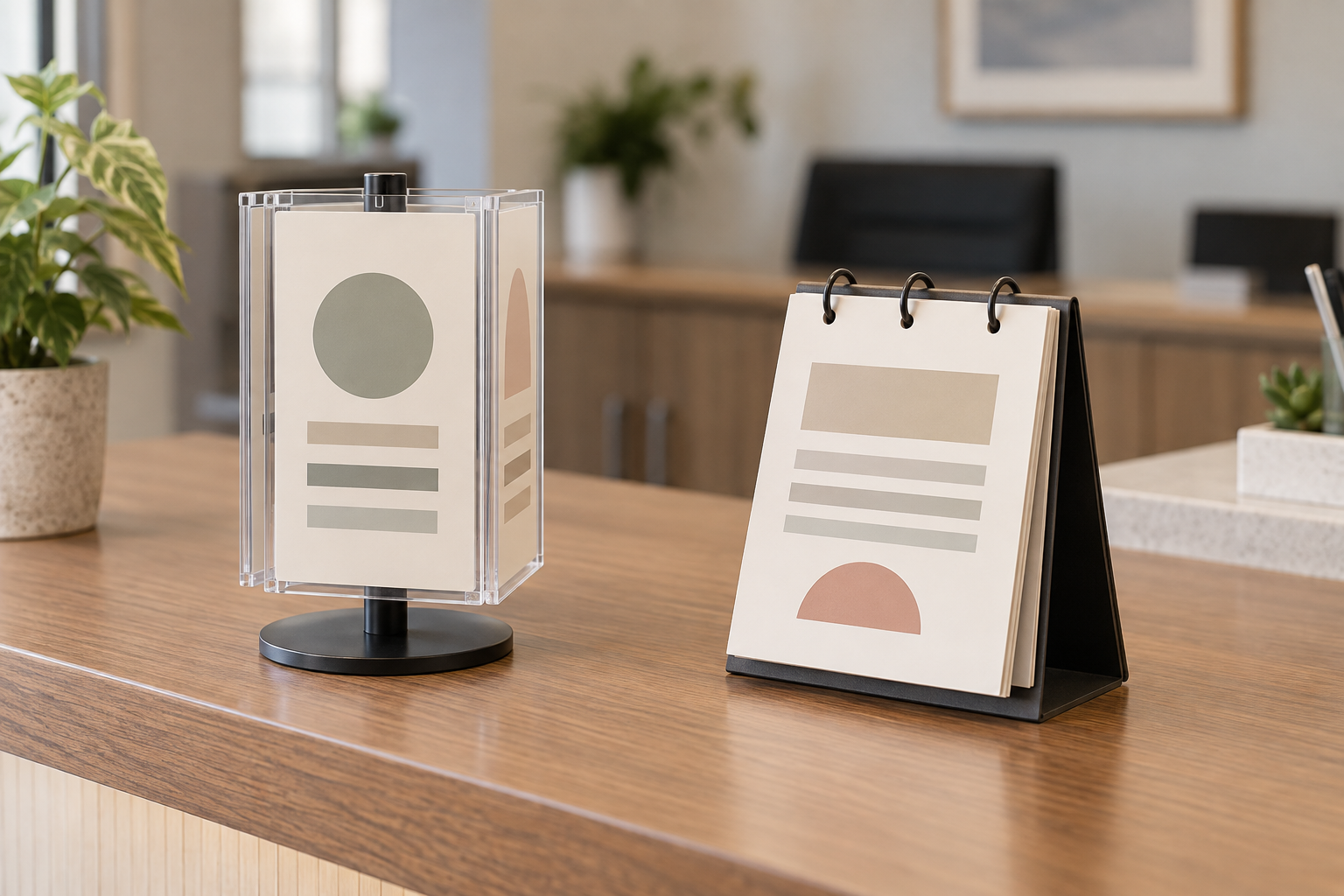
Compare the mechanism after mapping the messages
Check current listings for the exact face or page count, visible insert dimensions, orientation, complete base footprint, loading or binding method, total height, and manufacturer instructions. Product photos alone rarely show the clearance needed to rotate a holder or flip a full page.
Quick comparison
| Decision | Rotating tabletop holder | Tabletop flip chart |
|---|---|---|
| How messages appear | On separate faces arranged around a rotating body | On bound pages shown one at a time |
| Who changes the view | A reader or staff member turns the body | Usually a staff member flips and sets the page |
| Best message relationship | Independent choices or directions with similar importance | An ordered set, schedule, prompt sequence, or selected daily message |
| Clearance to measure | Base, face sweep, and comfortable turning access | Base, open page, binding, and page-flip path |
| Skip when | One instruction must be visible without interaction | Several directions need to be visible at once |
When a rotating tabletop sign holder fits
A rotating holder fits several short, parallel messages that can share one counter position. Examples include service categories, brief instructions for different visitor tasks, or information intended for people approaching from different sides. Its advantage is access to multiple faces without loose pages; its cost is that most faces remain out of view until someone turns it.
Map each normal approach direction before deciding how many faces help. A face that points toward a wall or staff-only area does not add useful capacity. Also identify whether visitors are expected to touch the display. If the message only works after an unfamiliar reader discovers the rotation, a fixed sign or separate holders may be clearer.
When a tabletop flip-chart sign fits
A flip-chart fits messages that staff intentionally sequence or select: today’s class step, the next appointment instruction, a short training progression, or a limited set of recurring desk prompts. Pages remain attached and ordered, making it easier to return to a known sequence than with loose inserts.
The hidden-page tradeoff is deliberate. A visitor normally sees the page staff selected, not every available message. That makes the format poorly suited to simultaneous choices unless someone is present to guide the interaction. Before buying, confirm the documented page capacity or binding method and test whether a complete page can turn without striking a wall, monitor, shelf, or overhead obstruction.
Run a paper workflow test first
- Write every real message. Use the intended words, type size, orientation, and visual hierarchy.
- Name the operator. Decide whether a visitor, receptionist, instructor, or other staff role changes the visible content.
- Map approach directions. Mark where each reader stands and which message must appear first.
- Build both mockups. Tape pages around a box for the rotating route and bind paper over a tented card for the flip-chart route.
- Rehearse the change. Rotate the complete mockup or flip the full-size page without moving nearby equipment.
- Measure the swept space. Record the base, height, face or page dimensions, and movement clearance—not just the advertised insert size.
Setup and counter-space tradeoffs
A rotating unit needs a level location, its complete base area, and enough surrounding clearance for the body or faces to turn as designed. A flip-chart needs its open base plus a clear path above and behind the binding for pages to move. Trace both footprints and movement paths on the actual counter before choosing a listing.
Keep either display clear of payment terminals, pickup areas, doors, staff work, and other places where routine movement can conflict with the sign. Follow the manufacturer’s assembly and placement instructions. If the counter cannot spare a clear operating area, a wall-mounted notice, fixed insert holder, or single visible sign may be the better format.
Updates, cleaning, and maintenance ownership
Rotating holders commonly use separate inserts or panels, so updates require matching every face to its documented loading path and orientation. Flip charts may use bound reusable pages, replaceable sleeves, or a product-specific attachment. Do not assume pages or inserts are replaceable until the current listing says so.
- Assign one owner for the source files, approval, update schedule, and removal of obsolete messages.
- Check that every face or page remains in the intended order and orientation after an update.
- Follow the exact maker’s cleaning instructions for clear panels, printed pages, binding, and base.
- Inspect the turning or page-binding mechanism and stop using it if parts loosen, bind, or no longer operate as documented.
- Store the complete display according to its instructions; do not assume protruding faces, rings, or pages tolerate stacking.
Who should skip the rotating holder
- One urgent instruction must be visible immediately from every relevant approach.
- Readers are unlikely or not expected to touch the display.
- The mapped counter position lacks clearance for the complete rotating movement.
- The messages form a strict sequence that staff should control.
- The product’s face size, loading method, or number of faces does not match the tested content.
Who should skip the flip chart
- Several independent choices need to remain visible together.
- People approach from multiple directions without a staff member selecting the page.
- The counter lacks clearance for the documented page-turning path.
- Pages would be changed so rarely that a fixed insert offers a simpler workflow.
- The visible area, page capacity, or binding method cannot support the real message set.
Next steps
If you have chosen the mechanism but not the exact product, use the rotating tabletop holder worth-it test or the tabletop flip-chart worth-it test to challenge the purchase against simpler alternatives.
For the larger counter plan, continue with the small-business sign planning pillar. If only one or two fixed viewing directions matter, compare single-sided and double-sided counter signs instead.
Bottom line
A rotating holder organizes independent messages around a shared axis; a flip-chart organizes messages into a staff- or reader-controlled sequence. Choose the rotating format when direction and equal access matter. Choose the flip-chart when order and deliberate page selection matter. Skip both when the main instruction cannot afford to be hidden.