 The Good Sign Company
Counter sign-holder comparison
L-shaped vs T-shaped acrylic sign holder: which profile fits your counter?
Choose an L-shaped acrylic holder when one approach direction matters and a single face can lean toward the reader. Choose a T-shaped holder when the same counter needs a face toward two opposing approaches. The profile does not settle fit by itself: verify the exact insert opening, complete base, loading edge, orientation, and cleaning directions for the holder you are considering.
This is narrower than a general single-sided-versus-double-sided sign decision. It compares two formed clear-holder profiles after you have decided to use replaceable paper inserts. If that first decision is unresolved, use the L-shaped holder worth-it test before comparing profiles.
Disclosure: As an Amazon Associate, we may earn from qualifying purchases and approved partner referrals.
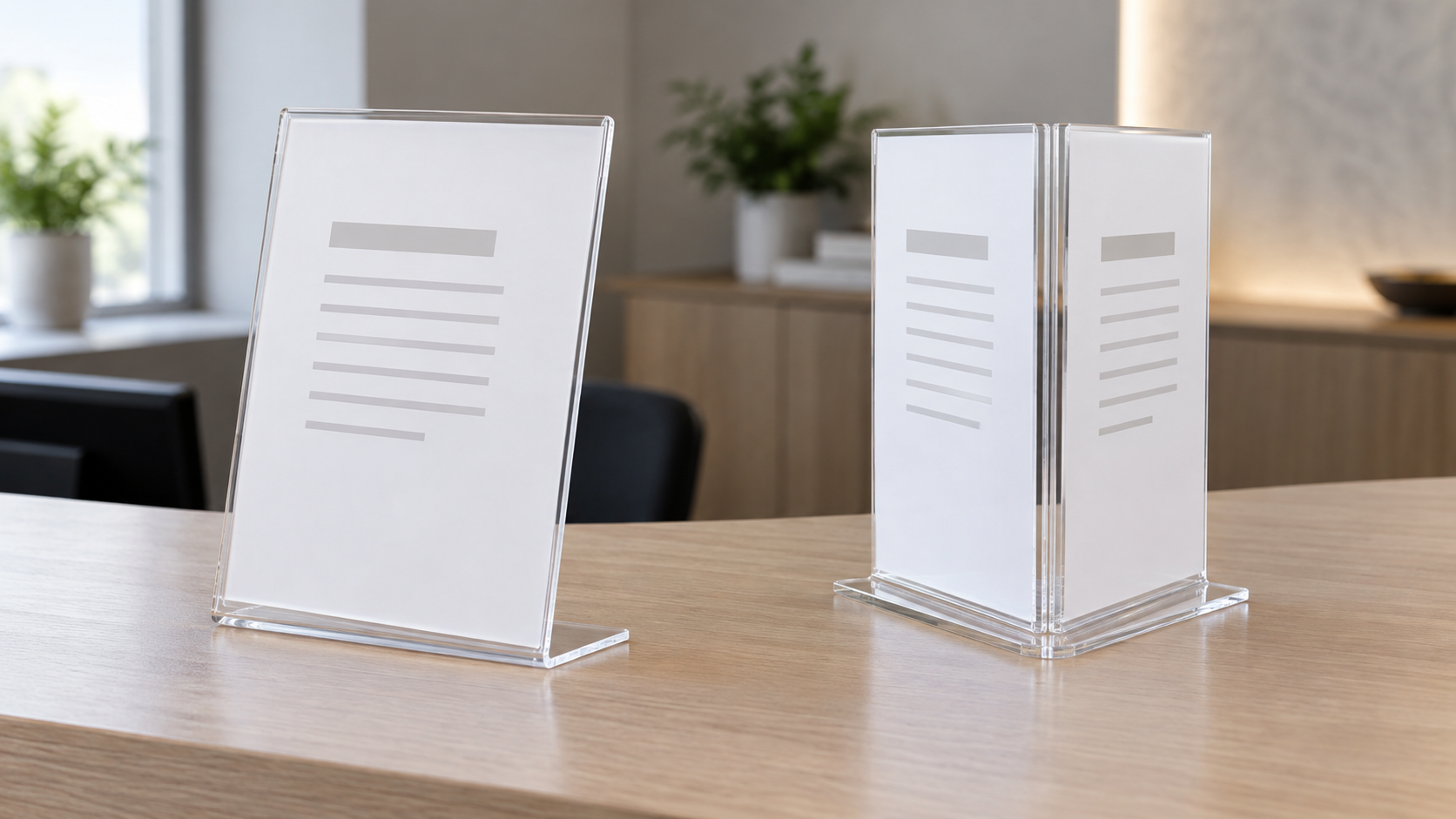
Compare both profiles after mapping the approaches
For each current listing, check insert and visible dimensions, portrait or landscape orientation, number of readable faces, loading edge, complete base dimensions, material description, cleaning directions, and package quantity. Do not infer stability from the profile name.
Quick decision
- Choose L-shaped: customers approach mainly from one side, one message face is enough, and the lean improves the close-range view.
- Choose T-shaped: people approach or sit on opposite sides and both need the same message or coordinated inserts.
- Choose neither: the counter is too crowded, glare cannot be controlled, the message needs a higher sightline, or a flat printed card already works.
- Delay the order: insert size, orientation, traffic direction, or update ownership is still changing.
Viewing direction is the real dividing line
An L-shaped holder normally uses a formed foot to support one display face. That makes it a natural candidate for reception desks, checkout counters, and vendor tables with one dominant customer approach. Put a paper mockup where the holder would sit and walk the actual route; a face that reads well straight on may disappear when the line bends around the counter.
A T-shaped holder normally centers an upright display section over a base, with two faces intended for opposite views. That can help on shared tables, islands, pickup counters, or desks approached from two sides. Two faces add no value when one side faces a wall, staff-only area, monitor, or merchandise. Map both viewing positions before giving up counter depth for a second face.
One insert, two inserts, or one folded piece?
Seller terminology varies. A T-profile may accept two separate back-to-back sheets or one folded or doubled insert, and loading can be from the top or side. An L-profile may lean backward and load behind the front panel, but exact construction varies too. Read the current instructions and photos for the specific item; do not assume that two products with the same profile label load the same way.
Print the longest normal message at full size. Keep essential words away from edges that the holder covers or distorts. If the two sides need different messages, label the mockups by approach so staff do not reverse them during an update.
Footprint and loading access
Trace the complete base of each candidate on the real counter with removable paper tape. The L-profile often projects behind its display face, while the T-profile distributes its base around a centered face. Neither outline is automatically smaller or more stable; dimensions, construction, height, surface, and placement all matter.
Leave space for the loading edge and for a hand to remove the insert. Then rehearse normal work around the outline: payments, forms, bags, pickup items, devices, and conversations. A holder that fits on an empty counter can still obstruct the counter's main job.
Portrait, landscape, and reading distance
Match orientation to the message, not to an empty patch of counter. Portrait holders suit a short heading above a compact stack of details. Landscape holders can suit a short line, menu strip, price group, or directional statement, but only when the type remains readable from the intended approach.
Verify both the listed insert size and the visible opening. A familiar paper-size label is not enough if edges disappear behind bends or seams. For longer viewing distances, a larger sign or higher placement may be more useful than either tabletop profile.
Reflections, cleaning, and storage
Both formats add clear reflective surfaces in front of the print. Test a transparent sleeve or clear sheet under normal window and overhead light, viewing from every required approach. The second face of a T-shaped holder creates another reflection to check; the lean of an L-shaped face can catch a different light source. Move the mockup before assuming darker or bolder artwork will solve the problem.
Follow the current maker's cleaning directions. When holders travel or go into storage, separate them so rigid edges do not rub against clear faces. Count the storage volume of the full set, not just one display.
Side-by-side checklist
- Approaches: one dominant direction for L-shaped; two useful opposite directions for T-shaped.
- Faces: confirm the actual construction and number of readable inserts.
- Fit: verify insert size, visible area, orientation, overall dimensions, and complete base.
- Updates: identify the loading edge and rehearse replacing every insert.
- Message: use the longest real wording, not a blank-paper estimate.
- Light: check reflections from every required viewing position.
- Workflow: keep payment, service, pickup, and handoff areas clear.
- Care: use the specific maker's cleaning, handling, and use instructions.
When to skip both profiles
- The message is visible from only a few inches away and a simple printed card or smaller card stand uses less space.
- The counter has no location outside its active work zones.
- People need the message before they reach the counter, which calls for a different placement or a higher display.
- Reflections obscure the important line from the normal approach and repositioning does not fix it.
- The listing omits insert dimensions, orientation, loading method, base dimensions, or other details needed to verify fit.
- The message is accessibility-, emergency-, lease-, or code-sensitive; the responsible organization or qualified professional must define the requirements.
Bottom line
The L-versus-T decision starts with traffic: one important viewing direction favors an L-shaped holder, while two meaningful opposite approaches favor a T-shaped holder. Confirm that advantage with a full-size paper mockup, then verify insert fit, visible area, orientation, base footprint, loading clearance, reflections, workflow, and current instructions before buying.
Continue with the small-business sign planning pillar, compare single- and double-sided counter messages, or use the table tent versus acrylic holder comparison if the reusable holder itself is still undecided.