 The Good Sign Company
Recurring craft-booth decision
Is a pegboard sign holder system worth it for a recurring craft booth?
Dedicated pegboard sign holders can be worth buying when you reuse the same documented board, place labels in repeatable positions, and want cards to move with product groups. Skip or delay the system when the fixture changes between events, the board geometry is unknown, or a few freestanding cards can explain the display with less setup and packing work.
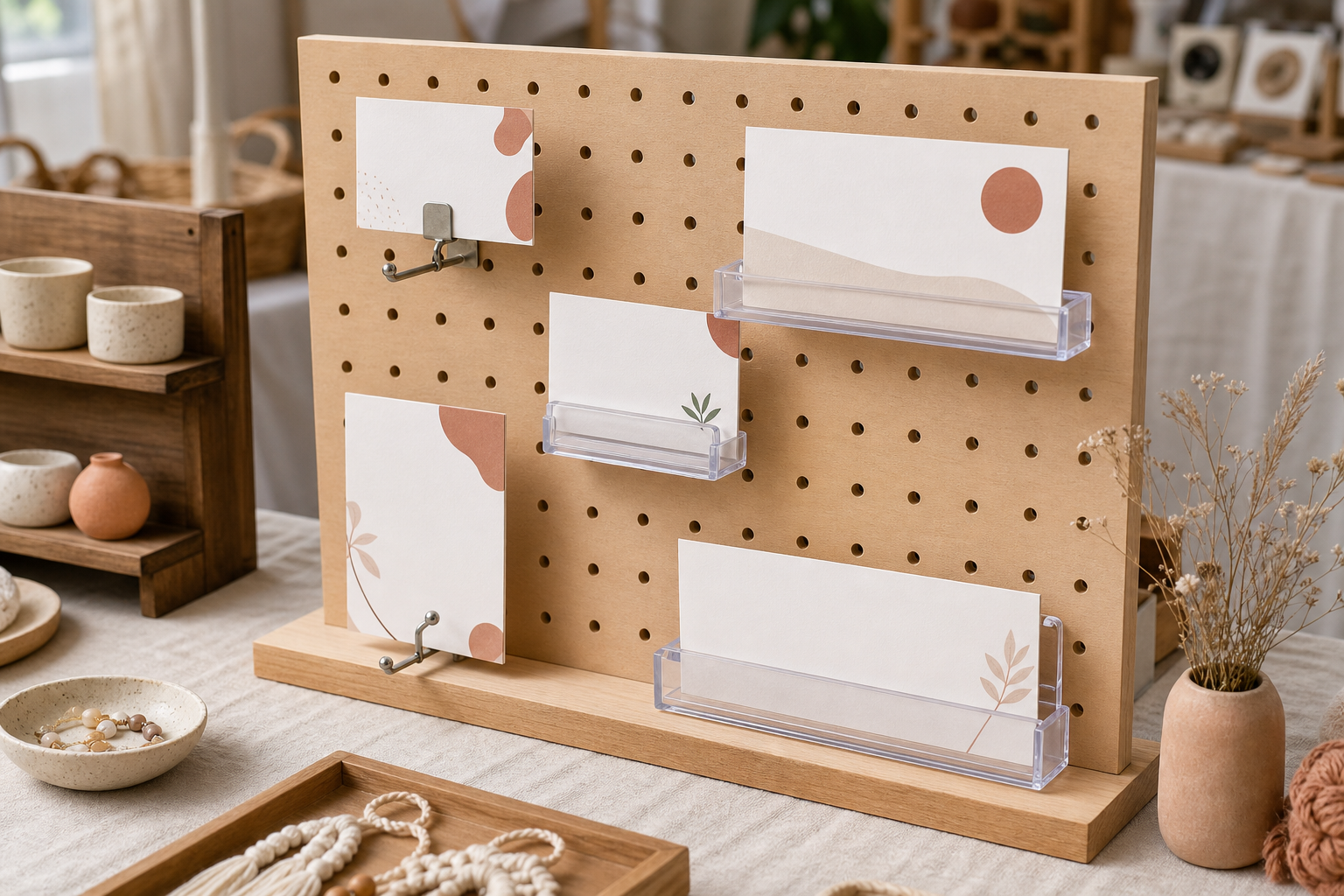
Measure the board before comparing holders
Record the board maker when known, hole spacing and diameter, panel thickness, rear clearance, finished card dimensions, and the space around merchandise. Verify those measurements against each current listing's compatibility guidance, included parts, insert fit, and instructions.
Quick verdict
- Buy: the same compatible pegboard attends recurring events, labels have stable jobs and positions, and fixture-mounted cards reduce loose tabletop pieces.
- Delay: the booth layout is still changing, card sizes are unsettled, or you have not timed a realistic setup and pack-down.
- Choose an alternative: use freestanding cards, a tabletop header, or shelf-edge labels when messages do not need to stay attached to the pegboard.
- Escalate: ask the fixture or holder maker when compatibility, attachment geometry, included parts, or intended use is unclear. Confirm event and venue requirements separately.
The six-part worth-it test
| Decision | The system has a case when… | Skip or delay when… |
|---|---|---|
| Fixture commitment | The same measured pegboard is part of the recurring booth. | You borrow fixtures or alternate among pegboard, gridwall, and tables. |
| Compatibility | Current guidance matches the board geometry and available rear clearance. | The listing relies on “universal” language without useful dimensions. |
| Message pattern | Prices, categories, or short product notes return in predictable positions. | Every event needs a completely different message hierarchy. |
| Setup value | Attached or organized holders make the booth faster to rebuild accurately. | Separate clips and cards add sorting, alignment, or snag problems. |
| Display space | Cards remain readable without blocking products or using needed holes. | The fixture is already crowded or the cards project into movement paths. |
| Ownership | Someone updates inserts, checks fit, and keeps the holder kit complete. | Old prices linger or small parts routinely disappear in storage. |
Count the complete cost
The purchase is more than the holders. Include insert printing, trimming or sleeves if used, spare parts, labeled storage, replacement for damaged pieces, and the time required to update and place every card. Avoid assuming a material or format will tolerate a particular handling routine; follow current maker care and use guidance.
A larger system is not automatically better value. Start with the few messages customers repeatedly need—usually price, product category, or one short instruction—and add holders only when each card has a clear job.
Test one real booth layout first
- Photograph the normal display and mark every proposed label position.
- Print paper cards at finished size and temporarily place them on the board.
- Stand at the customer approach and check reading order, contrast, blocked merchandise, glare, and crowding.
- Measure the exact board and verify compatibility before buying a small pilot set.
- Set up, update, pack, transport, and rebuild the pilot through two events.
- Expand only if the cards stay current and the system reduces loose pieces or repeated positioning work.
Red flags before you buy
- The board brand or geometry is unknown, and the holder listing gives no usable fit information.
- A card or hook projects where shoppers, bags, clothing, or staff may brush it.
- The label blocks merchandise, consumes important display holes, or competes with the booth's main identity message.
- Inserts require a card size or loading clearance the booth cannot support.
- The system depends on many small unmatched parts with no packing plan.
- The proposed purchase is being treated as venue approval, a capacity claim, or a substitute for current manufacturer instructions.
When another format is better
- Freestanding price cards: fit a changing display when labels need to move independently of the fixture.
- One tabletop sign: fits a booth where a single payment, ordering, or brand message matters more than item-level labels.
- Shelf-edge holders: fit labels that belong to a confirmed shelf profile rather than the board itself.
- Gridwall hardware: fits an existing wire-grid fixture; the attachment geometry is different. Use the pegboard versus gridwall holder comparison before choosing a fixture-specific route.
Who should skip a dedicated system?
Skip it if you attend only occasional events, rent or borrow changing fixtures, use very few labels, or rebuild the entire product layout each time. Also skip it when a readable tabletop card can do the same communication job without compatibility research, small parts, and fixture commitment.
The bottom line
A pegboard sign holder system is worth considering when a recurring indoor booth already relies on the same documented board and stable label positions. Pilot the smallest useful set, measure the entire setup and packing workflow, and choose holders only after compatibility and card fit are clear. Continue with the small-business sign planning pillar to set message hierarchy and sightlines before adding hardware.