 The Good Sign Company
Worth-it decision
Is a changeable menu board worth it for a pop-up?
A changeable menu board is worth it when your indoor pop-up returns regularly, the menu changes in small predictable ways, and the board can be rewritten, packed, and set up without becoming a bottleneck. Skip it when a clean printed sheet already handles a stable menu. Delay when you have not timed the reset or tested the copy at the real viewing distance.
This guide decides whether to own a reusable board at all. If that threshold is already clear, use the portable chalkboard menu guide to choose a format, or step back to the small-business sign planning pillar to map the customer approach and message hierarchy.
Disclosure: As an Amazon Associate, we may earn from qualifying purchases and approved partner referrals.
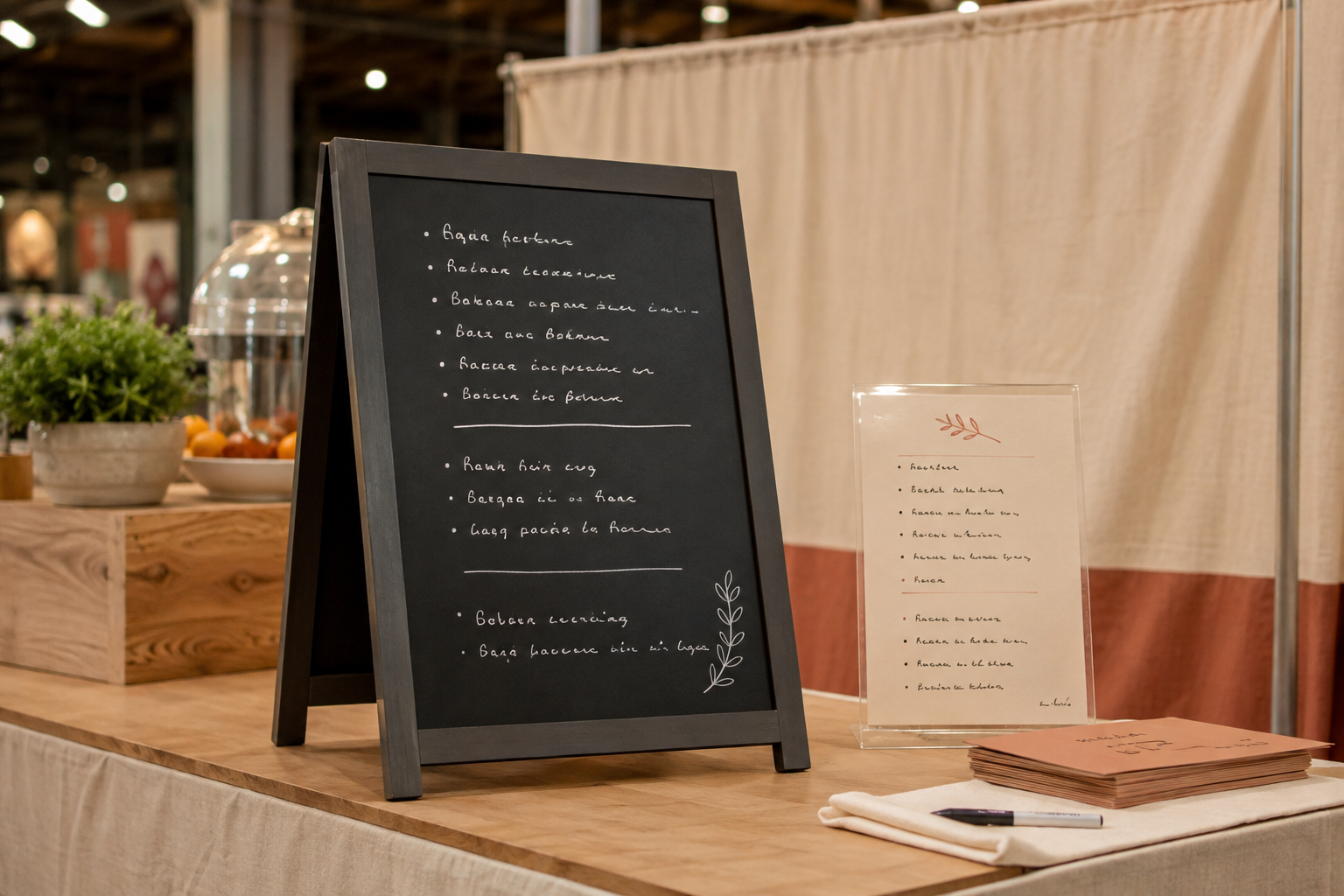
Compare boards only after the routine works
Check the usable writing area, outer and packed dimensions, stand footprint, surface care instructions, included accessories, and the maker's intended indoor use. Match those facts to your longest normal menu—not an idealized short version.
Quick verdict: buy, skip, delay, or print
- Buy: you run recurring indoor pop-ups, change only a few menu lines at a time, and can assign one person to reset and proofread the board.
- Skip: the menu is stable, the board would duplicate another display, or its base would take space needed for products, payment, pickup, or service.
- Delay: your menu wording, counter layout, packed storage, or normal viewing distance is still changing. Test a full-size paper mockup at several events first.
- Choose printed inserts: the menu changes as a whole, needs a logo or tightly aligned details, or can be replaced more cleanly as one prepared sheet.
- Escalate: ask the venue or responsible authority about any required messages, placement rules, or event-specific constraints. This decor and buying guide does not determine approval or compliance.
The purchase threshold in six questions
- How often does the menu really change? A reusable surface has more value when one or two items change often. Reprinting may be simpler when the entire layout changes only occasionally.
- How much copy must fit? Draft the longest normal menu at full size. Count headings, item names, prices, and short qualifiers, then edit before choosing the board dimensions.
- Where will customers first read it? Test from the real approach and queue, not from directly in front of the counter. A small tabletop board is a close-view aid, not a distant attraction sign.
- Who owns the reset? Name the person who updates, aligns, cleans, and proofreads the board before opening. An ownerless changeable sign quickly becomes stale.
- Can it travel with the setup? Measure the folded or disassembled shape, protect the writing face, and assign a place in the vehicle or rolling case.
- Does it fit the service counter? Mock up the complete base, not just the visible face, and leave working room for payment, products, pickup, and customer questions.
Cost, reset, and maintenance tradeoffs
Compare the whole workflow rather than assuming reusable means effortless or less expensive. The useful comparison is the board plus its stand, markers or letters, cleaning supplies, packing protection, storage space, and labor to update it versus preparing and printing replacement sheets.
- Handwritten surfaces: offer flexible wording, but neat spacing and consistent lettering take time. Use only markers and cleaning methods approved for the specific surface.
- Letter boards: create orderly lines but require character counting, alignment, proofreading, and divided storage for loose pieces.
- Printed inserts: move layout work off the counter and make full-menu swaps quick, but each new version needs correct files, printing, and protected transport.
- Setup: freestanding and easel formats need a measured footprint and a repeatable position. Confirm every hinge, support, holder, and fastener according to its maker's instructions.
- Cleaning: food-counter proximity can mean fingerprints and splashes, but cleaning needs vary by product. Follow the board or holder maker's care instructions rather than using a universal method.
Who should skip the reusable board
- A first-time vendor whose menu, booth layout, and customer flow are still being learned.
- A pop-up with a fixed short menu that already fits one clear printed sheet.
- A vendor who must rewrite most of the board before every event.
- A crowded counter where the base interrupts payment, service, pickup, samples, or product display.
- A setup in which no one can reliably update and proofread prices and item names before opening.
- An event that needs long-distance menu reading but only has room for a small close-view board.
Red flags before buying
- The listing gives outside dimensions but not the usable message area or complete base depth.
- Your sample menu only fits after shrinking the lettering or compressing the spacing.
- The board has no protected packing position and will ride against bins, stands, or other hardware.
- Cleaning, compatible markers, replacement letters, or surface-care instructions are unclear.
- The menu changes too quickly for the planned writing or letter-setting routine.
- You expect one display to handle brand identity, full menu detail, ordering instructions, and pickup directions at once.
Run a three-event mockup before buying
- Make a paper or cardboard mockup at the proposed board's exact face and base dimensions.
- Lay out the longest typical menu using the approximate letter size. Remove copy until it can be scanned comfortably from the normal approach.
- Use the mockup at three indoor events. Record how often the message changed, how long resetting took, and whether the sign interfered with the counter.
- Pack it where the real board would travel and note the space and protection it requires.
- Buy when the same reusable format solves the job at all three events. Choose printed inserts when the layout changes wholesale or the reset repeatedly feels burdensome.
When another format is better
- Printed insert in a clear holder: useful for polished full-menu changes and quick swaps. Compare acrylic holders for printed menus by insert size, loading, glare, footprint, and cleaning.
- Small price cards: useful when individual products change independently. The craft-fair price-sign guide covers grouping and close-range reading.
- Fixed brand sign plus replaceable menu: useful when the identity stays stable but products change. Keeping those two jobs separate can simplify each display.
- Dry-erase sign: useful for fast operational edits when the writing style fits the setup. Compare the update and cleanup tradeoffs in the chalkboard versus dry-erase guide.
Bottom line
A changeable menu board is worth it for a recurring indoor pop-up with brief, predictable updates, a known reader position, enough counter space, and a named person responsible for resets. It is poor value when the whole layout changes, the sign is hard to pack, or a printed sheet is already clear and easy to replace. Test three real events before converting a visual preference into another piece of equipment.
Next, compare portable chalkboard formats, review menu-board formats for a more stable counter or wall, or use the small-business sign planning guide to separate menu, identity, and directional messages.