 The Good Sign Company
Indoor Market Display Decision
Is a card spike holder worth it for an indoor market display?
Usually yes when small cards change often, each spike has a maker-approved host, and labels must sit above a measured display without taking up base space. Delay the purchase until the finished cards and host are known. Skip spikes when the attachment point is uncertain, the cards rarely change, or a clip, tent card, slotted base, or flat label solves the job with less handling.
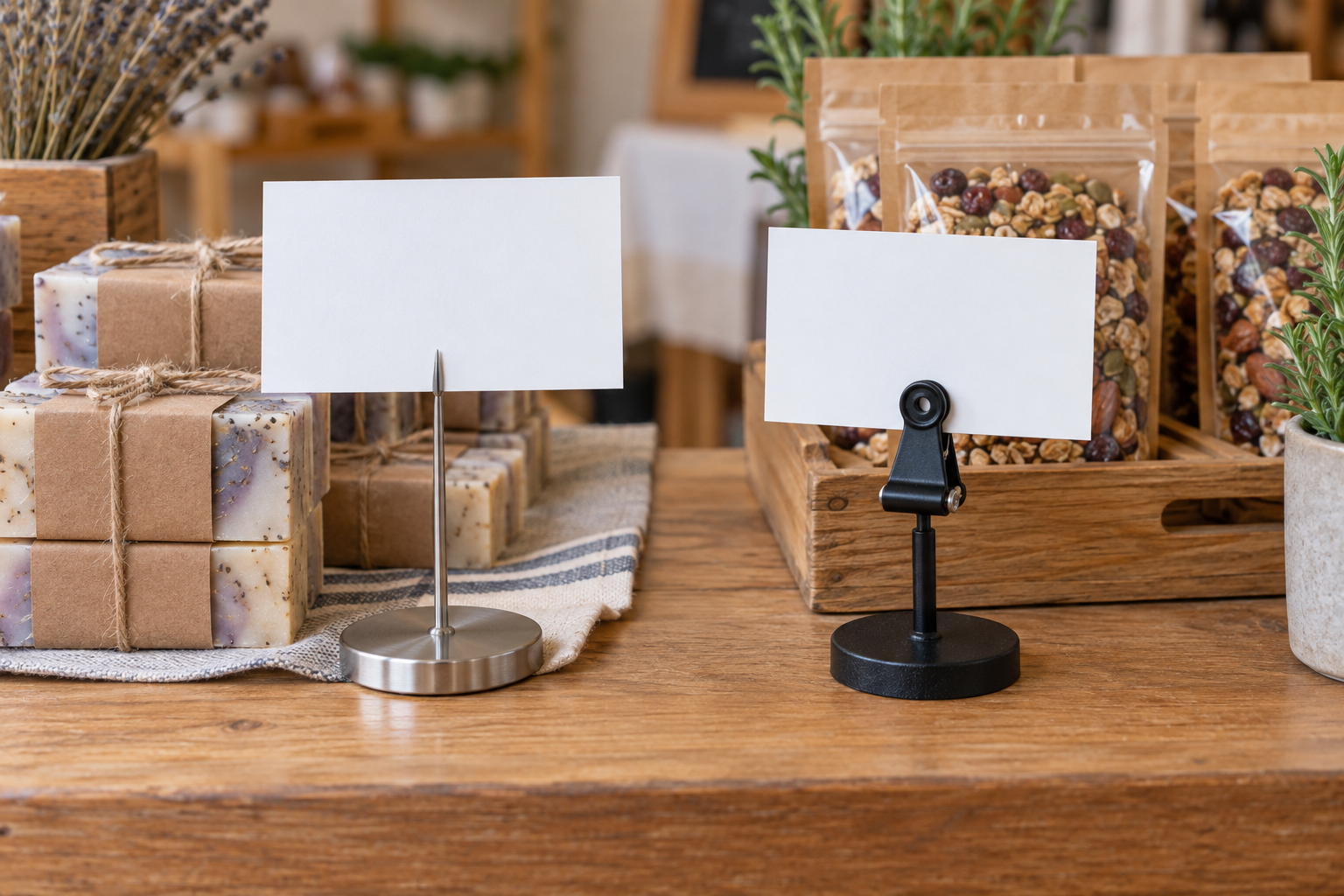
Compare products only after the workflow passes the fit test
Record the intended host, finished card dimensions and weight, required label height, change frequency, and packing method. Then verify current product guidance, dimensions, card capacity, included parts, and intended use for every candidate.
The short answer: buy, delay, skip, or switch
| Decision | When it fits | What to verify |
|---|---|---|
| Buy | Small cards change repeatedly, a documented suitable host exists, and the label needs height without a freestanding base. | Host guidance, complete geometry, finished-card fit, viewing angle, parts handling, and storage. |
| Delay | The card stock, longest message, product arrangement, insertion point, or table plan is still changing. | Mock up one complete label in the final display before ordering a set. |
| Skip | The message is permanent, the card can lie flat, or staff cannot control and store pointed loose hardware. | A printed label or existing holder may do the job with less upkeep. |
| Switch | No suitable insertion point exists, but a shelf edge, basket rim, or small patch of tabletop is available. | Compare a compatible clip, slotted base, tent card, or flat label. |
Six criteria that decide whether it is worth buying
- Recurring-use threshold: list the next several indoor markets and count how many product or price cards change at each one. A holder system is easier to justify when it supports a repeatable routine, not one uncertain display.
- Host compatibility: identify exactly where the spike would enter and compare that material with current maker guidance. Do not improvise with merchandise, packaging, food, furniture, cables, plants, or finished fixtures.
- Finished-card fit: measure the completed card, including lamination or backing. Confirm the holder's documented capacity and check that the grip does not cover needed text.
- Sightline and height: make an actual-size paper mockup at the proposed finished height. View it from the customer approach and behind nearby merchandise.
- Table interaction: map where hands, sleeves, bags, payment equipment, restocking, and product pickup occur. Escalate to the market organizer or venue contact if placement rules or public interaction make the setup uncertain.
- Setup and storage: count spikes, caps, collars, and cards. Assign a rigid container and an owner so pointed hardware does not mix loose with signs, textiles, or cables.
Cost, maintenance, and setup tradeoffs
Judge value with the whole system, not the holder price alone. Compare the current product cost and replacement terms with the number of holders needed, card-printing routine, setup minutes, loose-part count, storage container, and the cost of the best non-penetrating alternative. Do not assume a sales increase or payback period.
Maintenance is mostly operational: keep a piece count, inspect grips and adjustment points according to the maker's instructions, replace damaged cards, and keep cards separate from pointed hardware during transport. The system becomes less attractive when different displays require different stem heights, the insertion point moves each week, or staff must rebuild the label layout from scratch.
Red flags and who should skip
- The host is only “probably soft enough.” Choose a non-penetrating holder instead.
- The card needs several lines, a large QR code, or heavy backing. A supported sign holder may fit better.
- The point would contact food or enter a food display. This general guide does not establish food-contact suitability; use product- and operation-specific guidance.
- The display is outdoors, overhead, unattended, or in an active aisle. Generic indoor card spikes do not establish suitability for those conditions.
- The card changes rarely. A fixed printed label, tent card, or flat label may add less setup work.
- Staff cannot cap, count, and store every pointed part. Choose simpler hardware.
Choose the alternative by the constraint
- A grippable basket or shelf edge is available: compare a card spike with a clip holder.
- A small clear patch of table is available: use a tent card, slotted base, or compact freestanding holder.
- The message stays with the package: consider a flat label compatible with that package and operating process.
- The sign needs more copy or stronger support: use the indoor market product-sign guide to choose a larger route.
Final decision checklist
- The recurring cards and update frequency are documented
- The exact insertion point and host material are known
- Current manufacturer guidance supports the intended use
- The finished card fits without covered text
- The assembled height works from the customer approach
- The setup does not interfere with product handling or checkout
- Every loose or pointed part has a setup and storage routine
- A clip, base, tent card, or flat label would not solve the job more simply
If the host, card, sightline, and handling routine are all known, buy one documented match and trial it in the complete display before expanding the system. If any input remains uncertain, delay or choose a non-penetrating alternative.