 The Good Sign Company
Worth-it decision
Is an adjustable-angle sign stand worth it for a checkout counter?
An adjustable-angle stand is worth considering when the customer approach and counter height create a known viewing-angle problem that a fixed holder cannot solve. Skip it when a simple fixed stand already faces the reader, and delay the purchase until the sign size, free counter space, and normal customer sightline are measured.
This is a fit and workflow decision, not a claim that tilting a sign will increase attention or sales. Start with the wider retail checkout sign guide if the sign's message or format is still undecided.
Disclosure: As an Amazon Associate, we may earn from qualifying purchases and approved partner referrals.
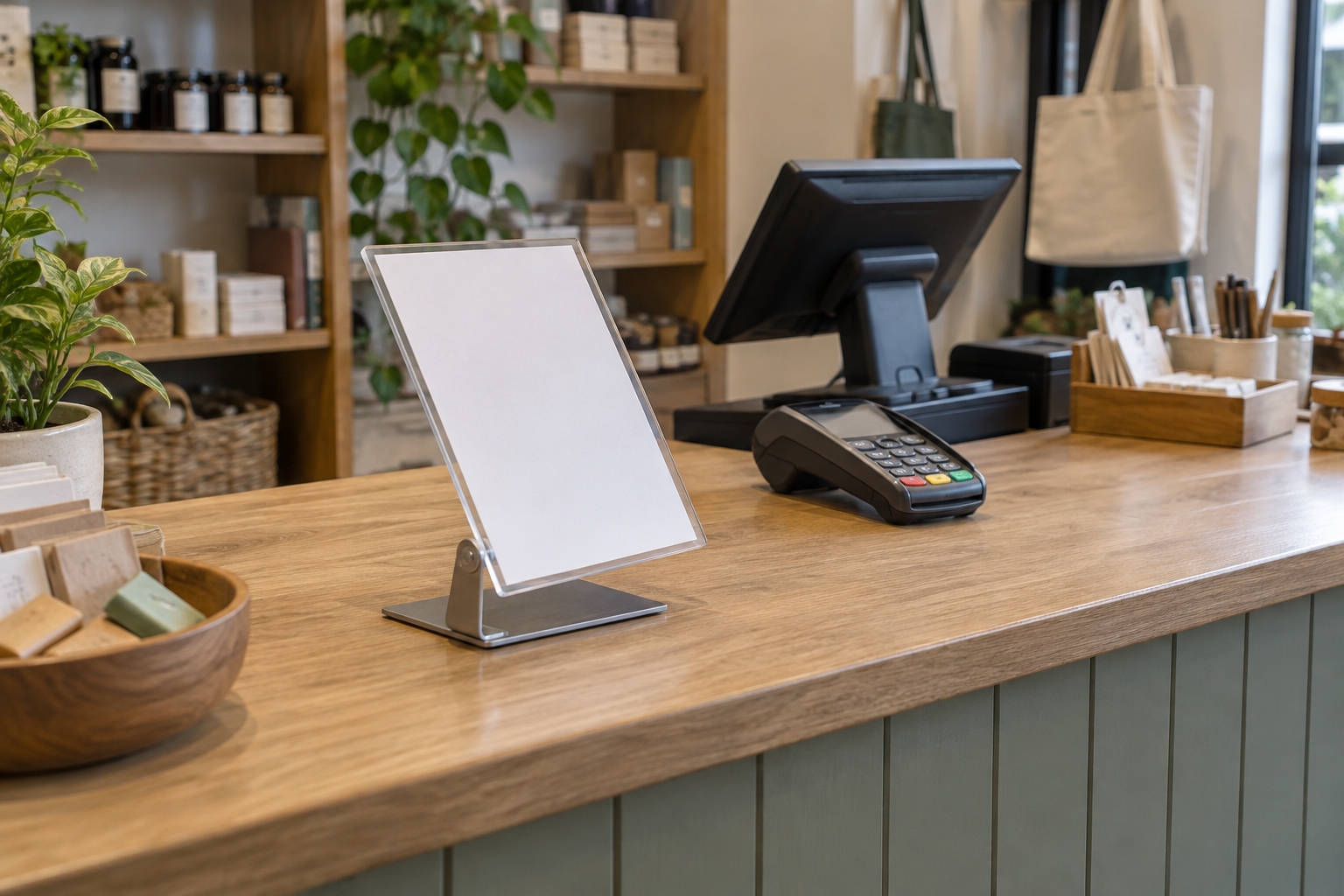
Compare stands after measuring the sightline
Verify the complete stand height and base footprint, supported sign dimensions and weight, adjustment range, locking method, and current maker instructions. A product photo does not prove that its joint or sign fit suits your counter.
Quick verdict: buy, skip, delay, or simplify
- Buy: a paper mockup proves the message is hard to read at a fixed angle, the stand supports the planned sign, and its full base fits outside the payment and pickup zones.
- Skip: one fixed angle serves the normal approach, the adjustment joint adds no useful position, or the available footprint is too small.
- Delay: the payment equipment, sign dimensions, counter layout, or customer route is still changing.
- Simplify: use a fixed holder, a shorter message, or a better location when those changes solve the sightline without an adjustable joint.
Prove there is an angle problem first
Measure from the place where a customer first needs the message—not from directly in front of an empty counter. Note counter height, approximate eye line, reading distance, and whether the approach is straight on or diagonal. Then make a full-size paper or cardboard sign and test several angles while the payment terminal, merchandise, bags, and pickup items are in their normal positions.
- Write one short, final-purpose message at the intended type size.
- Mock up the complete sign face and the proposed base footprint.
- Check the normal customer approach and the staff work side.
- Test whether moving or shortening the sign solves the problem before adding hardware.
- Record the useful angle and compare it with the current product specifications.
If people arrive from two distinct directions, angle adjustment may not solve the real problem. Use the double-sided counter sign worth-it test to decide whether a second face is justified.
Fit the whole stand, not only the insert
A listing may emphasize card or paper size while the base, stem, joint, frame, or clips determine whether the stand works. Record the complete height, width, depth, sign attachment, usable orientation, and adjustment controls. Confirm that the intended card or panel falls within the maker's documented fit and weight guidance.
Leave access to any knob, hinge, clamp, or loading edge. A stand that technically fits but must be removed for every adjustment or insert change may add work rather than reduce it. For a counter where insert access is the main constraint, read the top-loading acrylic holder decision guide.
Tradeoffs to account for
- Adjustment mechanism: A friction joint, ratchet, hinge, or locking knob creates a different setup routine. Follow the current maker's instructions and do not assume every position is supported.
- Footprint: Tilting the face may change the stand's total depth or clearance. Trace the full base and test it beside everyday equipment.
- Glare: A different angle can move a reflection rather than remove it. Check the real overhead and window light during operating hours.
- Message height: Tilting a face changes its apparent position. Make sure nearby merchandise or the payment terminal does not hide the lower portion.
- Updates: Confirm that staff can replace the insert or sign panel without losing the chosen angle, and name who owns changes.
- Cleaning: Use the maker's care guidance for the face, frame, base, and joint; do not assume one cleaner suits every material.
Who should choose another format?
Choose a fixed-angle stand when the counter and approach stay consistent. Choose a wall, shelf, or window location when tabletop space is the limiting constraint, subject to the property rules and product-specific installation guidance. Choose a larger sign elsewhere when the required reading distance makes a small counter card impractical.
When the final choice is between portrait and landscape, use the checkout sign orientation comparison. When the message changes frequently and a basic print holder may be enough, compare a table tent with an acrylic sign holder.
Red flags before ordering
- The listing omits the base dimensions, complete height, supported sign size, or adjustment method.
- The desired angle comes from a staged product photo rather than documented instructions or measurements.
- The sign panel is heavier or larger than the maker's stated guidance.
- The base would occupy payment, bagging, pickup, or staff work space.
- The joint or loading edge would be inaccessible after placement.
- No one has checked glare and readability from the real customer route.
A low-cost trial before you buy
- Cut a card to the planned sign dimensions and draw the proposed base on another piece of paper.
- Prop the card at the angle you think is needed and mark that angle approximately.
- Run the checkout normally for a representative period without obstructing payment or pickup.
- Ask staff whether the mockup gets moved and check the view under different daytime lighting.
- Compare products only after the angle, sign fit, footprint, adjustment method, and update access are known.
Bottom line
An adjustable-angle sign stand is worth buying when a measured checkout sightline requires a repeatable tilt and a compatible stand fits the complete working counter. It is unnecessary when position, message length, or a fixed holder solves the same problem more simply. Prototype first, then verify the current stand's full dimensions, sign limits, joint instructions, and return terms.
Continue with the small-business sign planning pillar or compare retail checkout sign formats.