 The Good Sign Company
Indoor tabletop sign comparison
Fold-flat tabletop easel vs acrylic sign holder
Choose a fold-flat tabletop easel when you already have a stiff finished board and want an angled support that packs separately. Choose a rigid acrylic holder when staff need to slide in measured paper messages and replace them without remaking the display hardware. Start with the sign media and update routine, then compare the full open footprint and customer sightline.
This guide covers small indoor event, reception, booth, and counter displays. It does not establish outdoor suitability, food-contact use, accessibility, stability, or compliance for a specific venue.
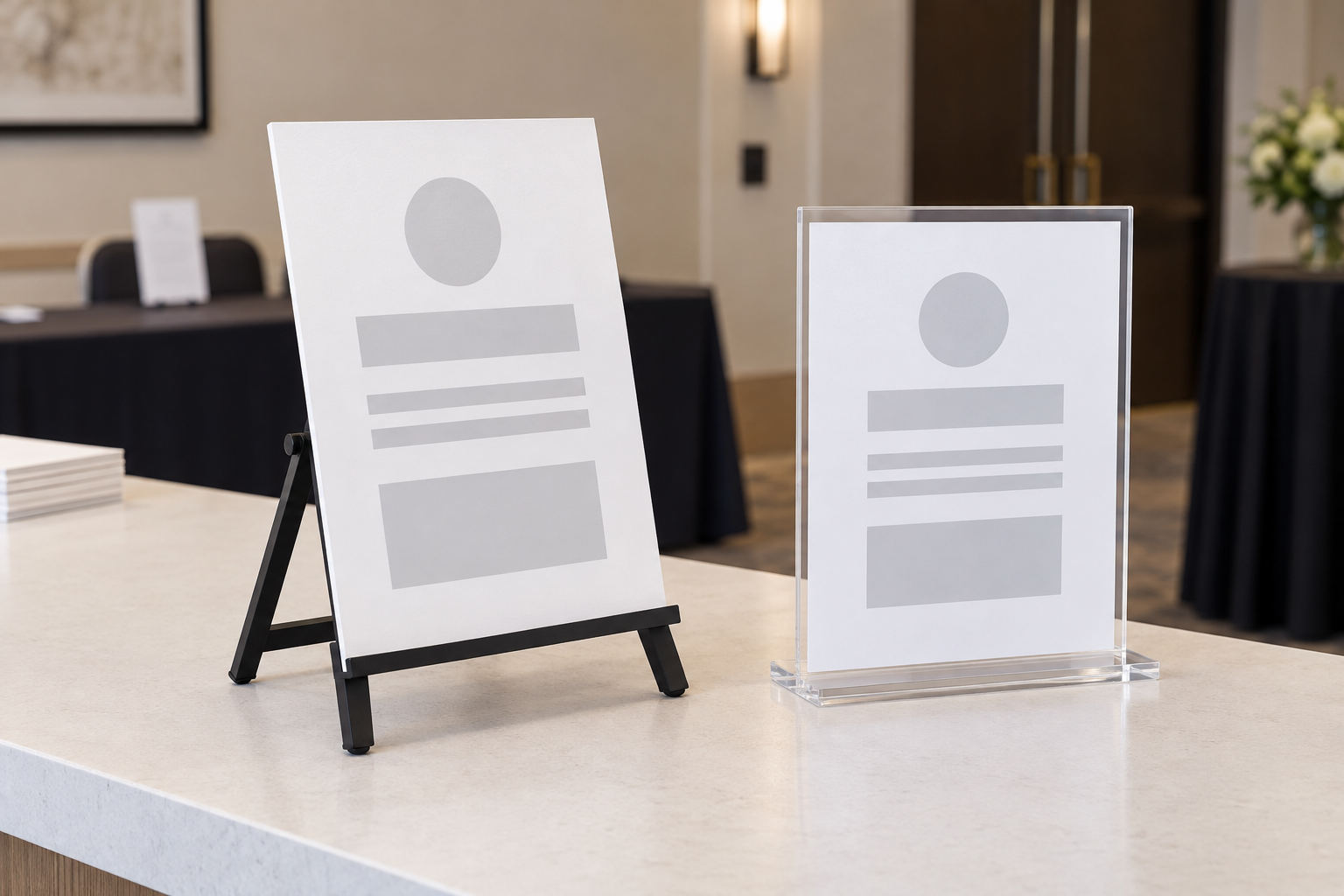
Compare the complete display, not just the stand
Use one actual-size message sample. Verify the easel ledge and open footprint or the acrylic holder's insert dimensions, loading edge, orientation, base, and current care instructions.
The short decision
| Decision | Fold-flat easel | Acrylic sign holder |
|---|---|---|
| Sign media | A finished board stiff enough for the documented ledge and support | A measured paper or compatible insert loaded into the holder |
| Updates | Replace the complete board | Remove and replace the insert |
| Viewing posture | Angle follows the easel geometry and board position | Face angle follows the holder profile |
| Counter space | Open legs create a front-to-back footprint | Base and face create a fixed footprint |
| Packing | Fold the easel and protect the board separately | Protect the clear faces, edges, and inserts |
Who each option fits
Use a fold-flat easel for a finished rigid sign
The easel route fits a welcome card, menu board, QR sign, product story, or event message already mounted or printed on a stiff panel. Measure the complete board after printing, backing, lamination, or decoration. Then verify its thickness, weight, bottom-edge contact, and dimensions against the easel maker's guidance.
This route is especially practical when the board itself is the reusable asset and the support needs to pack flat. It becomes less useful when staff change plain paper messages often or when the open rear stance consumes working space.
Use an acrylic holder for replaceable paper inserts
An acrylic holder fits a team that can standardize one paper size, keep a print template, and assign insert changes. Confirm portrait or landscape orientation, visible area, loading direction, paper capacity, base footprint, and whether the holder is intended for one-way or two-way viewing.
The clear face can make an insert feel more finished, but it can also reflect fixtures and windows. Test the loaded holder from the customer approach before buying a batch.
Setup and maintenance tradeoffs
Easel setup
- Open and lock or position the support only as its instructions describe.
- Place the completed board on the ledge and confirm all contact points.
- Map the entire footprint, including rear legs, on the real table.
- View the sign from normal approaches and check whether the ledge hides copy.
- Pack the board so easel hardware cannot press into its printed face.
Acrylic-holder setup
- Measure the holder's actual insert opening and visible area.
- Trim one test insert and load it through the documented edge without force.
- Check that seams, bends, or base lips do not cover key copy or a QR code.
- Inspect glare from the real sightline and move or angle the display if needed.
- Follow the maker's care guidance; do not assume every clear plastic accepts the same cleaner.
Message changes, storage, and ownership
For an easel, each revision normally means producing and storing another finished board. Label boards by event or version, protect corners and faces, and count the easels separately after use. For an acrylic holder, the display remains while the insert changes. Keep the approved print file, spare inserts, loading instructions, and holder-cleaning supplies together.
Whichever route you choose, assign one person or role to approve the current message, place the correct version, inspect the support, and retrieve it after the event. A reusable display without a reset owner quickly becomes an outdated sign.
Skip the easel when
- The sign is flexible paper with no compatible backing.
- The ledge, support angle, or documented size range does not fit the finished board.
- The rear stance conflicts with merchandise, service space, guest reach, or the table edge.
- Staff need frequent paper-only updates and do not want to store completed boards.
Skip the acrylic holder when
- The existing sign is a thick or rigid panel that is not a documented insert fit.
- Reflections obscure the message in the intended placement.
- The loading edge will be blocked by nearby equipment or a wall.
- The holder's orientation, base, or viewing faces do not match customer approaches.
Skip both when
- The message needs to be read from farther away than the tabletop format supports.
- The table cannot spare a measured, protected footprint.
- The display is exposed to movement, moisture, heat, outdoor conditions, or handling not covered by the product instructions.
- A wall, floor stand, hanging display, or staffed explanation better fits the job.
Run one full-size test before buying multiples
- Print or build the longest realistic message at final size.
- Measure the completed board or insert, not the design file alone.
- Shortlist products using current manufacturer dimensions and media guidance.
- Place one complete setup on the real counter and mark its footprint.
- Check sightline, glare, covered edges, loading access, and nearby work from each approach.
- Pack, store, retrieve, and reset the sample once so the whole workflow is visible.
If the easel route fits, use the guide to compare fold-flat tabletop easels by board fit and packed size. If the insert route fits, compare top-loading and side-loading acrylic holders. For the broader counter or event brief, continue to small-business sign planning.
Bottom line
Choose the easel when a finished rigid board is the sign and fold-flat support is the missing piece. Choose the acrylic holder when a replaceable paper insert is the sign and the reusable enclosure fits the sightline and counter. Skip both when the media, footprint, environment, or reading distance points elsewhere.