 The Good Sign Company
Indoor welcome-sign comparison
Floor easel vs poster stand: which fits an indoor welcome sign?
Choose a floor easel when the welcome sign is a finished rigid board and its edges, shape, or material are part of the presentation. Choose a poster stand when the message is a replaceable paper insert and a compact, upright display face matters more than showing the sign material. Measure the complete support—not just the visible sign—before either one reaches the venue.
This comparison is for decorative and informational indoor welcome displays. It does not determine venue approval, accessibility, emergency-sign placement, or route clearance. If you have not decided whether a floor display earns the space, start with the indoor floor-stand worth-it test.
Disclosure: As an Amazon Associate, we may earn from qualifying purchases and approved partner referrals.
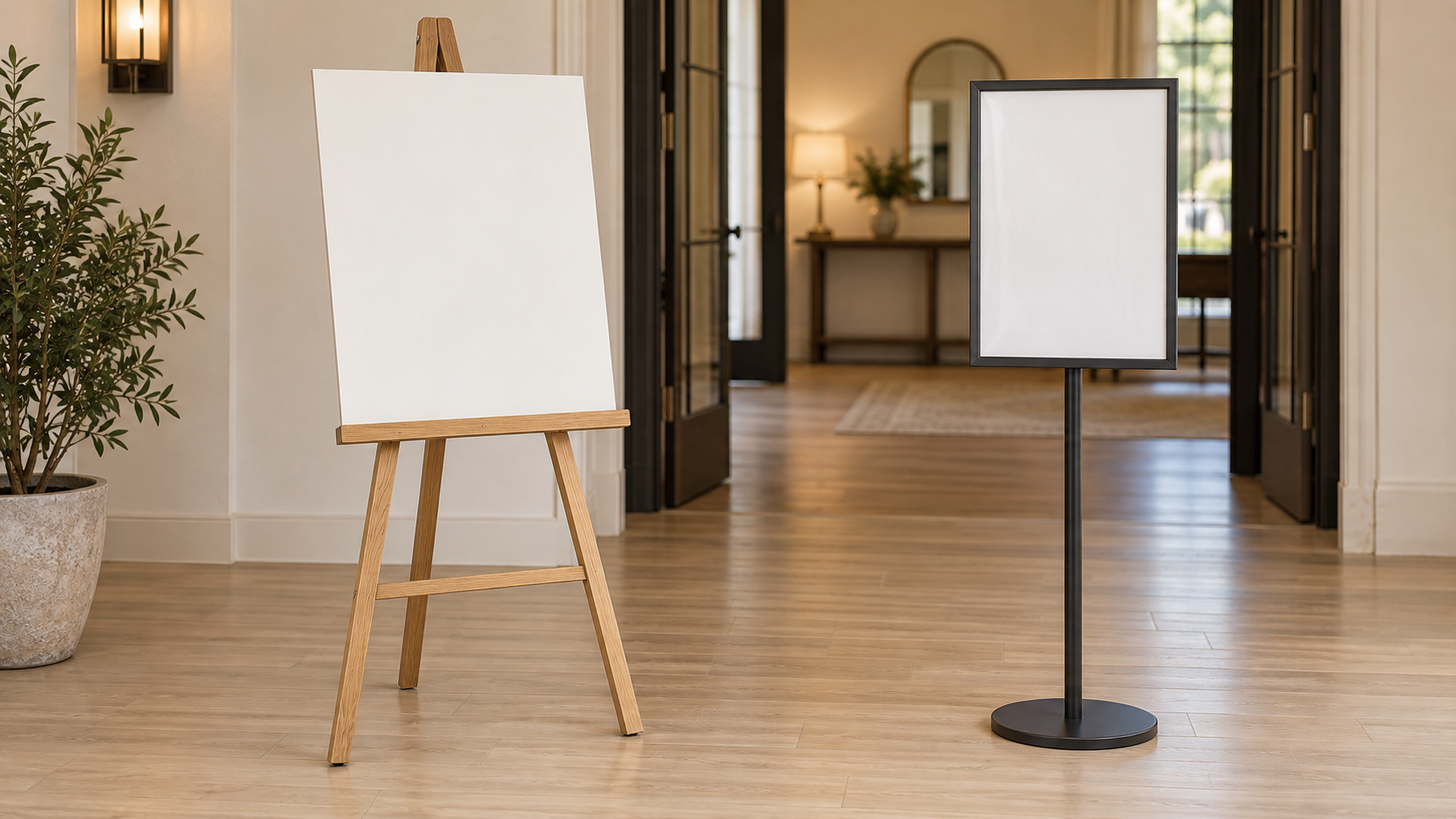
Compare both formats after measuring the sign and location
For an easel, verify the finished board's width, height, thickness, weight, support ledge, retainer, open stance, and current instructions. For a poster stand, verify insert size, visible area, orientation, loading method, overall height, base dimensions, product weight, assembly, and stated use.
Quick decision
- Choose a floor easel for a rigid welcome board whose material, cut edge, shape, or finish should remain visible.
- Choose a poster stand for a standard paper or thin insert that changes between events, rooms, or schedules.
- Borrow from the venue when the event is occasional and a documented support already matches the finished sign.
- Use a tabletop holder when guests reach a staffed check-in surface before they need the message.
- Skip the floor display when no suitable location has been confirmed for the entire open stance or base.
The sign format usually settles the choice
A floor easel supports a separate rigid object. That can be useful when the board itself carries the look: wood grain, a shaped edge, a painted panel, a framed piece, or a thick printed board. The purchase hinges on documented panel fit, ledge depth, retention, and the open geometry of the legs.
A poster stand treats the message as an insert inside a fixed display face. That favors repeat updates and consistent formatting. The purchase hinges on the exact insert opening, how the frame loads, how much of the print remains visible, and whether the portrait or landscape orientation matches the message.
Do not force a rigid board into an insert holder or balance a paper print loose on an easel. Choose the support around the finished sign construction.
Support and footprint are different
An easel may contact the board along a ledge and at a top retainer or rear support. Its legs can spread behind and beside the visible sign, so the usable floor area is larger and differently shaped than the board face. Measure the outermost feet in the exact setup described by the maker.
A pedestal poster stand typically concentrates its floor contact in one base under a stem and frame. That can make the footprint easier to trace, but a compact outline is not proof that a location is suitable or that the stand resists contact. Record the full base dimensions and assembled height, then let the venue review the proposed location.
Viewing height and message design
Mock up both choices at their documented display heights. A large rigid board can offer more design area, but decorative lettering and long copy may still fail from the approach. A poster stand creates a predictable framed window, which can discipline the layout but may reduce the visible print area.
- Walk from the entrance to the first guest decision point.
- Use one greeting, destination, or next action as the primary message.
- Print a full-size rough layout and view it under event-time lighting.
- Check reflections from windows and overhead fixtures from each approach.
- Test the complete support location only after the venue approves the plan.
Updates, setup, and transport
Poster stands usually create the simpler repeat-message workflow when the holder accepts a standard insert that staff can replace according to its instructions. Confirm whether loading is front, side, or top access and whether tools or frame removal are required.
Easels can be simpler when the venue already owns the right one or the rigid welcome board is the main custom piece. For an owned easel, compare folded dimensions, projecting hardware, setup sequence, loose parts, and storage. The panel and easel may need separate protective packing.
Neither format is automatically portable. Compare the longest packed part, total pieces, product weight, assembly steps, vehicle opening, stairs, elevators, storage space, and the person responsible for setup and retrieval.
Side-by-side checklist
- Sign face: rigid finished board for the easel; documented compatible insert for the poster stand.
- Fit: panel dimensions, weight, thickness, ledge, and retention versus insert dimensions, visible opening, and loading method.
- Floor area: complete open leg stance versus complete pedestal base.
- Presentation: exposed sign material and edges versus a consistent frame around replaceable artwork.
- Change cycle: replace or remake the rigid board versus update a compatible insert.
- Packing: folded support plus protected board versus stand parts plus protected frame and inserts.
- Instructions: use only within the current manufacturer's stated setup and conditions.
When neither is the right answer
- Guests already stop at a registration table where a table tent or acrylic holder can do the job at close range.
- The message changes by the hour and a staffed, controlled update method is more useful than a decorative board.
- The venue cannot confirm a suitable floor location for the full base or stance.
- The listing omits the dimensions, supported format, loading method, assembly, or instructions needed to check fit.
- The proposed sign is required, emergency, accessibility, or code-sensitive information that the responsible venue or professional must specify.
- The setup would be outdoors or exposed to wind; this indoor comparison does not establish suitability for those conditions.
Bottom line
A floor easel is the clearer match for a rigid welcome board that deserves to be seen as an object. A poster stand is the clearer match for a repeatable framed display with replaceable inserts. Decide from the finished sign format first, then verify support fit, full footprint, viewing height, update access, packing, current instructions, and venue approval.
If the insert format is already settled and the job is temporary indoor wayfinding, continue with the guide to floor sign stands for directional inserts.
Next, compare floor-easel categories for rigid welcome signs, decide whether any floor stand is worth owning, or use the event sign and easel storage guide once the format is settled.