 The Good Sign Company
Indoor market-display buying guide
Best sign clips for wire shelving and market racks
The best sign clip is the one whose rack-side jaw matches the actual wire and whose card-side grip supports the finished insert at a useful angle. Measure the attachment rod, crossing wires, card thickness, and viewing position before comparing stem length or finish.
This guide covers small indoor price, category, and product cards attached to wire displays. It does not assume that a clip fits every rack, and it is distinct from choosing between a clip-on holder and a weighted freestanding base.
Disclosure: As an Amazon Associate, we may earn from qualifying purchases and approved partner referrals.
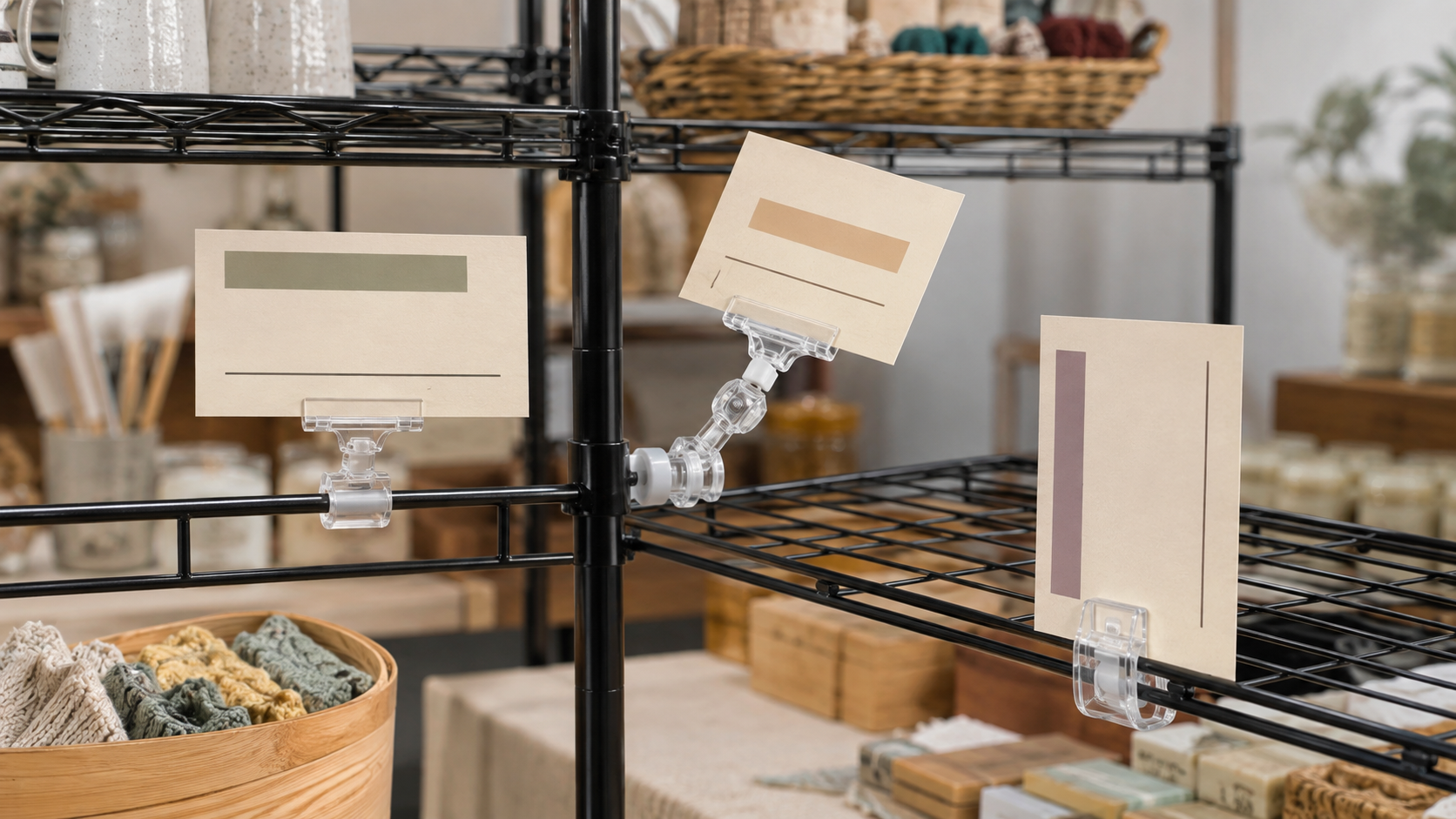
Compare clips only after measuring the rack
Confirm the maker's stated jaw opening, compatible attachment shape, card thickness or holder size, stem length, and angle adjustment. Product photos alone do not establish grip or cross-rack compatibility.
Best clip format by attachment job
These are fit-based categories, not named winners or hands-on rankings.
- Two-ended swivel clip: best when both rack angle and card angle need adjustment. Check the documented opening at each end; the two jaws may not be identical.
- Direct shelf-wire clip: best for a compact label close to the rack edge. A short connection reduces projection, but the card may sit below merchandise or face the wrong approach unless the clip angle is suitable.
- Long-stem clip: best when the card must rise above nearby products. Extra reach also creates more leverage at the rack connection, so use only within the product instructions and recheck alignment after the display is handled.
- Wide card-grip clip: best for a larger or softer insert. More contact area may reduce curling, but verify that the jaws do not cover important copy or mark the finished card.
Identify the rack geometry first
Measure the diameter or width of the wire where the clip will sit. Note whether it is round, flat, doubled, coated, or interrupted by a weld. A jaw shown on a straight rod may not seat correctly over a crossing wire or beside an upright post. Never assume that “wire rack compatible” means every wire display.
Attach a temporary paper flag at the proposed point and view it from the customer approach. This reveals whether merchandise, baskets, shelf lips, or neighboring cards block the message before hardware enters the decision.
Match the card to the card-side grip
Record the finished card width, height, and thickness, including any sleeve or laminate. A narrow clip can suit a stiff small card while a broader grip may better support a larger insert. Follow the clip maker's listed card fit; do not force thick stock into a jaw designed for paper.
Keep prices, product names, and key distinctions outside the portion covered by the clip. Print a full-size mockup and mark the grip zone before finalizing the layout. For the message itself, use the farmers-market product sign guide.
Choose an angle for the real sightline
A shopper looking down at a low basket needs a different card angle from someone scanning a shoulder-height rack. Test the clip position from the aisle and from the point where the product is picked up. If the mechanism swivels, confirm whether it holds the required orientation according to its instructions instead of inferring the range from a staged image.
Plan for quick changes without loose clutter
- Use one repeatable card size so replacements can move between confirmed-compatible clips.
- Keep spare cards flat and store unused clips together rather than loose in product bins.
- Assign someone to straighten cards and inspect attachment points during setup and pack-down.
- Follow the manufacturer's cleaning guidance for clear plastic, coated wire, and printed inserts.
- Test the complete rack after it is loaded; merchandise placement can change the sightline.
When to skip wire-rack sign clips
- Skip them when the rack geometry is unknown or outside the product's stated fit.
- Skip a projecting stem where customers, bags, or moving merchandise will repeatedly catch it.
- Skip small clip cards when the message must be read from across a room.
- Skip clip-mounted pricing when the product arrangement changes faster than the cards can be kept accurate.
- Use a tabletop or weighted holder when no suitable attachment point exists; compare that route in the vendor-booth tabletop sign guide.
Bottom line
Start with the rack-side connection, then the card-side connection, and only then compare height and angle. A direct clip keeps a small label close to the shelf; a swivel format adds aiming control; a longer stem can clear products when the documented fit supports it. The right choice is the format that matches measured wire, supports the finished card, and remains readable through normal display changes.
Continue with the small-business sign planning pillar, compare craft-fair price sign formats, or review pegboard sign holders when the host panel is perforated board rather than wire. If the host is a solid shelf edge, compare a magnetic shelf label holder with a clip-on holder. If the display is a modular wall panel, compare gridwall and slatwall sign-holder compatibility.