 The Good Sign Company
Indoor booth display comparison
Retractable banner vs fabric backdrop: choose by the display job
Choose a retractable banner when one narrow, portable panel needs to identify the booth or deliver a short message from the aisle. Choose a fabric backdrop when the job is to create a wider visual field behind the team or table. Neither format wins without measured booth space, a known sightline, and a transport plan.
Disclosure: As an Amazon Associate, we may earn from qualifying purchases and approved partner referrals.
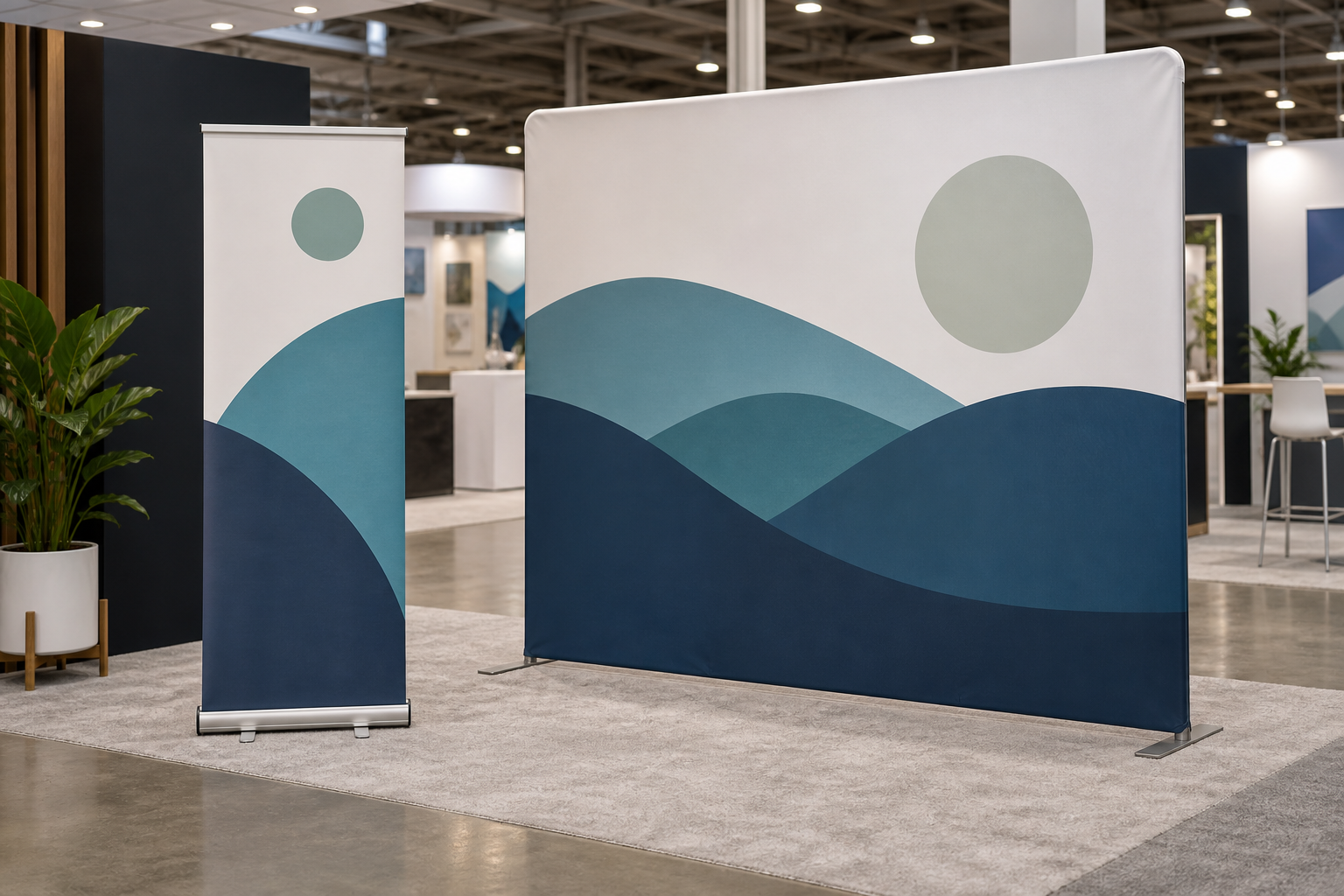
Compare both display systems
Retractable banner stands
Check assembled and packed dimensions, cassette footprint, graphic size, included case, replacement-graphic policy, and the maker's setup instructions.
Browse category: Browse retractable banner standsIndoor fabric backdrop systems
Check the complete frame dimensions, fabric attachment method, feet or base depth, packed components, graphic requirements, and assembly instructions.
Browse category: Browse fabric backdrop systemsQuick decision
- Choose a retractable banner for a narrow identification panel, one short message, quick positioning, and a compact packed format.
- Choose a fabric backdrop when the display must visually anchor most of the booth width or create a consistent background behind people and products.
- Choose both only for separate jobs—for example, a backdrop for identity and a roll-up panel for one offer or direction. Repeating the same artwork usually adds clutter.
- Choose neither yet if booth dimensions, permitted placement, approach direction, storage, or setup ownership are unknown.
Side-by-side tradeoffs
| Decision | Retractable banner | Fabric backdrop |
|---|---|---|
| Visual role | One tall, narrow message or identifier. | A broad branded field behind the booth. |
| Reading pattern | Supports a short hierarchy read from the main aisle approach. | Works best for large identity elements; detailed copy can be lost across folds, seams, or people standing in front. |
| Footprint | Uses a cassette and stabilizing feet or base defined by the product. | Uses the full frame width plus the documented feet, supports, or base depth. |
| Setup | Usually centers on extending the graphic and attaching it according to the maker's directions. | Usually involves assembling a frame and fitting or attaching the textile graphic. |
| Transport | Concentrates the system in a long case or packed unit. | Separates into frame parts and a folded or rolled graphic; confirm the complete packed kit. |
| Artwork changes | Replacement depends on the exact cassette and supplier process. | A replacement fabric graphic must match the particular frame and attachment system. |
Start with the booth job, not the hardware
Write one sentence describing what a person should understand before entering the booth. If the answer is “who we are” across most of the booth, a backdrop has the clearer role. If it is “what happens here” or one short invitation at a particular edge, a retractable banner may be enough.
A backdrop can also improve the visual background for demonstrations or photographs, but do not assume it will hide venue walls, neighboring booths, storage, or lighting from every camera angle. Map the actual width and likely standing positions first.
Measure the complete footprint
Product width alone is not the booth footprint. Record the furthest point of every foot, base, support, and angled component using current product documentation. Mark that rectangle on the floor, add the table and storage, then check the space needed by staff and visitors. Confirm placement with the event or venue rather than treating a generic booth diagram as approval.
For the banner, test whether a table, visitor, or neighboring display blocks the lower half. For the backdrop, check whether the frame extends beyond the allotted space or sits where people will repeatedly move around it. This is planning guidance, not a conclusion about venue, egress, accessibility, fire, or structural requirements.
Design for the real viewing distance
A retractable banner benefits from ruthless editing: a recognizable identity, one plain-language message, and one next step. Avoid placing critical copy at the bottom where the base, products, or people may hide it.
A backdrop should read as one composition from across the aisle. Keep the main identity visible above or beside the positions where people normally stand. Use a full-size layout or scaled booth drawing to check how seams, frame edges, and attachment zones interact with the artwork.
Compare the whole transport and setup routine
- List every packed component, its documented dimensions, and whether it fits the vehicle, cart, doors, and storage shelf.
- Assign who carries, assembles, checks, dismantles, and stores the system.
- Follow the manufacturer's assembly, graphic installation, cleaning, and packing instructions.
- Practice once before the event and keep small labeled parts with the correct system.
- Inspect artwork, hardware, and any linked destination before every reuse.
A retractable unit may involve fewer loose pieces, while a backdrop may pack into several sections. That does not prove either is faster or easier for a particular team; compare the actual manuals and run a timed practice with the complete kit.
Skip criteria and alternatives
- Skip the retractable banner when one narrow panel cannot do the visual job or when the only available position will hide most of it.
- Skip the backdrop when the booth does not need broad coverage, the frame footprint does not fit, or the team cannot own the assembly routine.
- Skip both when the message changes every event; a smaller changeable holder or current printed board may be easier to maintain.
- Use a tabletop sign for close-range instructions, a rigid panel on an approved stand for a defined one-event message, or a hanging sign only when the venue and the complete support plan permit it.
Plan the next step
If the narrow-panel route looks likely, use the retractable-banner worth-it test to check message life, reuse, storage, and ownership. If the remaining decision is display height rather than coverage, compare a hanging booth sign with a tabletop sign. The small-business sign planning guide connects either format to message priority, sightline, updates, and space.