 The Good Sign Company
Worth-it decision
Is a custom QR code sign worth it for a small business?
A custom QR code sign is worth it when the destination is stable, the sign has a proven scan position, and a finished branded display will stay useful longer than the message around it. Use a replaceable print when the URL, campaign, wording, placement, or customer task may change.
This guide is about committing the code and message to a custom sign—not whether a QR interaction belongs at the counter at all. Test that first with the QR code counter-sign worth-it guide, then connect the display to your broader small-business sign plan.
Disclosure: this page includes an approved partner link. We may earn from qualifying referrals.
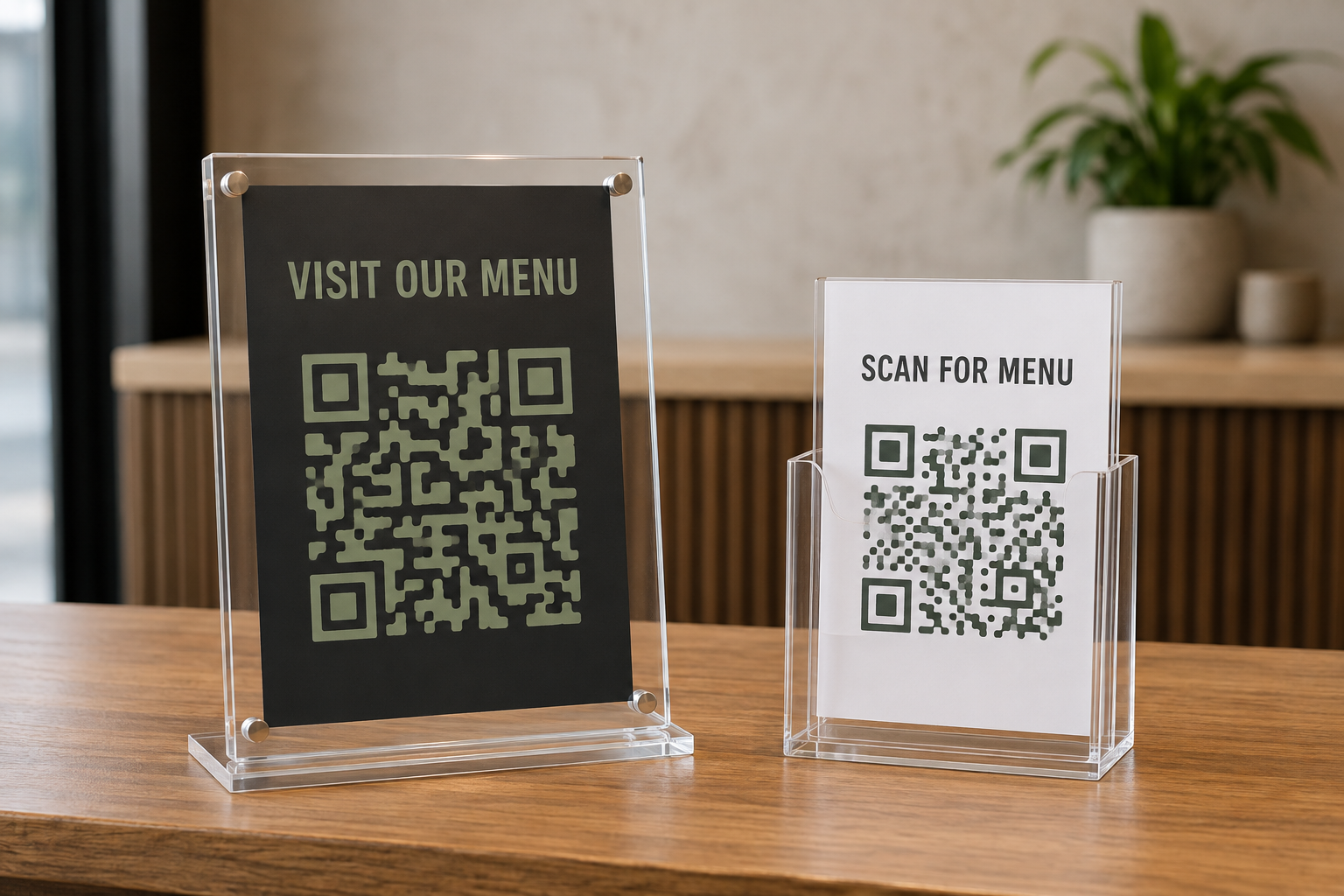
Prove the scan path before requesting custom work
Prepare the controlled destination, exact action label, finished dimensions, placement photo, full-size test print, and a plan for replacing or covering the code if the route changes. Ask how proofs, corrections, mounting information, and future revisions are handled before approving production.
Quick verdict: customize, test, or stay replaceable
- Customize: the business controls a durable destination, the same customer action will remain useful, and a full-size mockup scans reliably from the intended position.
- Test first: use a temporary print in the planned holder or location through normal lighting and customer flow before fixing the artwork.
- Stay replaceable: campaigns, menus, forms, platforms, locations, or wording change often enough that a new insert is the simpler update.
- Skip the code: essential information fits directly on the sign, the destination adds friction, or there is no non-phone path.
The real threshold is destination stability
A permanent-looking sign can outlive the page behind it. Before customizing, identify who controls the domain, redirect, account, and recovery access. Write down what would happen if the menu platform changes, a campaign ends, an employee leaves, or the business moves. A code that depends on an account nobody can recover is not ready for a fixed sign.
When practical, point the code to a stable address the business controls and manage the final destination behind that address. That can preserve the printed pattern through an ordinary page change, but it still requires an owner, renewal checks, and routine testing. Do not treat any redirect as maintenance-free.
Custom plaque versus replaceable insert
| Decision | Custom fixed plaque | Replaceable printed insert |
|---|---|---|
| Best fit | Stable destination, action, placement, and visual system | Changing campaigns, wording, locations, or service platforms |
| Update path | Replacement face, overlay, or another maker-approved revision | Revise the file and print a new insert |
| Proofing priority | Final code file, exact label, dimensions, finish, contrast, and mounting | Visible insert size, printer output, holder fit, and version control |
| Common compromise | Custom branded frame with a replaceable code panel | Consistent branded template in a durable holder |
Run the complete scan test
- Name the action: write a short label that truthfully tells people what opens. The pattern should never be the only explanation.
- Test the destination: open the full path on representative phones and confirm the page identifies the business and works at a small-screen size.
- Print at final size: export the code using the current guidance from the chosen generator, then test the actual printed output rather than a screen preview.
- Use the real position: scan from expected distances and angles under the lighting customers will encounter. Check reflections through any planned acrylic face.
- Protect clear space: keep the code separated from decorative art, edges, fasteners, and nearby copy; do not redraw or stretch the pattern to fit a layout.
- Keep a fallback: show essential information directly or provide a visible, staff-assisted, printed, or typed route for someone who cannot or does not want to scan.
Branding should clarify the task
Customization earns its cost when it makes the display easier to recognize and trust: clear business identity, one action, strong contrast, and a deliberate place in the counter or wall layout. Extra decoration that competes with the code or makes the action label smaller works against that goal.
Use the longest real action label in the proof and view it at the intended distance. If the sign needs several instructions, offers, social icons, or competing codes, split the tasks or simplify the customer path before production.
Plan the replacement before the first print
Ask what can be changed later: the entire face, a fitted insert, an overlay area, or nothing without remaking the sign. Record the source file, destination, generation method, sign dimensions, proof, and responsible owner somewhere the next employee can find. Add the physical sign to the checklist used after website, domain, platform, campaign, or menu changes.
If the code supports payments, accounts, sensitive forms, or another requirement-sensitive process, get the appropriate privacy, security, accessibility, and legal review. A sign-buying guide cannot determine whether that workflow meets a business's obligations.
Who should stay with a replaceable sign?
- A new business still learning which customer action deserves permanent counter space.
- A business sending visitors to short campaigns, event pages, rotating menus, or temporary forms.
- A team that does not control the destination account or cannot name the person responsible for testing it.
- A location where glare, distance, crowding, or a blocked sightline has not been tested with a full-size print.
- A task that visitors need to complete without a phone and lacks a clear alternative.
- A display whose custom treatment would make code replacement difficult or visually awkward.
The practical bottom line
Customize only after the destination, message, placement, and maintenance owner are settled. The strongest custom QR sign is not merely polished; it makes one stable action clear and includes a realistic revision path. When any of those pieces are still changing, a branded replaceable insert is the more useful choice.