 The Good Sign Company
Worth-it decision
Is a custom office hours sign worth it?
A custom office hours sign is worth it when the weekly schedule is stable, the entrance has one dependable viewing position, and a fixed branded presentation matters more than quick edits. Stay changeable when hours, staffing, location, or the exact wording may shift.
This is a customize-or-stay-flexible framework, not a ranking of sign makers. If you have already chosen the changeable route, use the business-hours sign guide to compare insert holders, movable panels, and lettering.
Disclosure: this page includes an approved partner link. We may earn from qualifying referrals.
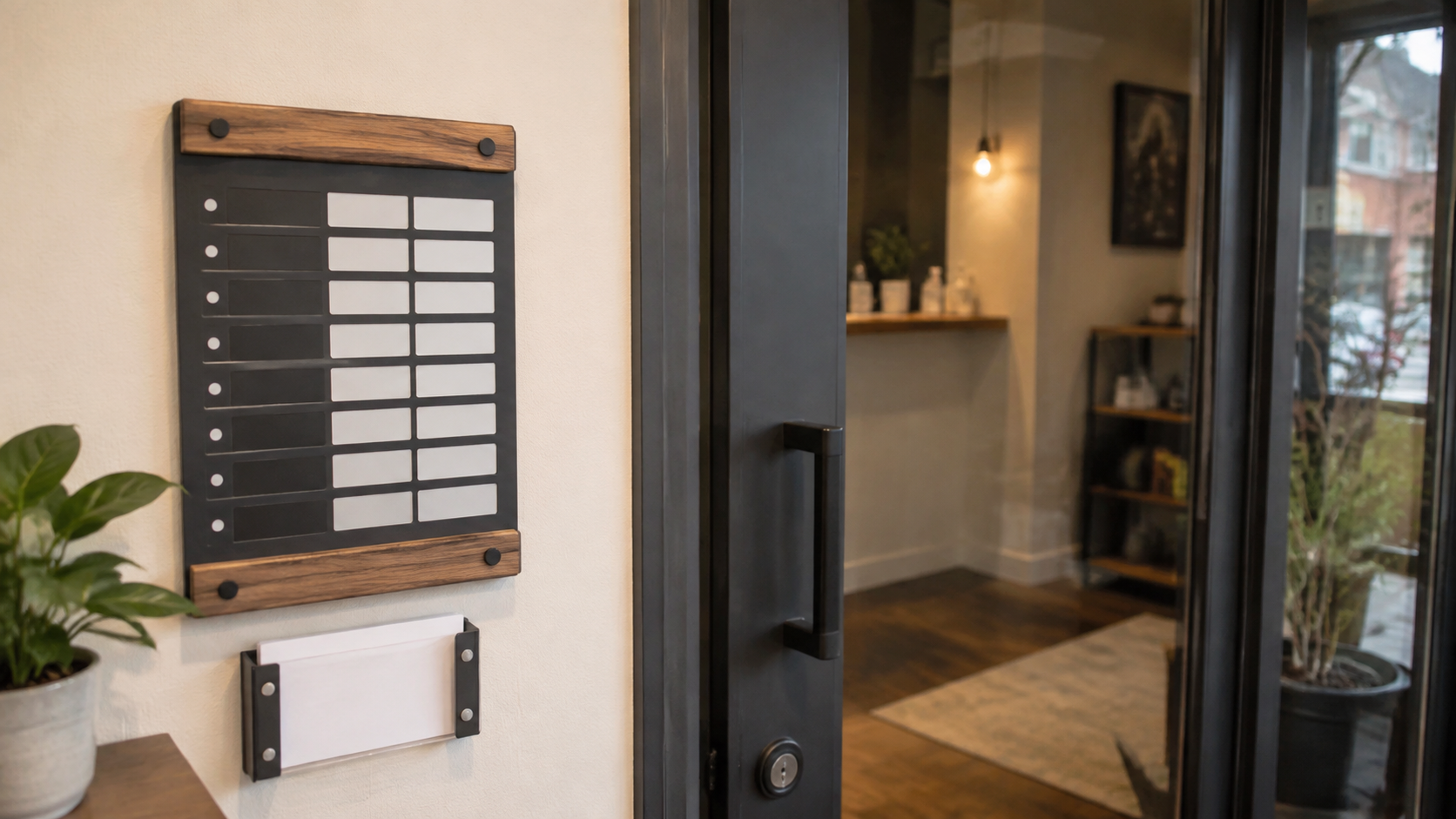
Prepare the complete schedule before requesting custom work
Write every day and time exactly as it should appear, include the longest line, measure the usable sign area, and photograph the entrance from the customer approach. Ask how dimensions, proofs, corrections, finish, mounting information, and future replacements are handled before approving production.
Quick verdict: customize, test, or skip
- Customize: the normal weekly schedule is settled, the sign has a clear location, and a finished branded presentation will be used long enough to justify proofing and production.
- Test first: print the complete schedule at proposed size and mount the mockup temporarily. View it from the normal approach in the lighting conditions when customers arrive.
- Stay changeable: seasonal hours, rotating appointments, staffing, or frequent exceptions make a replaceable insert or changeable panel more useful.
- Skip the project: an existing sign already communicates the schedule clearly, or adding another panel would make the entrance harder to scan.
The threshold is schedule stability
Write down every planned change from the previous year: seasonal schedules, extended shopping days, appointment-only periods, holiday closures, and recurring event hours. A custom fixed face works best when those exceptions can live on a separate temporary notice without changing the regular schedule.
If the core hours change often, customization can still make sense as a frame or branded header around a replaceable insert. Keep the variable information on the replaceable layer instead of fixing it into the permanent artwork.
Test the full schedule at actual size
- Set the hierarchy: decide what a visitor should notice first—business identity, the word “Hours,” or the schedule itself.
- Use the longest line: a short weekday can hide spacing problems that appear on “By appointment” or a longer time range.
- Check the first useful sightline: stand where a visitor actually looks for the schedule, not only directly in front of the sign.
- Observe glare and background: glass, glossy faces, and a busy interior can reduce contrast. Test the real location before choosing a finish.
- Reserve exception space: decide where a temporary closure or special-hours notice will go without covering the regular schedule.
Custom sign versus a replaceable insert
| Decision | Custom fixed sign | Replaceable insert |
|---|---|---|
| Best fit | Stable wording and a deliberate branded presentation | Schedules or tenants that may change |
| Update method | New face, lettering, or approved revision | Revise and reprint the insert |
| Proofing priority | Exact wording, line breaks, hierarchy, dimensions, and finish | Visible insert size, printer output, loading direction, and holder fit |
| Common compromise | Custom branded frame with a replaceable schedule area | Consistent template printed for each schedule change |
Proof the information, not only the look
Check spelling, punctuation, day order, time format, opening and closing times, and any appointment wording. Ask another person to compare the proof against the source schedule line by line. Confirm the final width, height, mounting orientation, and which side faces the customer. A visually attractive proof can still be wrong if one time or day is carried over incorrectly.
Do not crowd permanent exceptions into the main schedule. A short instruction such as where to check current changes may be useful only when the destination will be maintained and the wording remains readable.
Plan placement and mounting before production
Measure the clear wall, counter, or glass area and identify the actual surface. Ask for the finished sign's dimensions, weight, attachment points, and installation instructions before choosing hardware. If the placement involves glass, a leased surface, an exterior location, accessibility considerations, or regulated notices, confirm the applicable property and project requirements with the responsible parties; this page is not compliance or installation approval.
For broader message, sightline, and mounting questions, return to the small-business sign planning guide.
Who should stay with a changeable format?
- A new business still learning its most useful schedule.
- A studio whose hours depend on appointments, instructors, or rotating sessions.
- A seasonal shop that changes its weekly schedule several times a year.
- A shared entrance where the tenant, room use, or displayed identity may change.
- A doorway already crowded with notices, decals, and instructions.
- Any project without a confirmed mounting location and full-size readability test.
The practical bottom line
Choose a custom office hours sign when the normal schedule is genuinely stable, the entrance benefits from a finished presentation, and a full-size mockup proves the complete week is easy to read. Choose a replaceable insert when flexibility is worth more than permanence. A custom frame with a changeable schedule area often bridges the two needs without pretending future updates will never happen.