 The Good Sign Company
Recurring indoor event decision
Is a custom directional sign set worth it for a recurring indoor event?
A custom directional sign set is more likely worth it when the event repeats, the route stays mostly stable, and consistent signs must guide guests through several genuine decision points. It is usually a poor fit when rooms, entrances, arrows, sponsors, or instructions change each time. In that case, reusable holders with replaceable printed inserts preserve flexibility.
Disclosure: this page includes an approved partner link. We may earn from qualifying referrals.
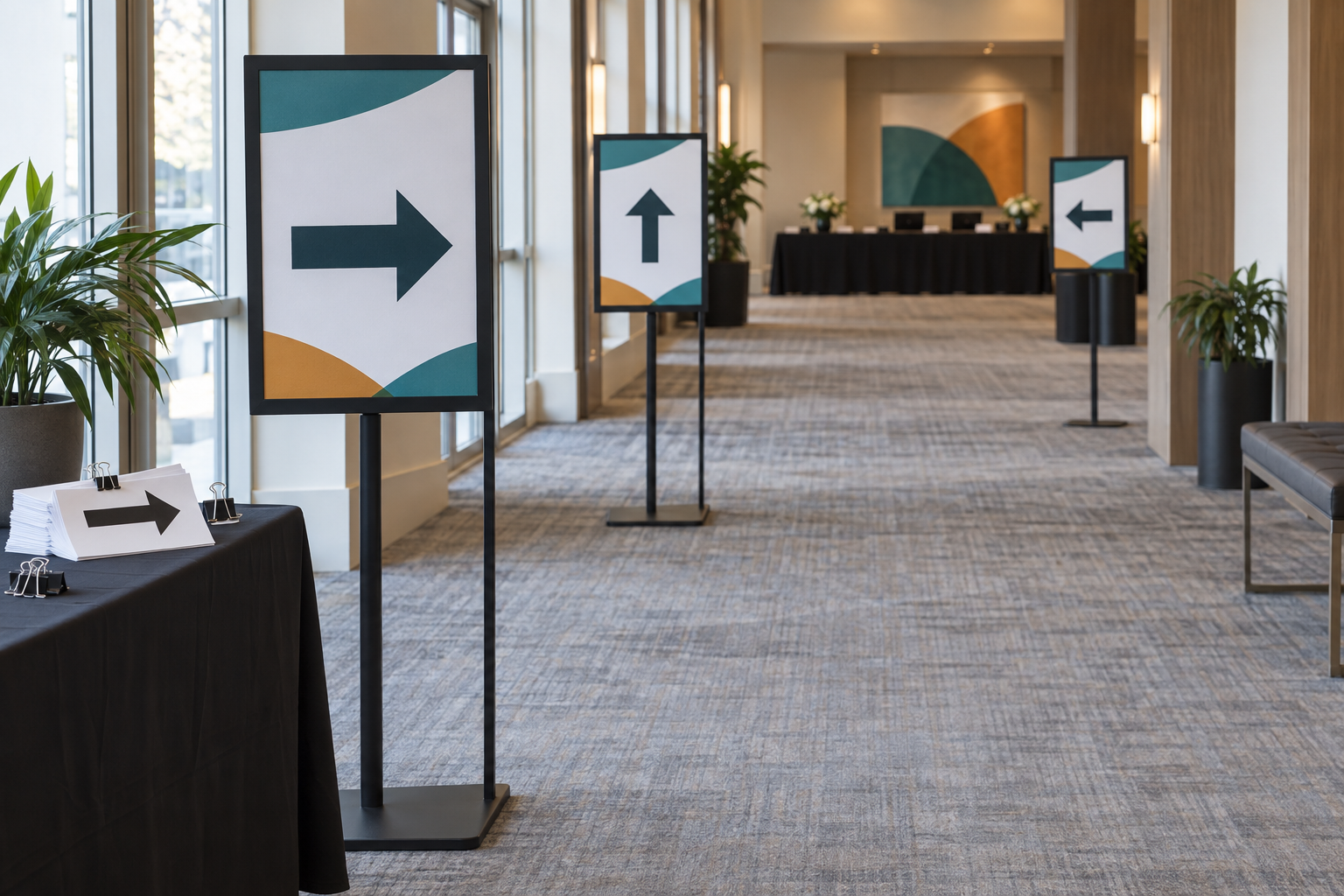
Bring the route map—not just a sign idea
For a small custom indoor sign project, prepare the number of decision points, viewing distances, stable wording, changeable fields, proposed supports, transport plan, and storage space. Ask the sign maker what formats fit that brief rather than assuming a material, size, or mounting method.
Quick verdict
- More likely worth it: the same event returns to the same venue or a repeatable layout, and the set will appear often enough to justify proofing, transport, and storage.
- Less likely worth it: the route changes, the next few dates are uncertain, or generic arrows in changeable holders already solve the problem.
- Best hybrid: keep the event identity and visual system fixed while putting direction, room, time, or sponsor details on replaceable inserts.
- Do not order yet: if the venue has not confirmed proposed locations, supports, attachments, and setup timing.
The seven-question worth-it test
| Question | Custom reuse has a case when… | Stay flexible when… |
|---|---|---|
| Does the event repeat? | Several confirmed events need the same wayfinding job. | The set is being justified by unbooked future dates. |
| Does the route repeat? | Entrances, hallway choices, check-in, and destinations remain stable. | Rooms or access points move from event to event. |
| Can the message stay short? | Each sign needs one destination and one clear direction. | The sign must carry a schedule, policy, or dense instructions. |
| What must change? | Changeable details can live in a separate insert or sleeve. | Arrows and room names are fixed into expensive faces. |
| Will the set look like one system? | Type hierarchy, colors, arrows, sizes, and labels follow one plan. | Pieces will be ordered one at a time without a shared layout. |
| Who runs setup? | One checklist assigns placement, inspection, retrieval, and packing. | No one owns the route walk before doors open. |
| Where will it live? | The full set has labeled indoor storage and a transport method. | Bases, faces, and inserts have no protected storage plan. |
Map decisions before counting signs
Walk every expected arrival path as a first-time guest. Mark only points where someone must choose: a lobby split, elevator versus hallway, registration versus session rooms, or a turn after check-in. A confirmation sign after the turn may help, but signs along a route with no choice add clutter rather than guidance.
At each decision point, record the first useful sightline, background, lighting, available floor or counter area, and the shortest destination label. Use full-size paper mockups and walk the route again. The small-business sign planning guide explains how to connect message, viewing position, and next action.
Separate stable identity from changeable directions
The most reusable system does not force every detail to be permanent. A consistent color band, event name, type style, and frame can tie the set together while arrows, room labels, session names, dates, and QR destinations remain replaceable. This reduces the chance that a polished sign becomes wrong when the venue changes one room.
Build a message inventory before requesting custom work. Label every field as stable, occasionally changed, or event-day variable. If most fields are variable, start with commodity holders and printed inserts. If only a short event identity stays fixed, consider a custom header paired with a replaceable directional panel.
Count the whole operating burden
A set is not useful merely because it can be reused. Someone must update the inserts, pack every piece, move it through doors and elevators, place it at the mapped locations, verify every arrow from the guest approach, retrieve it after the event, and store it together. Missing one sign can break the route.
Create a numbered location list and label each sign, base, insert, and case. Photograph the approved placement from the guest's approach and use that record as a setup guide. Before each event, confirm that the route still matches the plan; do not let a previous layout substitute for a current venue check.
Compare three buying paths
- Custom fixed set: best when identity, destinations, arrows, and route are unusually stable. It offers consistency but makes revisions harder.
- Coordinated changeable system: often the strongest recurring-event choice. Reuse the frames, bases, and visual template while replacing the fields that move.
- Fresh prints in basic holders: sensible for early events, changing venues, or low repeat frequency. It lets the route prove itself before custom production.
If the unresolved question is the hardware rather than customization, use the guide to decide whether an indoor-event floor stand is worth it. If the event also needs booth identification from an aisle, evaluate that separately from wayfinding.
Who should skip a custom set?
- Skip it when fewer than several real decision points need coordinated treatment.
- Skip fixed arrows when the set must work in rooms with different left-right layouts.
- Skip dense copy, decorative scripts, or subtle arrows when guests need a fast route decision.
- Skip production until the venue confirms the proposed indoor placement and support plan.
- Skip the custom route when inexpensive printed inserts can answer the same repeat-use need cleanly.
- Do not use this article as accessibility, egress, emergency, fire, code, or venue approval. Responsible venue staff or authorities must define those requirements.
The bottom line
A custom directional sign set can be worth it when confirmed repeat use, stable routes, consistent sightlines, and a disciplined setup-and-storage routine all point in the same direction. For most recurring events, the safer long-term design is a coordinated reusable system with changeable arrows and room details—not a fully fixed set. Prove the route with mockups and temporary inserts first, then bring the documented sign brief to a custom sign maker if consistency still earns the investment.