 The Good Sign Company
Small-business sign planning
Plan interior wayfinding as a sequence, not one crowded sign.
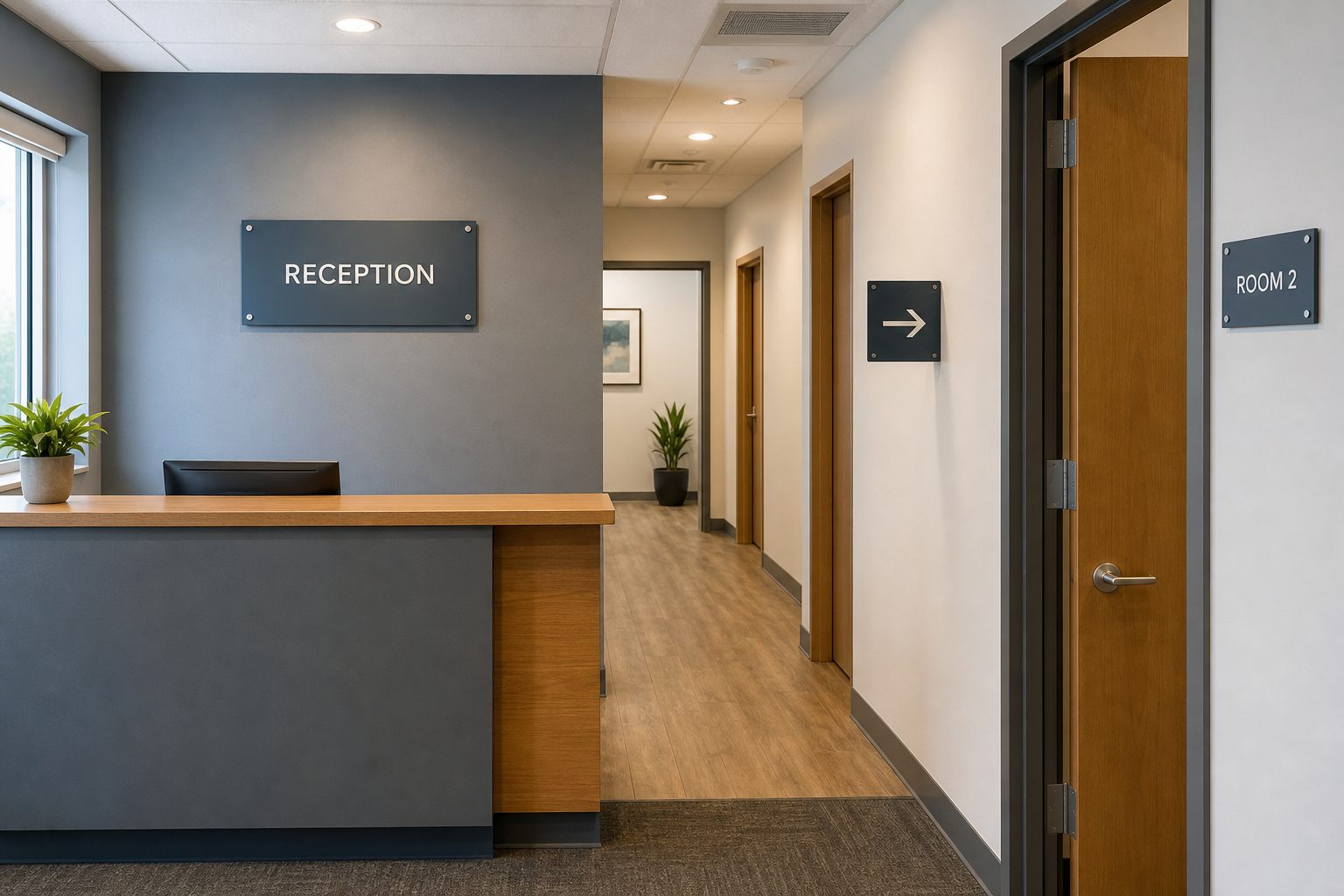
A first-time visitor usually needs three answers in order: “Am I in the right place?”, “Which way do I go?”, and “Have I reached the right room?” A useful sign hierarchy assigns those answers to identity, directional, and destination signs.
Disclosure: As an Amazon Associate, we may earn from qualifying purchases and approved partner referrals.
Need a coordinated custom interior sign set? DaNite Sign Company publicly offers custom commercial sign design, fabrication, installation, and interior signs for Columbus-area businesses. Discuss the project with DaNite Sign Company and confirm current scope, site fit, artwork, materials, installation, timing, and terms directly.
Start with the visitor route
Walk from the normal entrance to the destination without relying on what regular staff already know. Mark every point where a visitor must choose a direction. A sign belongs before the decision, where both the message and the available route are visible—not after the turn.
- Arrival: confirm the business or reception point.
- Decision: show one clear direction at each meaningful turn.
- Destination: confirm the room, department, or service point beside the correct entrance.
Give each sign one primary job
An identity sign can carry the brand. A directional sign should prioritize a destination and arrow. A room sign should confirm the destination at close range. Putting the full logo, service list, hours, arrow, and room list on every sign weakens the sequence and makes updates harder.
For the broader planning framework, start with the small-business sign planning guide. If the reception wall is the main decision, compare dimensional letters with a flat logo panel.
Separate permanent and changeable information
Keep stable identity and route information on the durable sign layer. Put staff names, schedules, temporary room assignments, and rotating instructions on replaceable inserts or another intentionally changeable surface. This avoids remaking an otherwise useful sign when operations change.
For small teams with changing names or availability, compare office door sign formats. For a changing arrival instruction, use the check-in sign guide.
Test sightlines before choosing size
- Photograph each decision point from the visitor’s approach.
- Record the first useful viewing distance, not only the distance from the sign to the opposite wall.
- Check whether open doors, plants, counters, people, or wall returns interrupt the view.
- Use short labels consistently; changing “Reception” to “Front Desk” halfway through the route creates doubt.
- Check glare and contrast during the hours when visitors actually arrive.
Coordinate the set without making every sign identical
Repeat a small system of type style, colors, arrow style, edge shape, and spacing so the signs feel related. Let the physical format change with the job: a reception identity sign can have more presence, while a hallway direction should be quick to scan and a room sign should fit the doorway context.
Before requesting a custom quote, use the custom business sign brief to collect route photos, wall measurements, destination names, artwork, mounting surfaces, and known project constraints.
When to skip a custom sign system
- Skip permanent custom production while departments, room uses, or visitor routes are still changing.
- Skip a coordinated multi-sign set when one standard, well-placed notice solves the only navigation problem.
- Skip decorative illuminated elements when ambient light is sufficient and illumination does not improve the visitor decision.
- Do not use this article as accessibility, code, permit, lease, or installation approval. Confirm project-specific requirements with the relevant authorities, property contacts, and qualified sign professionals.
A practical brief for a sign professional
Send a simple floor sketch, numbered approach photos, the exact destination list, the stable-versus-changeable information split, approximate viewing distances, wall measurements, mounting-surface notes, and the best available logo files. Ask the provider to confirm what belongs in the proposed scope. DaNite’s public site describes interior signs among its commercial sign products and lists design, fabrication, installation, and repair; contact DaNite Sign Company only if that verified commercial offering and Central Ohio service context fit the project.