 The Good Sign Company
Business sign lighting plan
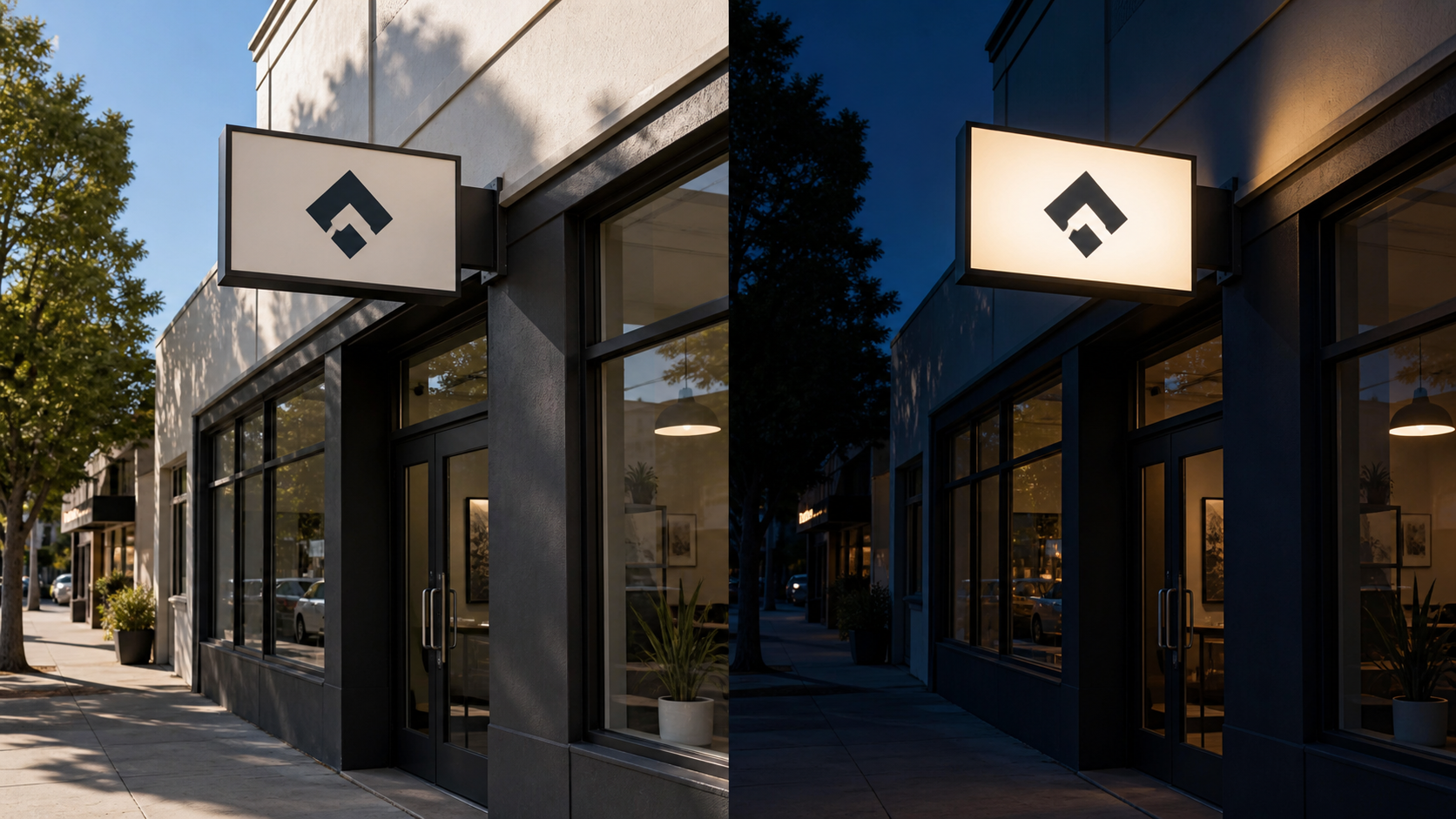
Plan daylight and darkness as two different viewing conditions
A business sign can look clear in a bright rendering and disappear after sunset—or glow at night while losing contrast when it is off. Plan the two conditions separately. The goal is not maximum brightness; it is a readable identity, controlled illumination, and a sign face that still makes sense during normal unlit hours.
Disclosure: As an Amazon Associate, we may earn from qualifying purchases and approved partner referrals.
Start with the hours the sign must do its job
Write down when customers actually approach the site. A daytime office may need excellent unlit contrast but little nighttime impact. A restaurant or entertainment business may need the main identity to remain useful well after sunset. Also note seasonal changes: a late-afternoon closing time can occur in full sun during one part of the year and darkness during another.
Separate identity from promotion. The permanent sign may need to identify the business in both conditions, while hours, offers, and changing details may belong on a window or closer-view display.
Run a daylight contrast check
Judge the sign face when its lighting is off. Compare the message with the face, the face with the building, and the full sign with neighboring windows, trim, landscaping, and parked vehicles. A light face on a light facade can lose its outline; reflective glass and deep shadows can make a seemingly simple elevation visually busy.
- Face contrast: can the letters or logo separate from the sign background?
- Building contrast: can the sign shape separate from the wall or mounting area?
- Sun and shade: does direct sun, shadow, or reflection change the first read?
- Unlit appearance: do the materials and colors still look intentional when the illumination is off?
Run a night legibility check
At night, brightness is only one variable. A very bright face can wash out narrow strokes, reduce color separation, or create glare. Surrounding streetlights, window lighting, vehicle headlights, and neighboring signs change the amount of contrast the sign needs.
Ask for a night rendering or project example that shows the whole storefront rather than a tightly cropped glowing sign. Review the main approach and any important side angle. If brightness control, automatic switching, or a particular lighting behavior matters, have the provider confirm the proposed system instead of assuming those features are standard.
Choose the sign format after defining the effect
An internally illuminated cabinet or light-box sign can make a broad sign face visible after dark. DaNite Sign Company's current public guidance describes a cabinet/light-box sign as an enclosed sign, typically aluminum, lit from inside. Other formats produce different effects: face-lit letters direct light toward the viewer, while reverse-lit letters use the wall behind them as part of a halo effect.
The useful question is not simply “Which one is brighter?” Compare daytime face appearance, nighttime edge definition, wall texture, sign depth, viewing angle, and service access. The backlit-vs-front-lit guide explains those visual differences, while the cabinet-sign-vs-channel-letters comparison focuses on sign format.
Prototype the same view twice
- Photograph the full sign area from the normal customer approach in daylight.
- Take a second photo from the same position after dark.
- Place the same scaled sign concept into both images.
- Check the name or mark first, then any supporting line.
- Repeat from another meaningful approach if the sign is seen from more than one direction.
Keep the message short enough to read in the available viewing time. If the layout becomes crowded before lighting is considered, use the business-sign message-length test to remove secondary information.
Account for mounting, power, and upkeep
Illumination changes the project scope. Ask the sign professional to show overall depth, mounting approach, the intended power route, control location, and how illuminated components are reached for service. Photograph existing walls and utilities, but do not treat a visual survey as a substitute for an on-site professional review.
Property requirements and local approvals can affect a project. Confirm them with the property owner, relevant authority, and sign provider for the actual location rather than relying on a general article.
Skip illumination when it does not solve the real problem
Do not add lighting by default when customers only arrive in daylight, the sign is already well lit by the environment, the message changes frequently, or the project cannot support the needed power and service access. A high-contrast non-illuminated panel, window graphic, or separately lit sign may be the more direct route. Delay fabrication if the name, logo, placement, or operating hours are still unsettled.
When DaNite is a relevant next step
DaNite Sign Company's current public site says it designs, fabricates, installs, and services custom commercial signs for Columbus businesses, including interior and exterior signs. Its site also discusses window vinyl, cabinet/light-box signs, and custom LED and neon signs. That makes it a relevant conversation when a Columbus-area business needs day/night visibility considered as part of a custom commercial sign project. Confirm the location, format, lighting, installation, service, and project scope directly.
Bring this day-and-night brief
- Normal customer approach and viewing distance
- Daylight and nighttime photos from the same positions
- Hours and seasons when visibility matters
- Exact approved name, logo artwork, and message priority
- Usable wall or sign area measurements
- Known property constraints and existing lighting
- Questions about mounting, power, controls, and service access