 The Good Sign Company
Commercial sign procurement
How to Compare Commercial Sign Quotes When Scope Differs
Before comparing proposal totals, check whether the providers are offering the same work for the same signs, locations and drawing revisions. Put every gap into a written clarification log instead of guessing what it will cost.
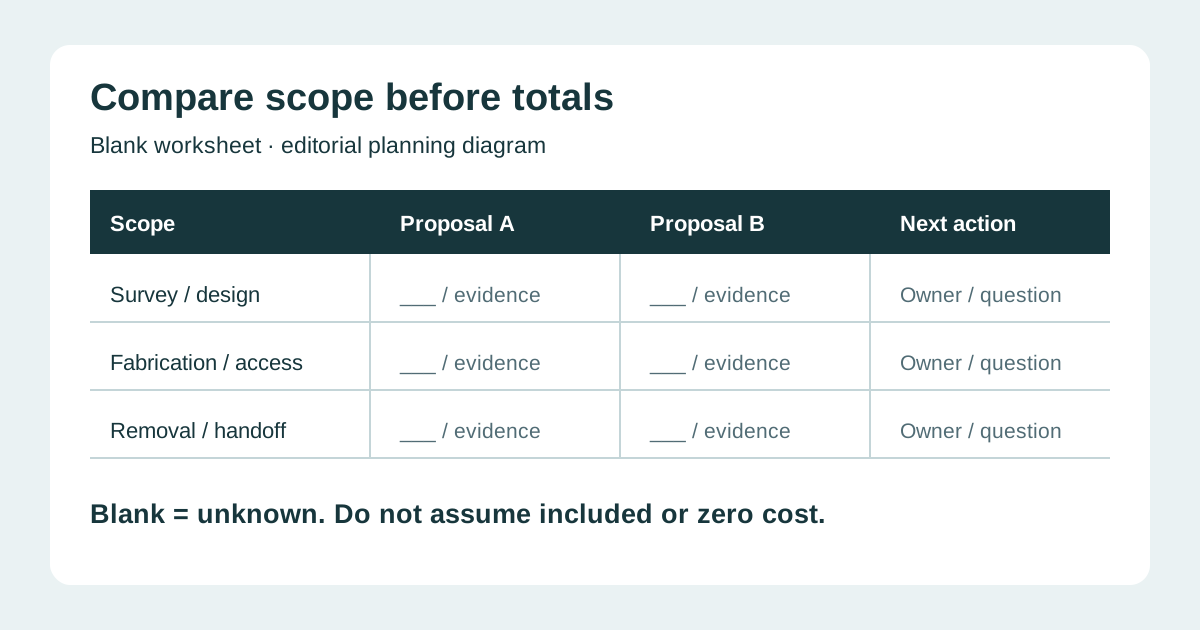
Compare scope first; keep unknowns visible.
Use one sign schedule, site list and artwork revision. Record each proposal’s explicit inclusions, exclusions, allowances and alternatives with its page or section reference. Assign each unresolved row an owner and a question. Unknown does not mean excluded, included or zero cost. Different construction proposals remain alternatives until the responsible provider or qualified specifier establishes what can be compared.
This guide is for procurement, facilities and operations teams holding two or more substantial commercial sign proposals. If you are still defining the project, use the custom business sign brief. For one straightforward nontechnical display without competing proposals, that brief may be enough; skip the full matrix.
1. Freeze the comparison header
Write the project and location IDs above the matrix. Match sign-item quantities and schedule revisions, drawings, artwork and the proposal IDs, revisions and dates. Record requested timing, each proposal’s validity and any delivery or access assumptions. If the proposals cover different sites or sign items, resolve that identity gap before treating their totals as comparable.
For a portfolio, use the multi-location sign specification guide to establish the location list and controlled revisions. Keep genuinely different concepts in separate alternative columns rather than forcing them into the same base scope.
2. Copy the scope worksheet
This is an editorial planning tool, not a provider’s form. Copy it into your comparison document and add columns for additional proposals. Each proposal cell needs status + exact proposal page/section + written response reference/date. Preserve the provider’s wording and units where supplied.
- I — Included
- Explicitly included in the cited proposal scope.
- E — Excluded
- Explicitly excluded; record the wording.
- A — Allowance
- Record its stated basis and what remains open; it is not a confirmed total.
- O — Optional / alternate
- Keep outside the base scope comparison.
- U — Unclear / not stated
- Blank cells are U. Seek clarification without assigning an amount.
- N/A — Not applicable
- Use only when confirmed not applicable, with the confirmation reference.
On small screens, scroll the table horizontally. Focus the table region to scroll with a keyboard. A text version follows for copying.
| Scope row | A status / evidence | B status / evidence | Gap or unknown | Accountable clarification owner | Next question / written response reference |
|---|---|---|---|---|---|
| Site survey / verification deliverable | ___ | ___ | ___ | ___ | ___ |
| Artwork / design / proof revisions | ___ | ___ | ___ | ___ | ___ |
| Fabrication: sign items, quantities, proposed construction | ___ | ___ | ___ | ___ | ___ |
| Removal / disposal / retained existing components | ___ | ___ | ___ | ___ | ___ |
| Access: work window, equipment and site coordination assumptions | ___ | ___ | ___ | ___ | ___ |
| Installation and scope boundaries with other trades | ___ | ___ | ___ | ___ | ___ |
| Property / permit / engineering inputs and responsible parties | ___ | ___ | ___ | ___ | ___ |
| Exclusions and allowances, including stated basis | ___ | ___ | ___ | ___ | ___ |
| Alternates and optional services outside base scope | ___ | ___ | ___ | ___ | ___ |
| Change triggers, written authorization and revision process | ___ | ___ | ___ | ___ | ___ |
| Closeout records, care information and service boundaries | ___ | ___ | ___ | ___ | ___ |
Copy the worksheet as plain text
Add commercial-terms rows for currency, tax/freight treatment, payment milestones and proposal validity, copying the supplier’s actual documents. Do not invent an adjusted total for an unknown amount. Ask for a revised written proposal and leave contractual interpretation to the responsible adviser.
3. Work a gap into a clarification
Wholly hypothetical example: an organization receives two proposals for a reception identity sign. These invented entries are not DaNite’s or any other provider’s bid. No real site dimensions, technical design, prices or provider statements are represented.
| Row | Hypothetical A | Hypothetical B | Owner and next question |
|---|---|---|---|
| Survey | I: site verification named | U: not mentioned | Facilities asks B what verification it assumes and what it would deliver. |
| Design / artwork | I: one proof revision stated | E: finished artwork supplied by buyer | Brand confirms the actual artwork revision; procurement requests matched design scope or records the difference. |
| Fabrication | I: reception sign item R1 | I: item R1, different construction description | Provider or qualified specifier confirms differences and suitability. Procurement does not declare equivalence. |
| Removal | E: existing sign removal excluded | I: removal named; disposal U | Facilities confirms what exists. Procurement asks B about disposal and A to identify its removal route. |
| Access / install | I: installation; normal-hours access assumed | A: access equipment allowance; basis unstated | Facilities supplies access facts; procurement asks B for the allowance basis and what changes it. No extra charge is assumed. |
| Change handling | I: written scope change before added work | U: procedure not stated | Procurement requests B’s authorization and revised-document process. |
| Closeout / service | I: completion photos; future service excluded | U: handoff / service scope absent | Facilities asks B what records are included and separates future service from installation acceptance. |
These proposals are not yet compared on an equivalent scope. Neither is called cheaper, better or more complete overall. Suppose B later provides an access allowance basis: update only the status and evidence that response establishes. That response alone does not resolve artwork, removal or service questions.
Preserve both original proposal revisions. Keep one clarification entry per gap: issue ID; proposal reference; question; owner; date sent; written response reference; revised proposal; remaining decision. A provider’s answer is evidence for that row, not a reason to close every open item.
4. Send the same bounded request
Ask each provider to clarify its own proposal against the same inputs. Do not share another provider’s confidential bid without appropriate authorization.
For project ___, please confirm your proposal ___ against sign schedule ___ and artwork revision ___. For each attached row, state included, excluded, allowance with basis, optional or not applicable; identify assumptions, information needed from us and who owns the next action. Please record any scope or commercial change in a revised written proposal. We are seeking clarification, not authorizing added work.
Procurement owns the comparison record; facilities confirms site and access facts; brand confirms artwork; providers confirm their own proposed scope. Keep engineering, electrical, property and permit decisions with responsible qualified parties. This article does not authorize fabrication, changes or technical installation.
5. Record the decision you can actually make
- Same scope, documented: compare the commercial terms through your organization’s process, retaining the evidence and revisions.
- Open scope: name the unanswered question, accountable owner and next response needed. Leave unknown amounts unknown.
- Different technical concepts: retain separate alternatives and obtain the relevant specialist assessment before claiming equivalence.
For later service ownership, use the multi-location maintenance responsibility guide. Do not turn a closeout-document row into an assumed ongoing service agreement.
Discuss your commercial sign scope with DaNite
You can begin an enquiry while gathering inputs; a completed worksheet or internal approval sequence is not required to make initial contact. Share the location, intended sign work and the questions you need help resolving. Confirm scope, location fit and terms directly; this guide does not establish project acceptance, pricing, timing or results.
Discuss your commercial sign scope with DaNiteSources and editorial basis
The worksheet and hypothetical comparison are original editorial synthesis prepared with AI assistance. We did not obtain real customer bids, contact providers, test products or evaluate a technical installation. This page is preparation guidance, not legal or engineering advice.
- FAR 15.404-1(b)(2)(ii)(A)–(C), Acquisition.gov: historical-price comparisons consider material differences and technical advice. Used only as a limited procurement analogy for checking comparability; it does not impose a duty on every private sign buyer, supply a sign-price benchmark or authorize adjusting supplier quotes. Displayed FAC 2026-01, effective March 13, 2026; accessed November 10, 2026.
- SignTek’s quote-request form separately identifies survey, removal, installation and design requests and asks for dimensions and applicable landlord criteria. This supports treating those inputs separately at that provider, not assuming industry-standard inclusions or DaNite capability. Displayed page timestamp October 19, 2022; later update date unverified; accessed November 10, 2026.
DaNite’s public homepage and enquiry page were inspected for the accepted research on November 9, 2026; publication/update dates were not stated. Fresh homepage and tagged-destination retrievals returned HTTP 403 on November 10, 2026. Their current contents and project-specific offering could not be reconfirmed in this check; ask DaNite directly.