 The Good Sign Company
Replacement-hardware buyer guide
How to Choose Replacement Alligator Clips for Small Sign Holders
The best replacement clip is the one that matches the holder’s connector and angle, grips the actual card without marking it, and keeps the message upright. Measure the surviving hardware and test a duplicate card before buying a pack.
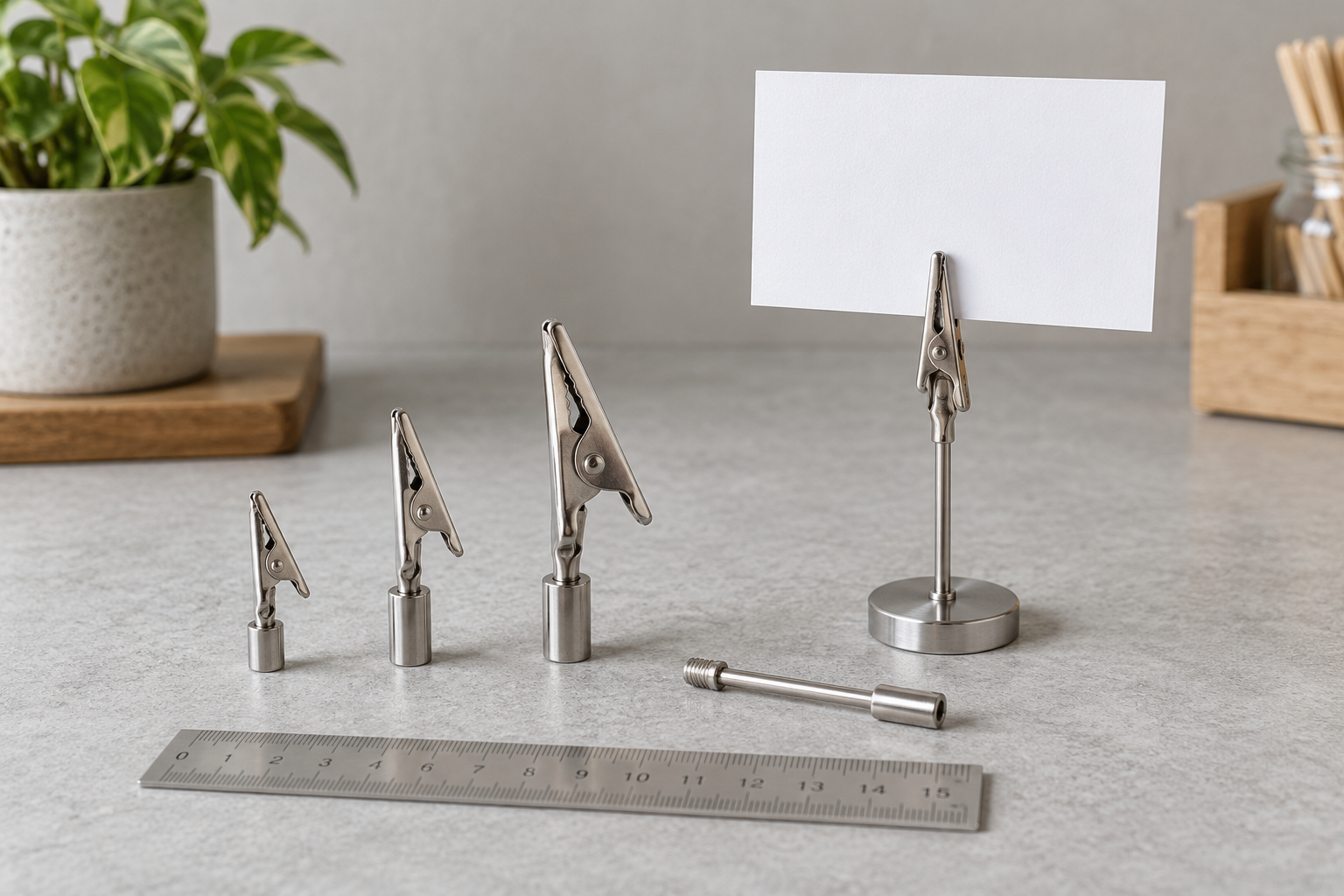
Compare replacement clips after identifying the connection
This category route includes loose clips and clip assemblies. Verify the current listing’s connector type, dimensions, jaw opening, orientation, and stated use against the holder you own. A similar-looking clip is not proof of fit.
Quick comparison framework
| Clip route | Potential fit | Verify first | Skip when |
|---|---|---|---|
| Threaded connector | A stem or base has matching documented threads | Diameter, pitch, thread length, and orientation | The listing omits thread measurements |
| Push-fit or socket connector | The original clip detaches from a measured socket | Stem profile, insertion depth, and retention method | Fit depends only on a photo or broad size name |
| Integrated clip-and-stem assembly | The whole upper assembly is replaceable | Stem length, base connection, final card height | The added leverage makes the base unstable |
| Original maker part | A model-specific replacement is documented | Holder model, part number, and current instructions | It belongs to a different holder system |
Measure the holder before shopping
- Document the connector: photograph the clip from the front, side, and underside before removing anything.
- Measure the mating parts: record thread diameter and pitch when known, or the stem width, profile, and insertion depth for a socket.
- Measure the card: note finished thickness and how far it entered the original jaws.
- Record the display angle: a clip that twists the card sideways changes the sightline even when it attaches.
- Check the complete height: a longer assembly raises the center of gravity and may make a small base easier to tip.
Use the same unit for every measurement and compare dimension diagrams rather than judging scale from listing photos.
Selection criteria that matter
Connector geometry
The connector is the first gate. “Fits memo holders” is too broad if the listing does not show the same thread, socket, crimp, or stem arrangement. Do not force a near-fit or add an improvised adapter that the holder maker does not support.
Jaw opening and usable depth
Confirm that the card can enter far enough to sit squarely without forcing the jaws beyond the seller’s guidance. Thick laminated inserts and layered cards need more opening than single cardstock, while a deep bite can cover a short message area.
Contact surfaces
Inspect the teeth and pressure points. Aggressive serrations may suit a disposable paper card but can dent a finished insert. For reusable graphics, test on a duplicate and consider a holder designed around the material rather than cushioning an incompatible clip.
Orientation and rotation
Some clips swivel; others lock to the stem. Decide whether the card must face one direction or be adjusted after setup. A rotating joint can help alignment, but an undocumented loose joint can also let the message droop.
Base stability
A larger clip is not automatically better. Added clip mass, stem length, and card area all increase leverage on the base. Set up the complete holder indoors on its actual counter and replace the whole holder if the base no longer stays settled during ordinary card changes.
A practical fit check
Follow the holder maker’s instructions for disassembly. Compare the replacement connector without forcing it, then install a duplicate card of the real thickness and dimensions. View it from the customer approach, turn it only through the intended adjustment range, and change the card several times. Stop if the connector binds, the clip marks the card unacceptably, the joint slips, or the base rocks.
This check establishes practical compatibility for a small indoor paper or card display; it does not establish a load rating or make the holder suitable for outdoor, overhead, or safety-critical use.
Who should skip replacement clips
- The connector type or dimensions cannot be confirmed.
- The base, stem, joint, or socket is cracked, bent, loose, or corroded.
- The holder uses a fixed crimp or proprietary head not intended for user replacement.
- The new card is much larger, thicker, or heavier than the original format.
- The display will be outdoors, overhead, or in a location where a falling part creates a hazard.
- A complete holder costs less in setup time and uncertainty than adapting loose hardware.
Alternatives when the clip is not the real problem
If you are still choosing the gripping style, use the spring clip versus alligator clip comparison. For a crowded counter where a loose clip holder gets bumped, compare a clip-on holder with a weighted base. A rigid acrylic holder or wooden slot stand may suit a larger insert that should not carry tooth marks.
For broader card, base, wall, and attachment decisions, continue with the sign mounting and display supplies guide.
Bottom line
Choose a replacement alligator clip from measured connector geometry, jaw opening, card thickness, contact surfaces, orientation, and complete-holder stability. Skip generic loose hardware when the connection is undocumented or the rest of the holder is damaged.
Compare measured replacement-clip options