 The Good Sign Company
Changeable counter-message buying guide
Best letter board stands for counter messages
The best stand fits the exact board edge, holds the message at a readable angle, and leaves enough room to change letters without turning a small counter into an obstacle course. Measure the board thickness, frame depth, and complete counter footprint before comparing a slot base, mini easel, or angled support.
This guide assumes you already have—or have chosen—a letter board. If the message format itself is undecided, start with the changeable letter board guide.
Disclosure: As an Amazon Associate, we may earn from qualifying purchases and approved partner referrals.
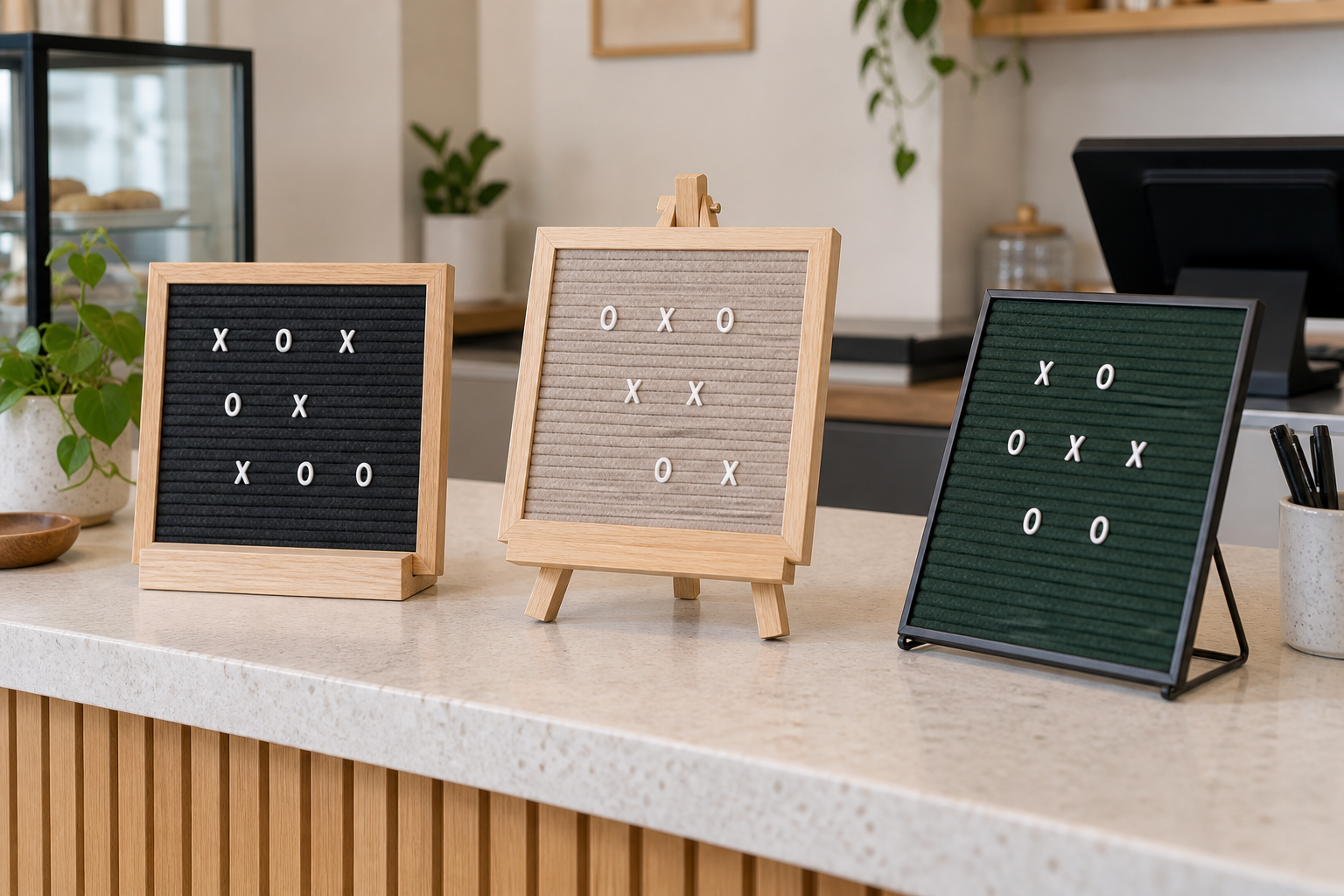
Compare stand formats after measuring the board
Check current product dimensions and instructions for the exact board. A listing that says “letter board stand” does not establish slot width, ledge depth, supported size, or compatibility with a thick frame.
Best stand format by counter job
These are fit-based categories, not named winners or hands-on rankings.
- Wood slot base: best for the smallest visual footprint. A low base keeps the support quiet and can suit a compact board, but the slot must accept the frame without forcing it. Check whether the board sits deep enough to remain upright while leaving the message visible.
- Tabletop easel: best when the angle needs simple adjustment. An easel can accommodate several board sizes and makes the frame easy to lift away for updates. Its rear leg may consume more counter depth than the front view suggests.
- Angled metal support: best for a low-profile contemporary setup. A support with a defined ledge can tilt the board toward a reader. Verify ledge depth, rear clearance, contact points, and the angle with the actual board.
- Fold-flat stand: best for a message that travels. Hinged or folding formats can pack with a market or event kit. Count the loose pieces and test the setup sequence before relying on it at a busy counter.
- Board-specific replacement stand: best when the maker documents the match. A compatible part can remove guesswork, but confirm the model or exact dimensions rather than assuming one brand's stand fits another frame.
Measure thickness, ledge, and rear clearance
Measure the board at its thickest edge, including the frame—not only the felt panel. For a slot base, compare that measurement with the documented slot opening and depth. For an easel or angled stand, measure the usable ledge and note whether a raised lip covers the bottom row.
Then map the rear brace or leg. A stand that appears narrow from the front may reach several inches behind the board, colliding with a wall, register, monitor, cable, brochure holder, or working area. Trace the full footprint on paper and place it on the real counter before ordering.
Set the angle from the reader's position
- Build the actual message with the intended letter size and spacing.
- Place the board at the real counter height with a temporary support.
- View it from the normal approach, waiting point, and transaction position.
- Adjust the tilt until overhead reflections and foreshortening are reduced without pointing the board above or below the reader.
- Confirm that merchandise, payment equipment, and staff movement do not block the message.
A steeper angle does not rescue crowded copy. If the message is hard to scan, shorten it and enlarge the useful words before changing the hardware.
Plan for letter changes and daily service
Some boards can be updated while seated in a stable slot base; others are easier to remove from an easel and lay flat. Decide who changes the message, where spare letters live, and whether the entire board can be lifted without moving checkout equipment. Keep loose letters away from food preparation, customer reach, and counter edges.
During a dry run, complete normal nearby tasks: open a drawer, use the payment terminal, pass a bag, and wipe the counter. If hands, sleeves, cables, or products repeatedly contact the board or rear brace, move the message or choose a shallower setup. Do not improvise a taller stack of loose bases to clear an obstruction.
Who should skip a separate stand?
- Skip it when the board already includes a stable documented base that fits the counter.
- Skip a slot base when the opening is narrower than the frame or the maker does not provide enough dimensional information to verify fit.
- Skip a deep easel when it reduces working space or conflicts with equipment behind the sign.
- Skip tabletop placement when the message must be readable across a room; a larger wall or floor display may fit that sightline better.
- Skip a changeable letter board when the counter needs detailed, frequently revised information; a printed insert or dry-erase format may be faster to maintain.
- Skip assuming an indoor tabletop setup is suitable outdoors or in a public traffic path. Follow venue and product guidance for the actual environment.
Bottom line
Choose a slot base for a compact compatible board, a tabletop easel when adjustable placement and easy removal matter, or an angled support when a defined ledge and low-profile look fit the counter. The deciding checks are exact edge fit, usable ledge, rear clearance, readable angle, update access, and the full footprint during normal service.
Continue with the small-business sign planning pillar to clarify message and sightline, or compare retail counter sign formats if a letter board is only one of several possible routes.