 The Good Sign Company
Adhesive wall hooks
Compare the hook shape, approved surfaces, stated load, application steps, waiting period, and removal-tab access against the sign's actual hanger.
Browse category: Shop adhesive wall hooksComparison
An adhesive hook gives a lightweight sign one visible hanging point and lets it lift off easily. Hook-and-loop strips hold a compatible flat back closer to the wall and can make repeated sign changes easier. The better choice depends on the sign back, complete weight, wall finish, update routine, and the exact product instructions—not on the sign's front dimensions alone.
Disclosure: As an Amazon Associate, we may earn from qualifying purchases and approved partner referrals.
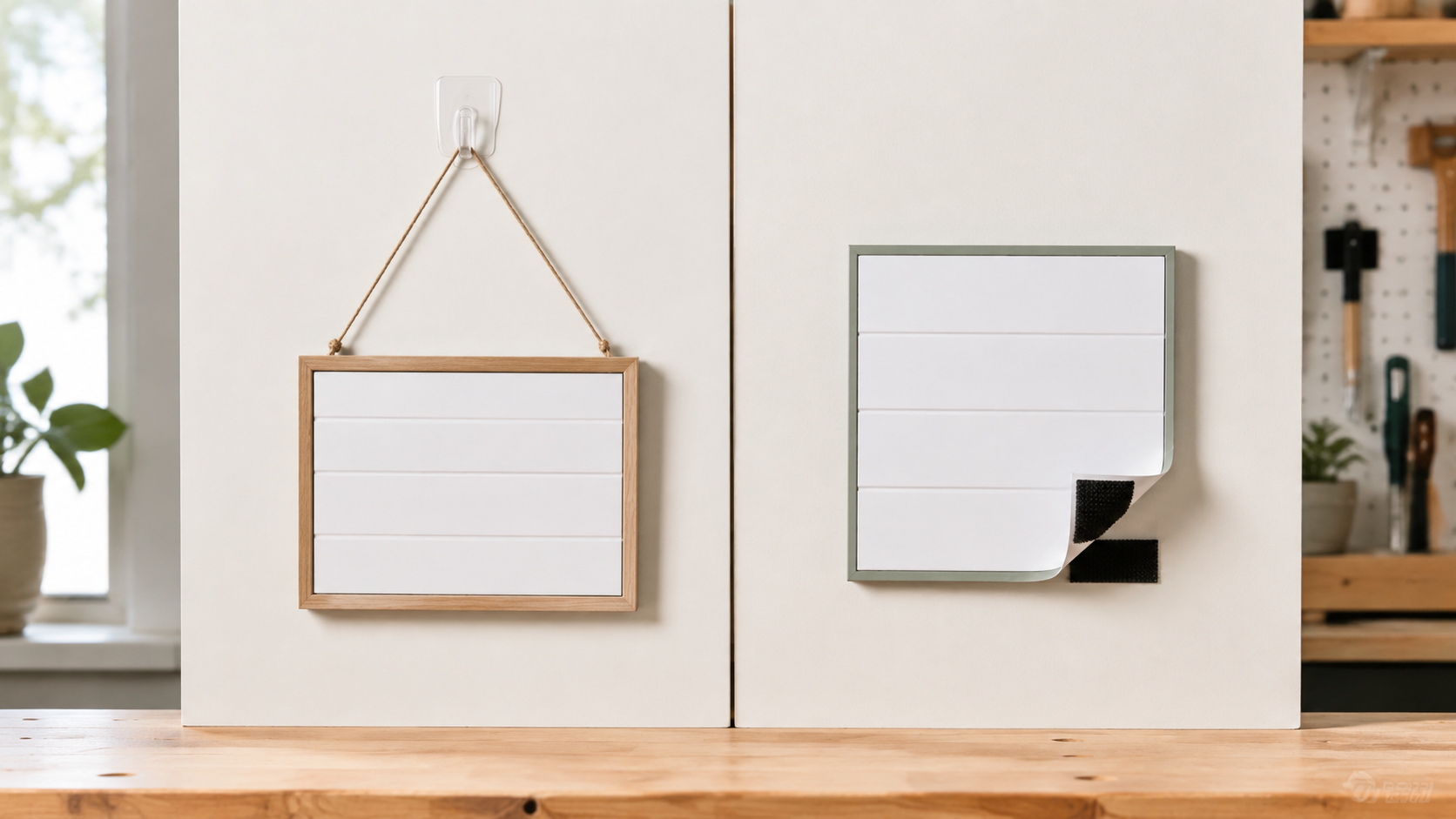
Compare the hook shape, approved surfaces, stated load, application steps, waiting period, and removal-tab access against the sign's actual hanger.
Browse category: Shop adhesive wall hooksCompare paired-strip dimensions, complete-system load guidance, sign-back compatibility, closure layout, wall gap, and removal instructions.
Browse category: Shop hook-and-loop stripsCompare removable strips, screws, frames, stands, standoffs, and cable management before committing to the wall.
Read the sign mounting supplies guideA hook separates the wall attachment from the sign's hanger. That is useful for a small frame, plaque, or changeable board already designed to hang from one point.
Paired strips can distribute contact across a flat-backed lightweight sign and hold it closer to the wall. They are most useful when the sign comes down regularly for lettering, inserts, seasonal changes, or cleaning.
A hook needs a hanger that seats securely on the chosen hook shape. Check whether the wire, cord, sawtooth, keyhole, or loop can engage without forcing the sign away from the wall. A frame's hanger—not merely its total width—determines whether one hook is practical.
Hook-and-loop strips need clean, flat contact zones. Raised frames, deep ribs, fabric, loose paper, dusty fiberboard, soft foam, and tiny contact patches may not match the strip maker's instructions. Plan the strip locations so you can press them as directed and still reach every required removal tab later.
No removable adhesive deserves a blanket “damage-free” promise. Paint condition, prior repairs, surface preparation, time, temperature, and removal technique can change the result. Renters should confirm property rules rather than treating a product label as lease permission.
If the sign changes weekly, ask what the update actually requires. A hook is convenient when the whole sign goes to a work surface and its hanger tolerates repeated lifting. Hook-and-loop strips make sense when removing the sign is part of the intended closure workflow and the sign is stiff enough to separate without bending.
Inspect either method when the sign begins to tilt, an adhesive edge lifts, the closure no longer engages fully, the wall changes, or the room conditions move outside the documented range. Stop using the setup if the product or wall surface shows deterioration; do not add unapproved adhesive as a patch.
Use the hook-and-loop strip guide when paired strips already fit the sign and you need to compare formats. If you are still choosing between adhesive and mechanical hardware, read adhesive vs screw mounting. For other wall-free and low-commitment options, return to the sign mounting supplies pillar.